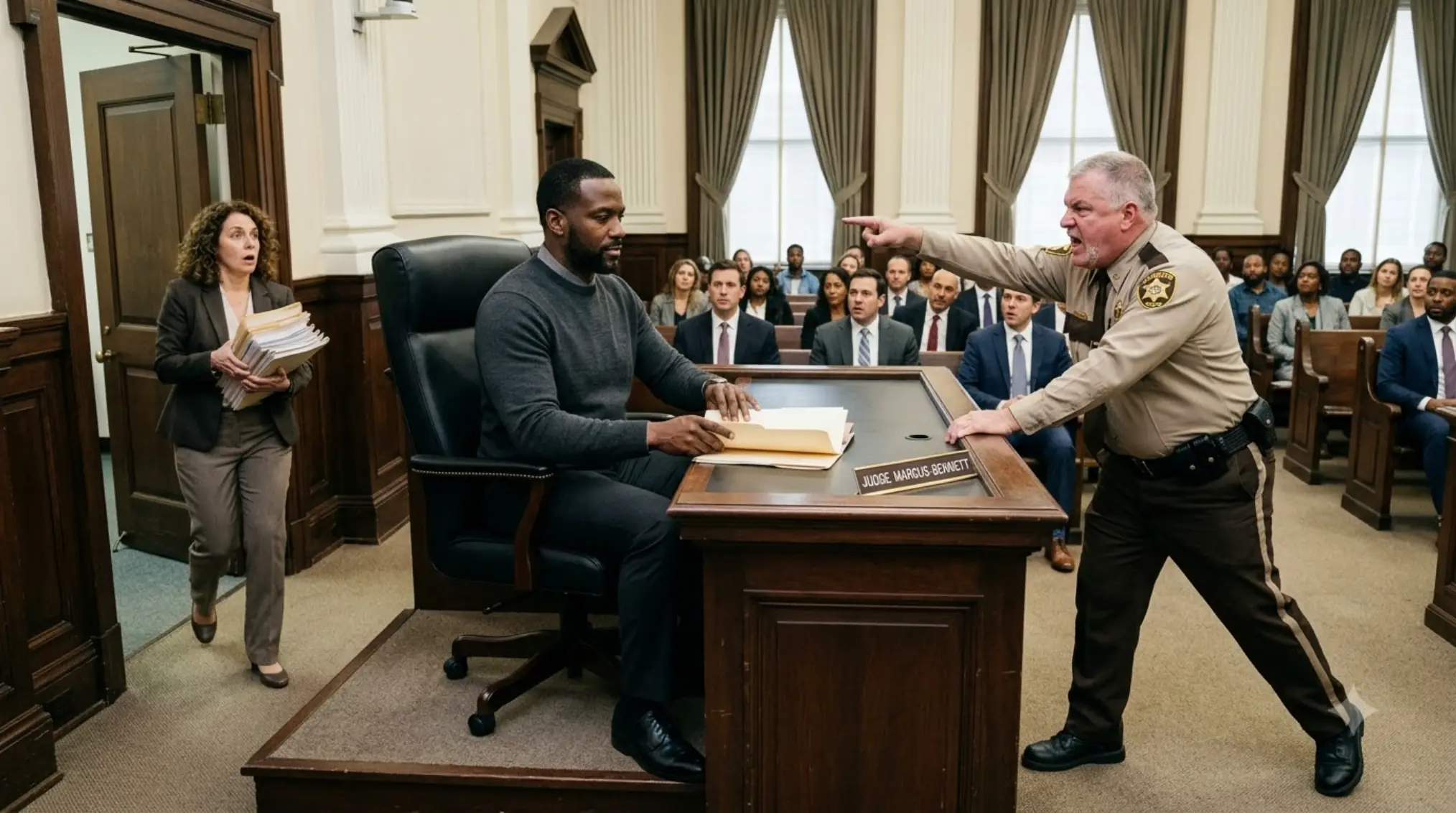
At 7:41 on a Monday morning, Marcus Bennett unlocked the private door behind Courtroom Four and entered the room where he was scheduled to begin the most important day of his professional life.
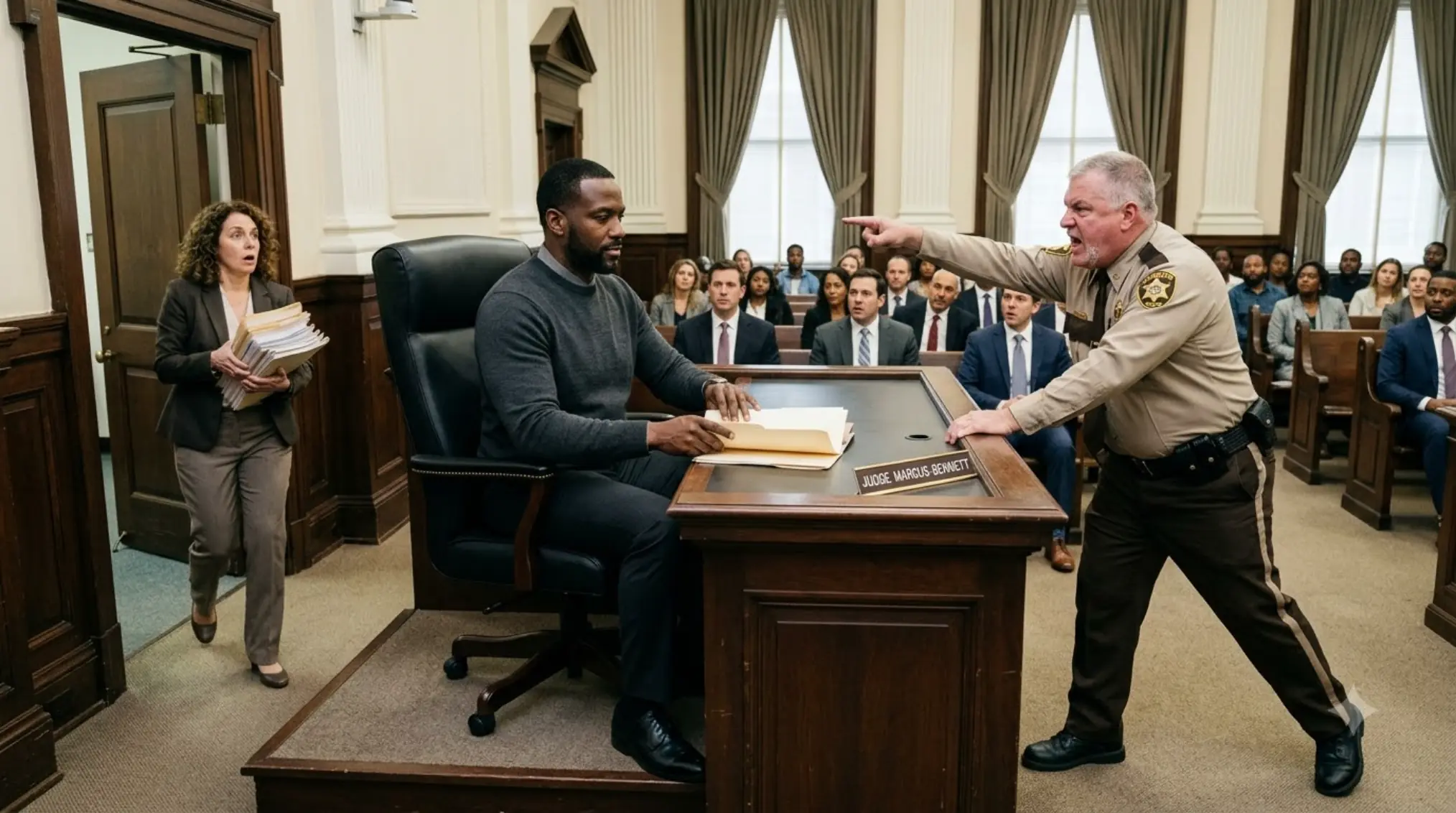
There was nobody inside yet except a cleaning employee pushing a cart through the gallery and a deputy checking the emergency exit near the jury box.
Marcus paused for a moment behind the judge’s bench.
For seventeen years, he had entered courtrooms through the doors reserved for attorneys.
For eleven of those years, he had stood at counsel tables arguing cases before other people.
For the last four, he had worked as a senior civil-litigation attorney for the Commonwealth, often handling complicated disputes involving property, contracts, administrative agencies, and public institutions.
Now the nameplate resting at the center of the bench read:
HON. MARCUS E. BENNETT
He touched it once.
Not dramatically.
Just enough to make the moment real.
Marcus was forty-five years old, broad-shouldered, with deep-brown skin, close-cropped black hair, and a neatly trimmed beard already showing the first traces of gray near his chin.
He was not wearing a robe.
That was deliberate.
His judicial robe hung inside chambers, freshly pressed and still carrying the faint smell of new fabric.
Marcus had arrived early wearing a charcoal crewneck sweater over a white undershirt, dark tailored trousers, and polished black shoes because he wanted one quiet hour before changing.
The courthouse would become crowded soon.
Attorneys would arrive.
Defendants.
Families.
Witnesses.
Clerks.
Court reporters.
Deputies.
And by nine o’clock, everyone would be looking toward him for decisions.
Marcus wanted sixty minutes in which nobody needed anything.
He sat.
The leather chair gave a low creak.
He opened the first file on the morning docket.
Twenty-seven cases.
Seven arraignments.
Three probation matters.
Five civil motions.
Two emergency protective-order hearings.
A landlord-tenant appeal.
A licensing dispute.
Several scheduling conferences.
Nothing glamorous.
Exactly what he wanted.
Marcus had never wanted to become the kind of judge people talked about because of theatrical speeches.
He believed courts worked best when procedure was so clear that drama became unnecessary.
He wrote three words in the margin of the first file.
Ask before assuming.
It was a phrase his late father used whenever Marcus became too certain about anything as a boy.
Then the public courtroom door opened.
Marcus looked up.
A courthouse bailiff entered.
Raymond Keller had worked building security for almost twenty-six years.
At fifty-six, he was a heavyset white man with short gray hair, thick forearms, and the stiff posture of someone who had spent decades expecting people to obey directions quickly.
He wore a tan sheriff-style uniform shirt, dark-brown trousers, black duty shoes, a radio microphone near his shoulder, and a heavy utility belt.
Keller entered carrying a ring of keys.
He glanced toward the witness stand.
Then the jury box.
Then the bench.
He stopped.
Marcus returned his attention to the file.
Keller stared for several seconds.
“Hey.”
Marcus looked up.
“Good morning.”
Keller frowned.
“What are you doing?”
Marcus glanced around the courtroom as though the answer might be somewhere obvious.
“Reading.”
Keller did not appreciate the response.
“Get out from behind the bench.”
Marcus studied him.
“Excuse me?”
“You heard me.”
The cleaning employee near the gallery stopped moving.
Marcus closed the file.
Keller approached.
“That area is restricted.”
Marcus nodded.
“I’m aware.”
“Then get your ass out of that chair.”
The room changed.
Marcus felt it immediately.
Not fear.
Something more familiar.
The mental shift required when another person had already decided who you were before asking.
He looked at Keller’s name badge.
Then at the courthouse insignia on his sleeve.
Marcus kept his voice even.
“You might want to ask who I am before you continue.”
Keller gave a short laugh.
“I don’t need your biography.”
Marcus said nothing.
Keller pointed toward the side aisle.
“Move.”
The cleaning employee quietly pushed her cart farther away.
Marcus noticed.
She did not leave.
That mattered later.
Keller stepped closer.
“You wandered into the wrong part of the building. I’m giving you one chance to walk out without making this difficult.”
Marcus placed both hands on the closed file.
“Officer Keller.”
The bailiff’s expression changed slightly when Marcus used his name.
Marcus continued.
“Put your hand on me and make sure you remember every word you said before doing it.”
Keller’s face hardened.
“Is that a threat?”
“No.”
Marcus leaned back slightly.
“It’s advice.”
Keller pointed toward the courtroom doors.
“You have five seconds before I put you in cuffs for trespassing.”
Marcus looked at the large courthouse clock.
7:46.
“Five seconds?”
“Four.”
Marcus almost smiled.
Not because the situation was funny.
Because Keller had become so certain that Marcus understood any explanation offered now would sound like resistance to him.
“Three.”
Marcus remained seated.
“Two.”
The side door opened.
A woman entered carrying two thick file boxes and a stack of folders almost high enough to block her face.
Elaine Porter, the senior court clerk, had worked for the county judiciary for nineteen years.
She was fifty-one, blonde, precise, impatient with disorder, and capable of identifying every judge in the circuit by the sound of their footsteps outside her office.
She looked toward the bench.
Then Keller.
Then Marcus.
Her expression went blank.
“Ray?”
Keller turned.
“Elaine, give me a minute. I found somebody behind the bench.”
Elaine stared at him.
Marcus watched recognition become disbelief.
Keller continued.
“He won’t move.”
Elaine slowly lowered the morning docket onto counsel table.
“Ray.”
“What?”
“Back away from the bench.”
Keller frowned.
“I’ve got this.”
“No.”
Elaine’s voice sharpened.
“Back away from the bench right now.”
Keller looked irritated.
“Why?”
Elaine pointed toward Marcus.
“Because that is Judge Bennett.”
Silence.
The cleaning employee stopped completely.
Keller looked at Marcus.
Then at Elaine.
Then back again.
“What?”
Elaine stepped closer.
“Judge Marcus Bennett.”
Keller’s hand slowly lowered.
“The appointment ceremony was Friday.”
Marcus said nothing.
Elaine continued.
“He takes the bench this morning.”
Keller’s face changed.
Not all at once.
Confusion first.
Then calculation.
Then disbelief.
Finally fear.
“You’re the new judge?”
Marcus opened the folder again.
“Yes.”
Keller stared.
Nobody spoke for several seconds.
Then Keller said, “Why aren’t you wearing a robe?”
Marcus looked up.
Elaine closed her eyes.
The question seemed to make the situation worse than silence could have.
Marcus answered calmly.
“Because court doesn’t begin for another hour.”
Keller’s mouth opened.
Closed.
Marcus added:
“And because people sitting in this chair are not required to prove their identity by clothing before being spoken to professionally.”
Keller swallowed.
“I didn’t know.”
“That is clear.”
“I thought—”
Marcus raised one hand.
“Stop.”
Keller stopped.
Marcus looked toward Elaine.
“What time does the security supervisor arrive?”
“Captain Reeves should already be downstairs.”
“Ask him to come here.”
Keller’s face tightened.
“Judge, I can explain.”
Marcus looked directly at him.
“You will.”
Keller seemed relieved.
Marcus continued.
“Just not before someone records exactly what happened.”
The relief disappeared.
Elaine picked up the phone beside the clerk’s desk.
Keller shifted his weight.
“You’re going to file a complaint?”
Marcus returned to the first docket file.
“I’m going to follow procedure.”
The statement unsettled Keller more than anger would have.
At 7:53, Captain Thomas Reeves entered Courtroom Four.
Reeves supervised courthouse security.