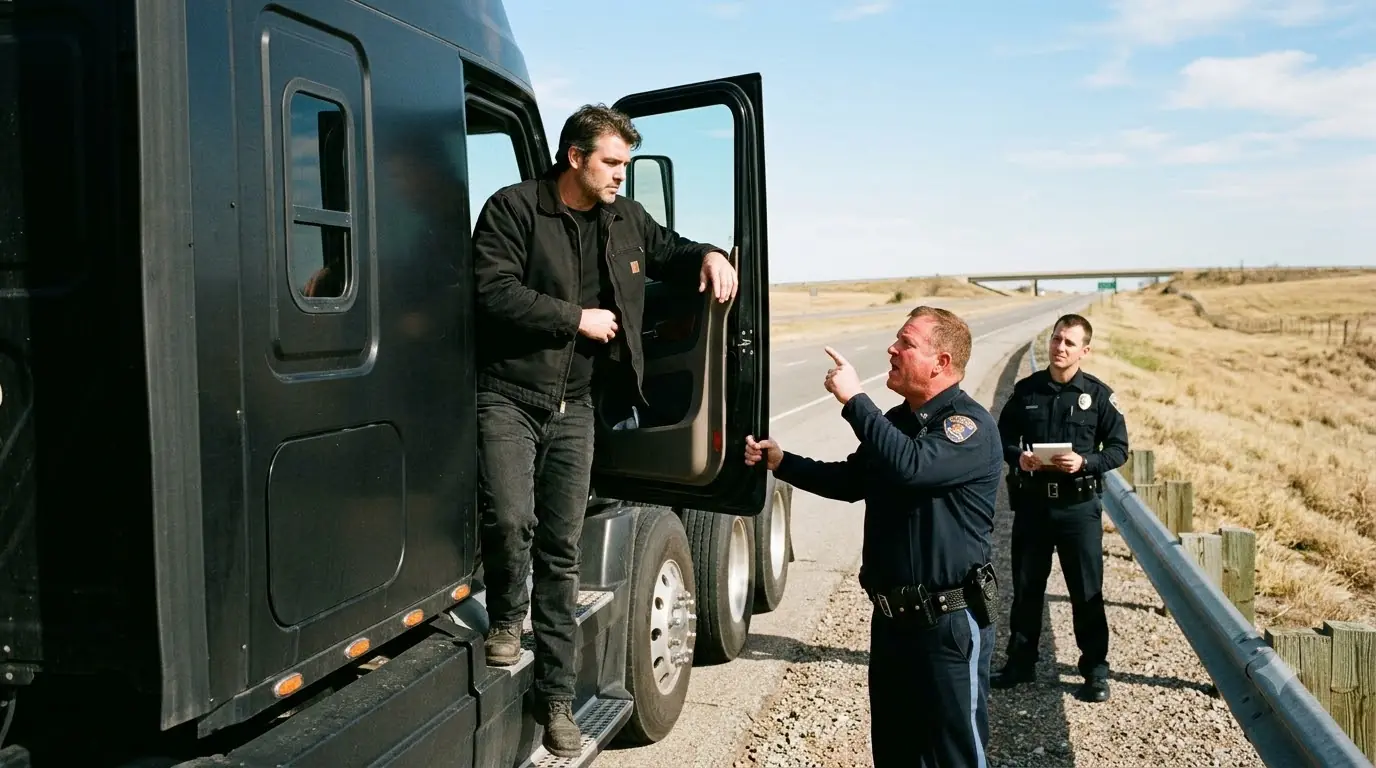
Daniel Cross saw the first patrol cruiser twenty-three miles before Exit 117.
It sat beneath a concrete overpass with its lights off, angled toward westbound Interstate 40 as though the officer inside were watching traffic without wanting traffic to notice him. Daniel drove past at sixty-three miles an hour, both hands relaxed on the enormous steering wheel of his matte-black semi, and did not turn his head.
The temptation was enormous.
Every instinct told him to look.
Training told him not to.
Instead Daniel checked the mirror in the casual manner of a driver monitoring eighteen wheels and nearly seventy thousand pounds of vehicle.
Nothing.
The cruiser remained under the overpass.
For another three miles.
Then red and blue lights appeared behind him.
Daniel exhaled once.
“Contact.”
The word was almost silent.
A tiny microphone hidden beneath the collar of his black work jacket transmitted it through encrypted equipment mounted behind the sleeper cabin.
A woman’s voice came through an almost invisible earpiece.
“Copy. Stay normal.”
Daniel smiled faintly.
That part had become increasingly difficult over the previous six weeks.
Normal meant pretending he was exactly what the officers believed him to be.
Forty-two years old.
Independent owner-operator.
Long-haul trucker.
Running refrigerated medical equipment from Arizona toward Tennessee.
Tired.
Alone.
Financially vulnerable.
Someone who could lose everything if an officer decided to impound his truck for several days.
The identity was almost entirely real.
Daniel actually knew how to drive the rig.
Federal investigators had learned years earlier that undercover work failed quickly when basic competence looked performed. Daniel therefore spent four months earning the proper commercial endorsements and another six weeks driving with professional instructors before the operation began.
What was false was his history.
The truck belonged to the federal government through three shell companies.
The freight was inexpensive medical packaging surrounded by equipment cases filled mostly with tracking electronics.
The insurance company did not exist outside carefully constructed databases.
And Daniel Cross was not an owner-operator desperate to make the next payment.
He was Special Agent Daniel Cross, assigned to a federal public-corruption task force.
The patrol cruiser stayed behind him.
Daniel activated the turn signal.
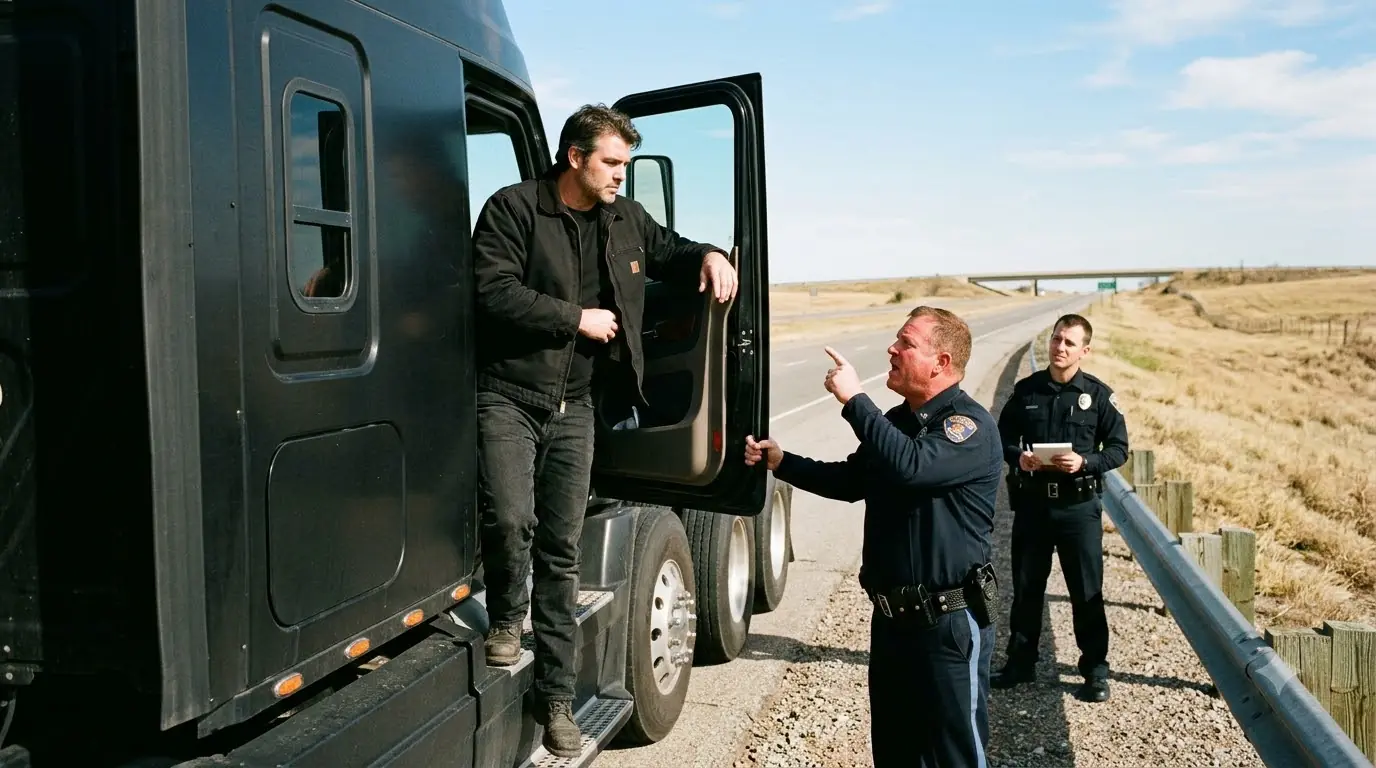
He eased sixty-seven feet of truck and trailer toward the highway shoulder.
Gravel crunched beneath the tires.
He stopped beside a steel guardrail under a vicious Oklahoma afternoon sun.
Nothing around him except dry scrubland, long highway, distant power lines, and heat shimmering above asphalt.
Perfect location.
Too perfect.
The cruiser parked behind him.
A second vehicle appeared roughly half a mile back but did not activate lights.
Daniel recognized the silhouette.
Another patrol unit.
Exactly as previous victims described.
He set the parking brake.
Lowered his window.
Placed both hands where they could be seen.
Then waited.
The first officer walked toward the cab slowly.
Sergeant Wade Harlan.
Daniel already knew the name.
Forty-eight years old.
Seventeen years in highway enforcement.
Seven commendations.
Two disciplinary complaints officially recorded.
Twenty-nine unofficial allegations discovered only after investigators began interviewing truckers.
Broad body.
Short reddish-brown hair.
Weathered face.
The permanent confidence of a man accustomed to being obeyed on roads where witnesses moved seventy miles an hour in both directions.
Wade stopped beneath the driver’s window.
“License. Logbook. Shipping papers.”
No greeting.
Daniel looked down.
“Afternoon, Officer.”
“Papers.”
Daniel handed them through.
Wade barely inspected the license.
His attention moved toward the interior of the truck.
Screens.
Dash controls.
Cabinet doors.
Sleeper compartment.
Nothing visibly unusual.
Daniel had spent hours ensuring that.
Wade looked toward him.
“You know why I stopped you?”
“No, sir.”
“Commercial compliance alert.”
Daniel frowned exactly as rehearsed.
“What alert?”
“Customs flag.”
“That doesn’t make sense.”
Wade’s eyes narrowed.
“You telling me how to do my job?”
“No.”
Daniel shook his head.
“I’m saying this load originated in Phoenix.”
“So?”
“So it never crossed an international border.”
Wade stared.
“Step down.”
Daniel remained still.
“Can I ask what the violation is?”
“You can ask from the pavement.”
The second cruiser pulled onto the shoulder.
Officer Eric Nolan stepped out.
Daniel recognized him too.
Thirty-four.
Six years in uniform.
No formal misconduct complaints.
But his name appeared beside Wade Harlan’s on sixteen questionable commercial stops during the previous eighteen months.
Investigators had not decided whether Nolan was participant, witness, or something in between.
That uncertainty made him dangerous.
Daniel climbed down.
Wade waited beside the truck.
The scale difference between them became obvious on the ground.
Daniel was lean, athletic, almost six feet two.
Wade was shorter but thickly built and used physical proximity as part of his authority.
He stood too close immediately.
“What’s in the trailer?”
“Medical packaging equipment.”
“Worth?”
“Maybe sixty thousand.”
“Maybe?”
“I don’t own the cargo.”
Wade looked toward Nolan.
“See that?”
Nolan had approached holding a citation pad.
“See what?”
“He doesn’t know what he’s hauling.”
Daniel kept his expression controlled.
“I know exactly what I’m hauling.”
Wade turned.
“Then why don’t you know the value?”
“Because value and contents are different questions.”
Nolan lowered his eyes.
Wade did not appreciate the correction.
“Open the trailer.”
Daniel hesitated deliberately.
“Do you have an inspection reason?”
Wade laughed.
“You commercial guys watch too many videos.”
Daniel said nothing.
Wade stepped closer.
“You think this is traffic court?”
“No.”
“Then open the damn trailer.”
Daniel looked toward Nolan.
The younger officer shifted.
Daniel noticed.
So did the surveillance team listening through the wire.
Agent Mara Ellis, parked in an unmarked van nearly two miles east, whispered into Daniel’s earpiece.
“Nolan uncomfortable.”
Daniel did not respond.
Wade slapped the side of the truck.
“Move.”
Daniel walked toward the trailer.
Every exterior camera recorded.
One lens disguised as a bolt head near the cab step.
Another beneath the trailer light assembly.
A third inside Daniel’s jacket.
He unlocked the rear.
Wade looked inside.
Rows of sealed freight pallets.
Perfect paperwork.
Nothing remotely suspicious.
He climbed halfway inside anyway.
Nolan remained outside.
Daniel watched Wade inspect three containers without actually opening them.
The sergeant seemed less interested in freight than in performance.
Five minutes passed.
Then Wade climbed down.
“We’ve got a problem.”
Daniel frowned.
“What problem?”
“Your seal record doesn’t match.”
It did.
Investigators had checked it eighteen times.
Daniel looked toward the paperwork.
“It matches.”
“No.”
Wade tapped a line without showing what he meant.
“This customs reference.”
“That is the manufacturer code.”
“Don’t argue.”
Daniel let irritation show.
Just enough.
“Sergeant, I’ve got a delivery window.”
Wade laughed.
“There it is.”
“What?”
“Now you’re in a hurry.”
“I’m a truck driver.”
Nolan looked away.
Wade stepped closer.
“Truck can sit here.”
Daniel stared.
“Or we impound it.”
“For what?”
“Suspected customs irregularity.”
Daniel looked toward Nolan.
“Does that sound legitimate to you?”
Nolan’s eyes flicked toward Wade.
Bad question.
Wade moved immediately.
“Don’t talk to him.”
Daniel returned his attention.
“Fine.”
Wade walked him toward the cab.
“Here’s how this works.”
The sentence appeared in three earlier victim statements almost word for word.
Daniel’s pulse increased.
Finally.
Six weeks of controlled stops.
Dead ends.
Officers who followed procedure because Daniel happened to encounter the wrong shift.
Truckers who changed stories after agreeing to cooperate.
A towing-company accountant who disappeared two days before a scheduled interview.
Now the phrase.
Here’s how this works.
Daniel leaned against the truck.
“I’m listening.”
Wade lowered his voice.
“Official inspection means tow.”
“Minimum twenty-four-hour hold.”
“Probably seventy-two.”
Daniel frowned.
“You just said customs.”
“Customs plus mechanical inspection.”
“You haven’t inspected anything mechanical.”
Wade shrugged.
“I’m about to.”
Daniel understood the threat.
A commercial truck could be put out of service for dozens of reasons if an officer decided to look long enough.
Brake adjustment.
Lighting.
Tires.
Log compliance.
Minor technical issues.
Some legitimate.
Others highly subjective.
For an independent driver, seventy-two hours could destroy a week.
Missed delivery penalties.
Towing fees.
Storage.
Replacement load.
Lost contract.
Wade knew exactly where the pressure lived.