The envelope contained exactly three thousand dollars.
Simone Bennett knew because she had counted it twice before leaving the teller window and once more while seated beneath the brass clock in the lobby of First Community Bank. Thirty crisp hundred-dollar bills, separated into three bundles of ten, inside a plain tan security envelope stamped with the bank’s date and transaction number.
It was not her money.
That detail mattered to Simone more than anything else.
The money belonged to her grandfather, Elijah Bennett, who had spent forty-two years repairing industrial pumps at a manufacturing plant outside Bellhaven, Virginia. Every month, his pension deposit arrived on the third business day. Every month, he complained that retirement checks were proof that companies had finally discovered a way to pay people for staying home after spending their whole lives telling them to work harder.
Simone had grown up hearing that joke.
Now Elijah was eighty-one, recovering from hip surgery, and temporarily unable to drive.
The three thousand dollars was for a roofing crew repairing storm damage on the small house he had owned since 1973.
He hated electronic transfers.
He hated payment apps.
He hated checks even more.
“Cash doesn’t forget its password,” he always said.
So Simone withdrew the money for him.
At 4:17 p.m., she walked through the glass doors of First Community Bank and stepped onto the sidewalk.
At 4:19, Officer Brent Cole grabbed her arm.
By 4:23, the money was no longer in her handbag.
And by 4:28, Brent Cole and Tyler Shaw were about to learn that they had chosen the worst possible afternoon to believe nobody would question them.
Simone did not look frightened when the officers approached.
That irritated Brent almost immediately.
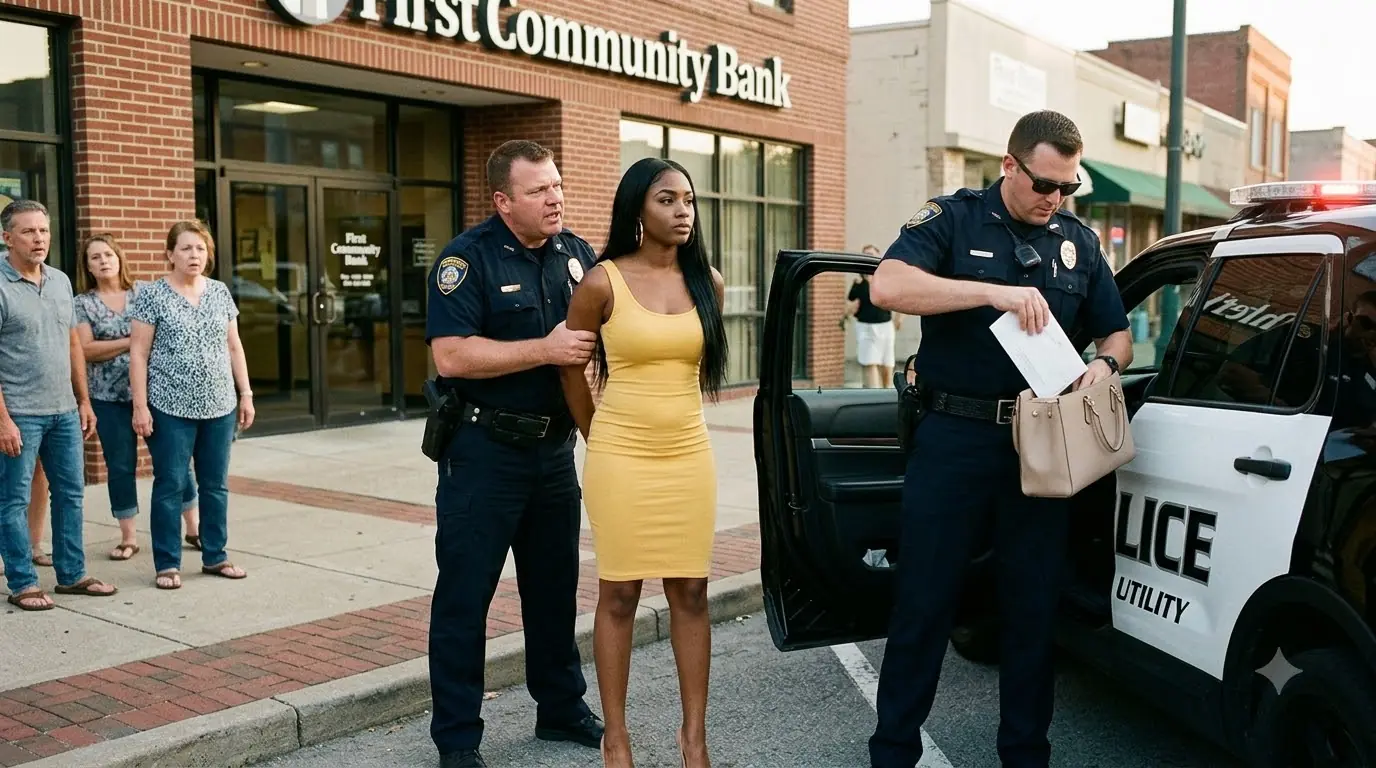
She was twenty-seven, tall enough to meet his stare without tilting her head very far, with deep-brown skin, long straight black hair, and the composed expression of someone who had already spent years sitting across tables from people who thought speaking louder could change facts.
That afternoon she wore a fitted sleeveless yellow dress, nude heels, a gold watch that had belonged to her mother, and a beige leather handbag hanging from one shoulder.
She had dressed for dinner.
Her grandfather’s roof was merely the errand before it.
Brent stepped from the curb beside a black-and-white cruiser.
“Ma’am.”
Simone stopped.
“Yes?”
“Come over here.”
She looked at him.
Then toward the second officer leaning against the patrol car.
Tyler Shaw.
Dark sunglasses.
Short brown hair.
Broad shoulders.
Expression already amused.
Simone did not move.
“What is this about?”
Brent’s eyebrows rose.
“I said come over here.”
“You did.”
“And I asked what this is about.”
Tyler laughed.
Brent walked closer.
“We got a report of suspicious activity involving a cash withdrawal.”
Simone’s expression changed slightly.
Not fear.
Interest.
“What activity?”
“You just came out of the bank carrying a large amount of cash.”
“That isn’t suspicious activity.”
Brent looked toward her handbag.
“How much?”
Simone paused.
“Why?”
“Because I asked.”
“No.”
His jaw tightened.
Tyler pushed away from the cruiser.
“Lady, you want to make this difficult?”
Simone turned toward him.
“I haven’t decided yet.”
Tyler’s smile disappeared.
Most people would later remember the yellow dress.
The images spread online afterward, and color had a way of simplifying memory. A woman in bright yellow between two officers in dark uniforms. The visual made the confrontation look almost staged.
It was not.
The bank surveillance cameras captured Simone leaving normally.
No one running after her.
No teller signaling security.
No alarm.
No complaint from another customer.
Yet Brent and Tyler appeared outside less than ninety seconds after she crossed the lobby.
That timing would become important.
At the time, Simone merely found it strange.
Brent held out his hand.
“Bag.”
She stared.
“No.”
“You want me to take it?”
“You want to tell me what crime you believe occurred?”
Tyler stepped closer.
“You lawyers always answer questions with questions?”
Simone looked at him.
He had guessed correctly for the wrong reason.
“Sometimes.”
Brent said:
“Give me the bag.”
“No.”
His voice sharpened.
“We have reason to believe money may have been obtained fraudulently.”
“Whose money?”
“You tell me.”
Simone almost smiled.
“That isn’t how evidence works.”
Brent reached for the handbag.
She stepped backward.
He grabbed her upper arm.
Several pedestrians stopped.
One man near the bank entrance pulled out a phone.
Simone looked at Brent’s hand around her arm.
“Remove your hand.”
“Stop resisting.”
“I am standing still.”
“You stepped away.”
“Because you grabbed my property.”
Tyler moved behind her.
“Bag.”
Simone kept her voice controlled.
“My identification is inside.”
“So is the money?”
She said nothing.
Tyler smiled.
“Thought so.”
He took the handbag from her shoulder.
The envelope was easy to find.
Tyler pulled it out.
He opened it without asking.
Thirty hundred-dollar bills appeared beneath the late-afternoon light.
His eyebrows rose.
“Well, look at that.”
Brent stared at Simone.
“Three grand?”
“Yes.”
“Where’d you get it?”
Simone looked toward the bank doors.
“Approximately thirty feet behind you.”
Tyler laughed.
Brent did not.
“Whose money?”
“My grandfather’s.”
“Name?”
“Elijah Bennett.”
“Why are you carrying his money?”
“Because he asked me to.”
“What does he do?”
“He is retired.”
Brent’s expression changed.
“Pension?”
“Yes.”
Tyler looked at him.
The glance lasted barely a second.
Simone saw it.
That interested her more than anything they had said.
Brent asked:
“You have permission to access his account?”
“Yes.”
“Proof?”
“In the bag you took.”
Tyler began searching.
Simone’s jaw tightened.
“Stop going through my things.”
He removed her wallet.
Cosmetics.
Keys.
A folded bank receipt.
Then a leather document sleeve.
Tyler opened it.
Inside was a notarized financial authorization allowing Simone to assist Elijah during his recovery.
He read enough to understand.
Then folded it shut.
Brent asked:
“What is it?”
Tyler hesitated.
“Nothing.”
Simone’s eyes narrowed.
“No.”
“Read it to him.”
Tyler placed it back inside.
Brent said:
“Quiet.”
Simone’s voice became colder.
“That document answers your question.”
“I said quiet.”
“You asked whether I had authorization.”
“You now have evidence that I do.”
Brent leaned closer.
“And now you’re interfering with an investigation.”
Simone stared.
“What investigation?”
“The one you’re making worse.”
The man filming near the entrance was named Daniel Ortiz.
He had entered the bank twenty minutes earlier to deposit checks from his landscaping business. Daniel was forty-six, married, father of three, and generally believed that involving himself in strangers’ arguments created unnecessary problems.
Still, he kept recording.
Something looked wrong.
Not because Simone was calm.
Because the officers appeared disappointed each time she answered correctly.
A woman leaving the bank stopped beside Daniel.
“What happened?”
“I don’t know.”
“Did she rob somebody?”
“No idea.”
They watched Tyler count the money.
One bundle.
Second.
Third.
Then Tyler placed the envelope beside his duty belt.
Not into an evidence bag.
Not back into Simone’s handbag.
Daniel zoomed slightly.
He did not know police evidence procedures.
He knew enough to notice that.
Simone noticed too.
“Where is my money going?”
Tyler looked toward her.
“Evidence.”
“Then issue a receipt.”
He paused.
“A what?”
“A property receipt.”
Brent stepped between them.
“We’ll handle the paperwork.”
“When?”
“At the station.”
“Am I under arrest?”
“Not yet.”
“Then return the money.”
Brent laughed.
“You really think you’re controlling this?”
Simone looked directly at him.
“No.”
“I think the law is.”
Tyler shook his head.
“Here we go.”
Brent pointed toward her.
“You keep talking like that, I’ll add obstruction.”
“To what?”
“Possible financial exploitation.”
Simone became completely still.
There it was.
“What financial exploitation?”
“Elderly pensioner.”
“Younger relative.”
“Large cash withdrawal.”
Simone’s eyes sharpened.
“You knew it was pension money before I told you.”
Brent’s expression flickered.
Barely.
Tyler looked toward him.
Simone saw both.
She repeated:
“How did you know?”
Brent recovered.
“Educated guess.”
“No.”
“You said ‘pension’ before verifying my grandfather.”
“Lots of retirees use this bank.”
“That is not an answer.”
Tyler moved closer.
“You are done asking questions.”
Simone looked at him.
Then toward the envelope of cash.
Something inside her shifted from personal anger to professional attention.
Because three months earlier, she had read a complaint containing almost the same sequence.
Simone Bennett worked for the Virginia Attorney General’s Financial Integrity Division.
Not undercover.
Not secretly famous.