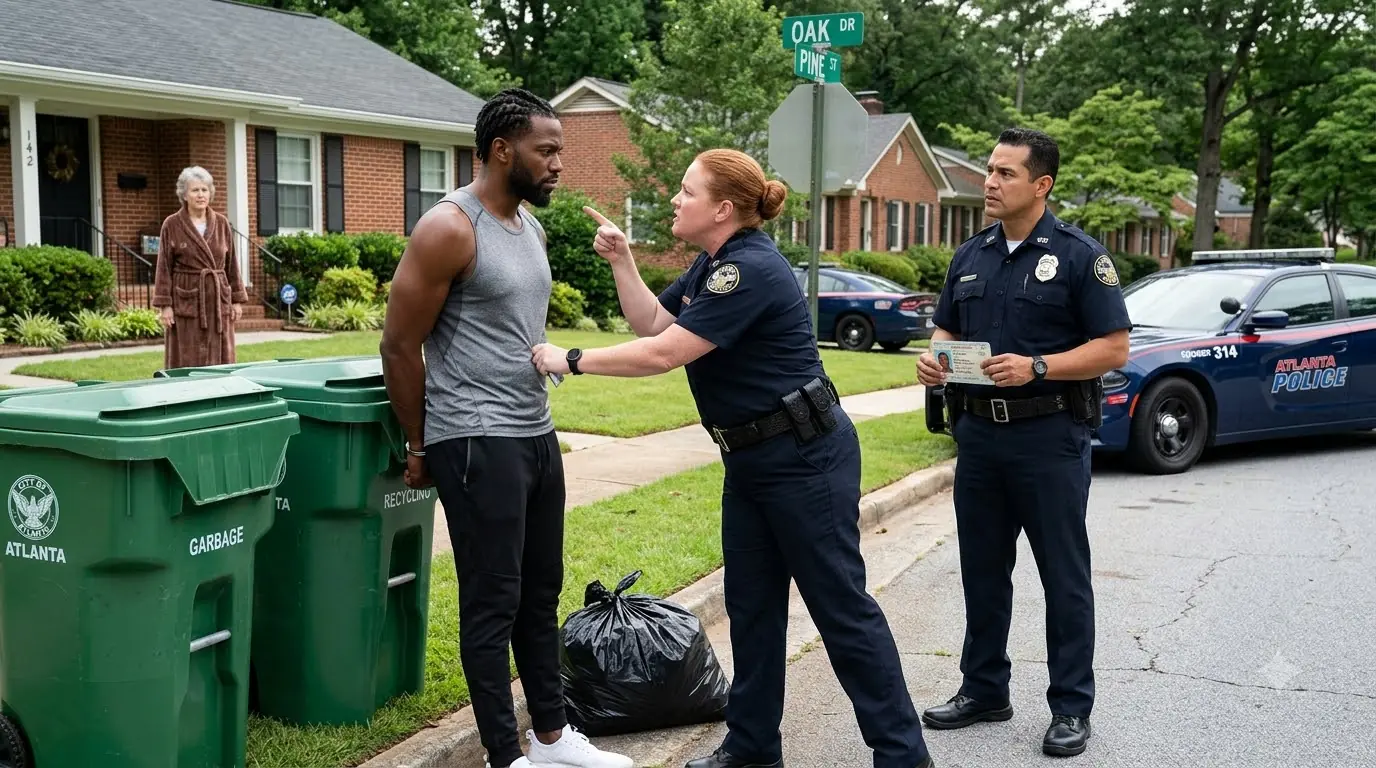
Marcus Cole had taken out the trash hundreds of times without remembering a single one of them.
That was what ordinary life was supposed to be.
You tied the bag.
Walked outside.
Lifted the lid.
Dropped it in.
Went back inside.
Five minutes later, the entire task disappeared from memory.
Saturday morning should have been exactly that.
Instead, Marcus would remember every second.
The temperature outside Atlanta had already climbed past seventy degrees even though it was barely eight in the morning. The sky was bright and clear after three days of rain, and the neighborhood lawns still glittered with leftover moisture.
Marcus had finished a workout in his garage twenty minutes earlier.
At thirty-eight, he remained in the kind of shape that made strangers assume he spent more time exercising than he actually did.
Short twists.
Trimmed beard.
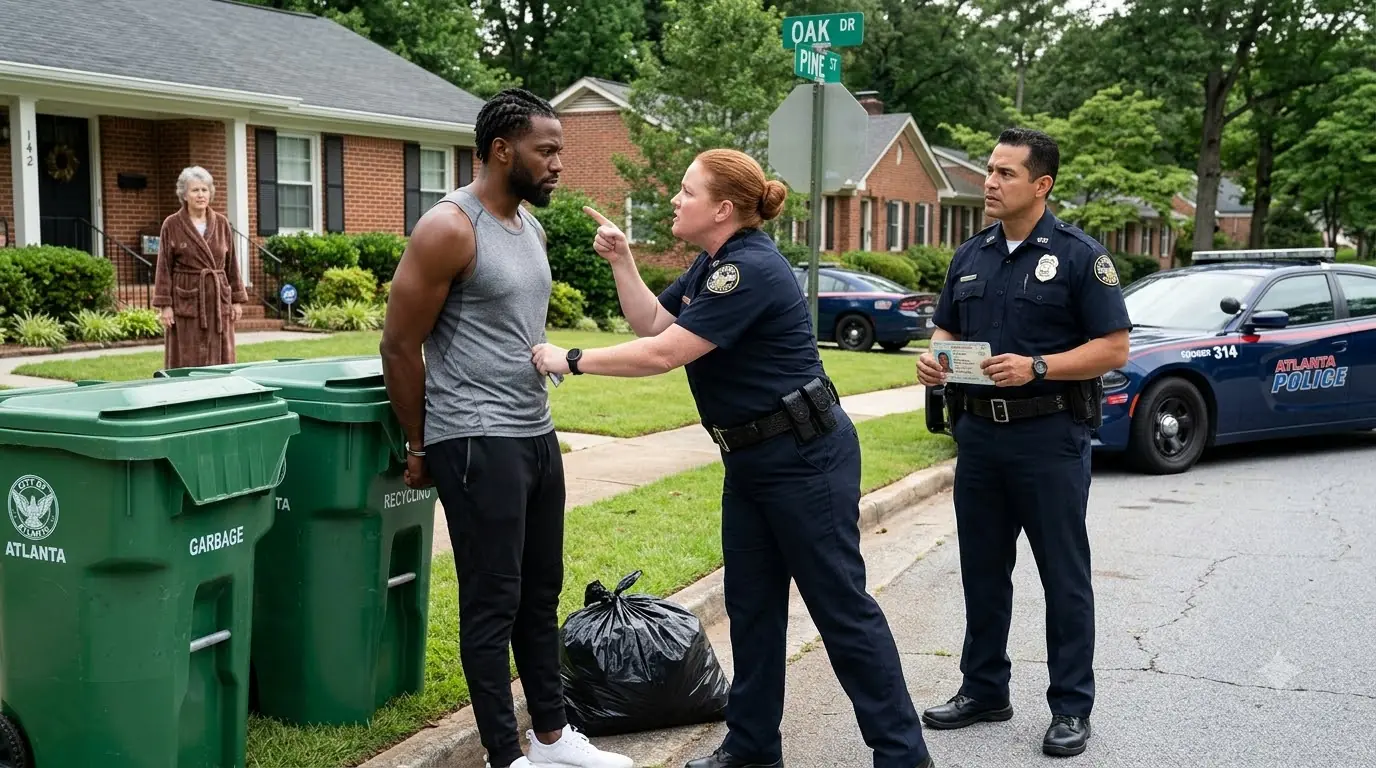
Gray sleeveless athletic shirt.
Black joggers.
White sneakers.
Black smartwatch.
Nothing unusual.
Nothing threatening.
Nothing that should have mattered.
His wife Leah was working the early shift at Emory University Hospital.
Their nine-year-old daughter Ava had spent Friday night with Leah’s sister.
For the first time in weeks, Marcus had the house entirely to himself.
He planned to take out the trash.
Shower.
Make eggs.
Then spend the rest of the morning fixing a loose cabinet hinge before the college football game started.
That was the entire plan.
Marcus pulled the black trash bag from the kitchen can.
Tied it.
Carried it through the garage.
The front of his house opened onto Sycamore Glen, a quiet subdivision twenty miles northeast of downtown Atlanta.
Two-story homes.
Neat lawns.
Small trees planted at equal intervals.
Sidewalks nobody used enough.
Green municipal trash bins stood beside the curb because Saturday was collection day.
Marcus stepped onto the driveway.
His phone remained inside.
Wallet in his left jogger pocket.
Garage door open behind him.
Front door unlocked.
He walked toward the curb.
Across the street, Eleanor Price watched from behind her living-room curtains.
Marcus did not know that.
Mrs. Price was seventy-three and had moved into Sycamore Glen only eleven days earlier.
She had purchased the house previously owned by the Halverson family after deciding that her old property in Marietta was too large to maintain alone.
She had met four neighbors.
Marcus was not one of them.
They had waved once.
That was it.
Mrs. Price had spent the previous evening reading posts inside the neighborhood Facebook group.
Package theft.
Car break-ins six streets away.
Someone complaining that a landscaper had knocked on the wrong door.
Another resident reminding everyone:
IF YOU SEE SOMETHING, SAY SOMETHING.
Mrs. Price believed in caution.
Caution had helped her live seventy-three years.
Her late husband used to say she could turn a shadow into a weather warning.
Usually the joke made her laugh.
That morning, she saw Marcus exit the open garage carrying a large black bag.
She watched him stop beside the green bins.
Then glanced toward the house.
She did not recognize him.
Her mind filled the missing information before she had a chance to question it.
A man she did not know.
Coming from a house.
Carrying a bag.
She picked up her phone.
Dialed 911.
The dispatcher answered.
“911. What is your emergency?”
Mrs. Price lowered her voice.
“I don’t know if it’s an emergency.”
“What’s happening?”
“There’s a suspicious man across the street.”
“What is he doing?”
“He came out of a house carrying a big black bag.”
“Which house?”
Mrs. Price gave the address.
“Is he trying to enter the house?”
“No.”
“Did you see him force entry?”
“No.”
“Any weapons?”
“No.”
“What is he doing now?”
Mrs. Price moved closer to the window.
“He’s standing near the trash cans.”
The dispatcher paused.
“Is it possible he lives there?”
“I’ve never seen him.”
“How long have you lived in the neighborhood?”
Mrs. Price hesitated.
“Almost two weeks.”
The dispatcher typed.
The call should probably have ended there.
But policy required dispatch when a caller reported suspicious activity connected to a residence and requested police presence.
The dispatcher entered:
Suspicious person. Male observed exiting residence carrying black bag. No forced entry witnessed. Caller unfamiliar with subject.
The nearest available unit belonged to Officer Karen Briggs.
Briggs had been on patrol since six.
Forty-five years old.
Fourteen years with the department.
Stocky build.
Reddish hair pulled into a tight bun.
She was drinking lukewarm coffee when the call appeared on her mobile data terminal.
Possible suspicious person at residential property.
Male.
Black.
Gray sleeveless shirt.
Black pants.
Carrying large dark bag.
Briggs saw those details.
She did not spend much time on the line that mattered most.
No forced entry witnessed.
She turned onto Sycamore Glen three minutes later.
Marcus had just placed the trash bag beside one bin because the first was full.
He heard the cruiser before he noticed it.
The vehicle stopped abruptly twenty feet away.
Blue lights activated.
Marcus looked toward it.
At first, he assumed something had happened nearby.
Then Briggs opened the door and pointed directly at him.
“You. Put the bag down.”
Marcus stared.
He looked at the bag.
Then at her.
“Me?”
“Put it down.”
He slowly lowered the garbage bag onto the asphalt.
Briggs approached.
One hand rested near her belt.
“What are you doing here?”
Marcus looked toward his house.
“Taking out the trash.”
“From where?”
He stared at her.
“My house.”
“Which house?”
Marcus pointed.
“That one.”
The garage remained wide open.
His lawn mower visible inside.
A blue bicycle leaning against the wall.
Two basketballs near a workbench.
Everything about the scene looked domestic.
Briggs barely looked.
“Do you have identification?”
Marcus nodded.
“Wallet is in my left pocket.”
“Keep your hands where I can see them.”
Marcus raised both hands slightly.
“You asked for my ID.”
“I know what I asked.”
“Then how would you like me to get it?”
Briggs’s face tightened.
“Don’t get smart.”
Marcus stared.
He felt the first warning inside himself.
Not fear exactly.
A tightening.
The knowledge that normal conversational logic might now be interpreted as disrespect.
He softened his voice.
“My license has this address on it.”
“I’ll decide what it shows.”
Marcus nodded.
“Okay.”
Briggs looked toward the garbage bag.
“What’s in there?”
“Trash.”
“What kind?”
Marcus blinked.
“Kitchen trash.”
“Open it.”
He stared.
“No.”
Her eyebrows rose.
“No?”
“There’s spoiled food and garbage in it. I’m not opening it in the street.”
Briggs stepped closer.
“I’m investigating a possible burglary.”
Marcus almost laughed.
“You think I burglarized my own house and stole garbage?”
“I don’t know whose house it is.”
“I told you.”
“You haven’t proven it.”
“I offered you my license.”
“And then you started arguing.”
Marcus took a slow breath.
“I am not arguing.”
“You’re refusing instructions.”
“Which instruction?”
“Open the bag.”
Marcus looked at the black plastic.
Then back.
“Am I legally required to open my household trash because a neighbor doesn’t recognize me?”
Briggs’s expression changed.
There it was.
A challenge.
Not to Marcus.
To her authority.
“You lawyers always think you know everything.”
Marcus frowned.
“I’m not a lawyer.”
“Then stop acting like one.”
He almost smiled despite himself.
“What does a lawyer act like?”
Briggs pointed.
“Turn around.”
His smile vanished.
“Why?”
“Turn around and put your hands behind your back.”
Marcus remained still.
“Am I under arrest?”
“You’re being detained.”
“For what?”
“Possible burglary investigation.”
“Of my house.”
“Turn around.”
Marcus looked toward his open garage.
Then toward Mrs. Price’s house.
He saw movement behind the curtain.
Someone was watching.
He understood suddenly.
A neighbor had called.
He looked back at Briggs.
“My name is Marcus Cole. I have lived at 1847 Sycamore Glen for six years. My wallet is in my left pocket. My driver’s license has that address. You can check the property records. You can check my car in the garage. My name is on the registration.”
“Turn around.”
“I’m offering you proof.”
“Last warning.”
Marcus’s jaw tightened.
He knew what was happening.
The problem was no longer the garbage bag.
The problem was that he wanted the officer to verify before restraining him.
Briggs interpreted that request as resistance.
Marcus slowly turned.
“Fine.”
Briggs grabbed his right wrist.
Harder than necessary.
Marcus instinctively tensed.
“Relax.”
“I am relaxed.”
“No, you’re not.”
She twisted his wrist behind him.
Marcus winced.
“My shoulder.”
“Stop resisting.”
“I’m not resisting.”
The first cuff closed around his right wrist.
Metal.
Cold.
His chest tightened.
He turned his head slightly.