PART ONE — THE WATER
The water struck the keyboard like a weapon.
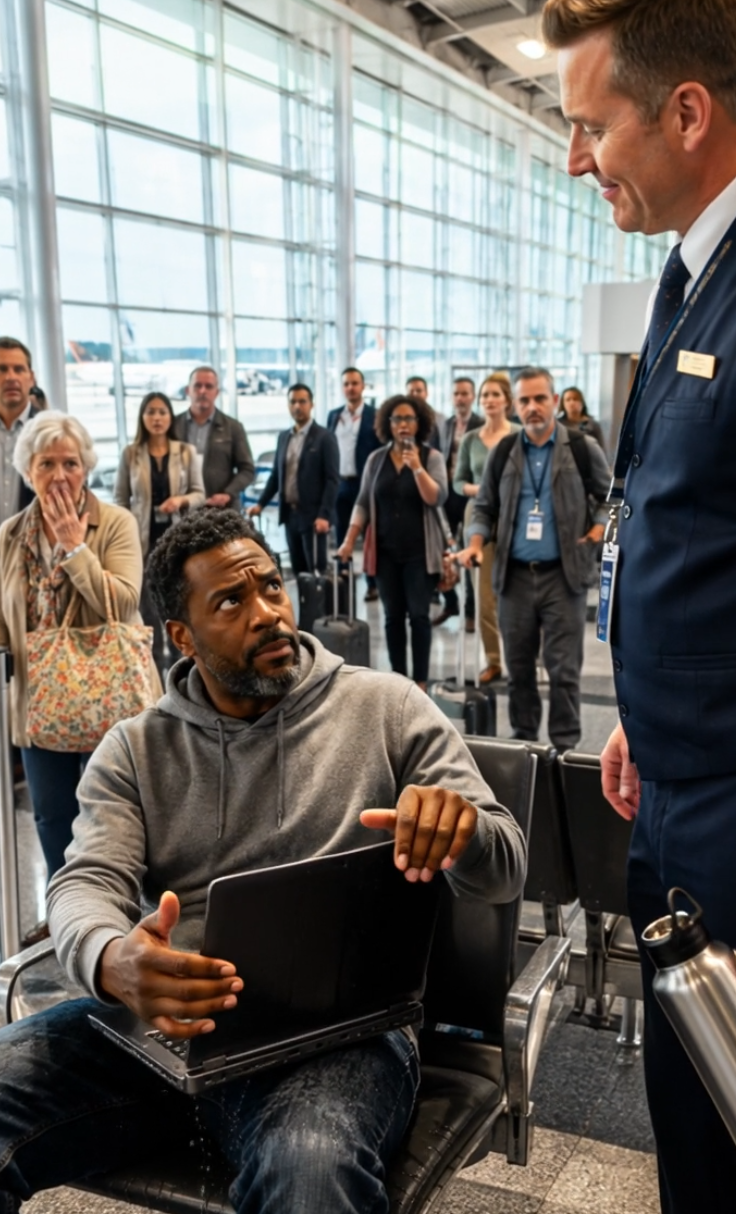
For one impossible second, Marcus Vance simply watched it fall—a glittering sheet spilling from the mouth of a stainless-steel bottle, splashing across the keys of his laptop, running into the vents, pooling around the trackpad, and dripping onto his jeans.
The screen flickered.
Blue.
Black.
Blue again.
Then it died.
Around him, Gate B24 at JFK International Airport seemed to lose its sound. The rolling suitcase wheels, the boarding announcements, the crying toddler three rows away—all of it became distant beneath the dull pounding of Marcus’s heartbeat.
Standing above him was Todd Mercer, the gate agent who had spent the previous ten minutes treating him like a problem that needed to be removed.
Todd lowered the bottle.
A thin stream of water continued dripping from its lip.
“Oops.”
He smiled.
Marcus looked at him.
Todd was perhaps forty, with carefully combed light-brown hair, a pressed navy vest, and the confident posture of a man who had learned how much authority could be borrowed from a radio clipped to his belt.
“Should’ve moved it when I told you to step aside, sir,” Todd added.
A few passengers shifted uncomfortably.
Marcus said nothing.
Todd’s smile widened.
“Clumsy me.”
Marcus closed his eyes for less than a second.
His father had taught him that trick.
Count before anger chooses for you.
Marcus was fifty-two years old now, managing partner of Vance & Associates, one of Manhattan’s most feared corporate litigation firms. He had questioned hostile CEOs, dismantled billion-dollar defense strategies, and once sat through nine hours of deposition while a pharmaceutical executive called him “boy” twice.
Still, some moments could reduce a man to every insult he had swallowed since childhood.
Marcus opened his eyes.
“You unscrewed the cap,” he said.
His voice was quiet.
That seemed to irritate Todd more than shouting would have.
“I tripped.”
“No, you didn’t.”
Todd leaned closer.
“Sir, you’re becoming confrontational.”
Marcus almost laughed.
He didn’t.
His eyes moved past Todd toward the airport security officers standing near the adjoining gate.
Todd noticed.
Of course he noticed.
That was the point.
“If you continue acting erratically,” Todd said, louder now, “I have the authority to deny boarding to anyone who presents a security concern.”
An elderly woman standing nearby tightened her grip on a floral tote bag.
Marcus had noticed her earlier. Late sixties, maybe seventy. Silver hair curled neatly around her face. Wedding ring. Comfortable shoes. The sort of woman who reminded Marcus of teachers he had known when he was young—women who noticed everything but had spent half their lives being told not to interfere.
She looked from Marcus to the soaked laptop.
Then to Todd.
Her face changed.
Not fear.
Disgust.
But she remained silent.
So did everyone else.
Marcus lowered his gaze to the ruined computer.
Todd had no idea what he had destroyed.
That laptop contained the locally decrypted working copy of thousands of documents given to Marcus by a confidential whistleblower six weeks earlier.
Maintenance records.
Internal emails.
Inspection logs.
Engineering warnings.
And a series of executive communications suggesting that Meridian Air—the airline operating Flight 418 to Atlanta that evening—had allowed regional aircraft to remain in service after certain safety inspections had been shortened, delayed, or recorded as completed when they had not been performed according to federal standards.
Marcus had spent forty-eight hours preparing the files for presentation to a federal oversight committee.
The meeting was scheduled for Monday morning.
He had refused to upload the decrypted archive to a commercial cloud server because the identity of the whistleblower was buried within the raw metadata.
There was an encrypted backup.
But only Marcus knew where.
Todd saw none of that.
Todd saw a Black man wearing jeans and a faded gray hoodie.
A man sitting near his boarding lane.
A man who had politely refused to immediately surrender his carry-on bag.
That had apparently been enough.
Todd bent closer.
“Well?”
Marcus slowly closed the laptop.
Water squeezed from the hinge.
“Are we going to have a problem?” Todd asked.
Marcus stood.
He deliberately moved slowly.
He kept his hands visible.
At six-foot-two, Marcus stood several inches taller than Todd, and for the first time the gate agent’s confidence faltered.
Marcus saw it.
A tiny uncertainty behind the eyes.
Todd had wanted rage.
Rage would have given him control.
Marcus gave him silence instead.
“No problem,” Marcus said.
Todd blinked.
“I won’t be taking this flight.”
The smirk returned.
“Smart choice.”
Todd turned toward the boarding lane.
“Next passenger! Boarding passes ready!”
Marcus lifted the wet laptop and slid it carefully into his backpack.
Then he walked away.
Not toward the exit.
Toward the Meridian Crown Lounge fifty yards down the terminal.
By the time Todd called Zone Three, Marcus Vance was already planning how to bring an airline to its knees.
He found a private booth in the lounge and called Sarah Bell.
She answered on the second ring.
“Vance.”
“Sarah.”
She heard something in his voice.
“What happened?”
“Meridian just destroyed the primary hardware containing the Delta-Echo files.”
Silence.
“Accident?”
“No.”
“How?”
“A gate agent poured water onto the computer.”
Another pause.
Longer.
“Marcus.”
“I have witnesses.”
“How many?”
“At least fifty.”
“Cameras?”
“Gate B24.”
Sarah’s voice changed instantly.
The friend vanished.
The litigator arrived.
“I’ll send preservation demands to general counsel, airport operations, terminal security, and their insurance carrier.”
“Include all fixed CCTV, employee body cameras if they use them, gate-area audio, radio traffic, internal messaging, incident reports, and Todd Mercer’s employment file.”
“You know his last name?”
“It was on his badge.”
Sarah typed rapidly.
“You want an emergency injunction?”
“Yes.”
“Damages?”
Marcus looked at the water dripping from his backpack onto the polished table.
“Amend the complaint.”
“To include?”
“Malicious destruction of property. Retaliatory conduct if we can connect him to corporate knowledge. Discrimination. Intentional infliction.”
Sarah paused.
“Marcus, be careful with retaliation. We don’t know Todd knew who you were.”
“He didn’t.”
“Then it wasn’t retaliation.”
Marcus stared through the lounge windows at the aircraft outside.
“No,” he said. “Which may be worse.”
Sarah understood.
Corporate cultures revealed themselves most clearly when employees believed nobody important was watching.
“What number?” she asked.
“Forty-two million.”
Sarah exhaled softly.
“That’s aggressive.”
“So was the water.”
She almost laughed.
Then her tone softened.
“Are you all right?”
Marcus looked down.
His hands were trembling.
Barely.
But they were trembling.
“I’m fine.”
“Marcus.”
“I said I’m fine.”
Sarah let the lie pass.
“All right. I’ll call you in ten.”
Marcus ended the call.
Then he sat alone in the expensive silence of the lounge and remembered his father.
PART TWO — THE THINGS MEN SWALLOW
Joseph Vance had worked nights for thirty-one years.
He cleaned a bank tower on Madison Avenue from eleven at night until seven in the morning, then rode the subway home while executives wearing thousand-dollar coats arrived for work.
Marcus had been twelve the first time he saw his father humiliated.
Joseph had forgotten to empty one trash bin.
A twenty-three-year-old assistant manager followed him into the lobby the next morning and shouted at him in front of half a dozen people.
“You people get paid to clean.”
Marcus remembered those words more clearly than he remembered the man’s face.
Joseph had lowered his eyes.
“Yes, sir.”
On the train home, Marcus had been furious.
“Why didn’t you say something?”
Joseph had looked at his son.
“Because your mother needs her medicine.”
“But he embarrassed you.”
“No.”
“He did!”
Joseph shook his head.
“A man doesn’t lose his dignity because somebody else behaves without theirs.”
At twelve, Marcus thought that sounded cowardly.
At fifty-two, he understood the price of restraint.
Joseph had died eleven years earlier.
Yet sitting in the airline lounge, Marcus heard his father’s voice as clearly as if he were across the table.
Don’t give another man ownership of your behavior.
His phone rang.
Sarah.
“They received the letter.”
“How fast?”
“Four minutes ago. Physical delivery to Arthur Sterling’s executive assistant.”
Marcus knew the name.
Meridian Air’s general counsel.
A formidable corporate attorney who had spent twenty years making problems disappear before they reached court.
Sarah continued.
“Our injunction team is filing now. Also, Marcus?”
“Yes?”
“I pulled Todd Mercer.”
Marcus sat straighter.
“What about him?”
“Twelve years with Meridian. Three internal complaints.”
“For?”
“Passenger conduct.”
“Meaning?”
“Two complaints alleging unnecessary escalation. One alleging discriminatory treatment.”
Marcus’s jaw tightened.
“Outcomes?”
“All closed.”
“Of course.”
“There is something else.”
Marcus waited.
“One of the complaints involved an elderly Korean War veteran three years ago. Todd allegedly mocked his hearing impairment and threatened removal when he asked him to repeat a boarding instruction.”
“And Meridian?”
“Customer-service credit. Five thousand miles.”
Marcus gave a humorless laugh.
Sarah continued.
“I also checked your flight.”
Marcus stopped smiling.
“What about it?”
“Flight 418 is still boarding.”
“I know.”
“Aircraft tail number MRA-721.”
Marcus felt something cold crawl up his spine.
He knew that number.
He had read it six hours earlier.
“Say that again.”
“MRA-721.”
Marcus stood.
His chair scraped backward.
“No.”
“Marcus?”
“Sarah, open Delta-Echo maintenance folder seven.”
Keys clicked.
“I’m in.”
“Search 721.”
Silence.
Then Sarah whispered, “Oh my God.”
Marcus was already moving.
“What does it say?”
“Hydraulic pressure anomaly. Repeated.”
“Date?”
“Friday.”
“Disposition?”
“Deferred.”
“Inspection?”
Sarah swallowed.
“Marked complete.”
“By whom?”
“Regional maintenance contractor.”
Marcus pushed through the lounge doors.
The boarding lane for Gate B24 was disappearing behind passengers heading down the jet bridge.
“Todd!”
The gate agent looked up.
Marcus strode toward him.
Todd’s eyes narrowed immediately.
“I told you, sir—”
“Stop boarding.”
Todd stared.
“What?”
“Stop boarding Flight 418.”
A few passengers turned.
Todd laughed.
“Absolutely not.”
Marcus lowered his voice.
“Call your station manager. Tell them to verify the hydraulic maintenance clearance for aircraft MRA-721.”
Todd’s face changed only slightly.
But Marcus caught it.
Recognition.
Not of the technical issue.
Of the tail number.
“You need to leave the boarding area,” Todd said.
“Call your manager.”
“Security!”
Marcus raised both hands.
Passengers recoiled.
Two airport security officers began moving toward them.
Marcus looked at Todd.
“You have an aircraft boarding right now with a maintenance anomaly that may not have been properly cleared.”
Todd’s face reddened.
“You are not an airline employee.”
“No.”
“You are not maintenance.”
“No.”
“Then stop pretending you know what you’re talking about.”
Marcus pulled his phone from his pocket.
“I represent the whistleblower whose records say otherwise.”
Todd froze.
It lasted less than a second.
But Marcus saw it.
So did someone else.
The elderly woman with the floral tote.
She was still there.
And now she was watching Todd with frightening concentration.
The security officers arrived.
One of them spoke calmly.
“Sir, step away from the podium.”
Marcus complied.
Todd pointed.
“He’s disrupting boarding and making threats about the aircraft.”
“I made no threat.”
“You said the plane is unsafe.”
“I said maintenance records raise a safety question.”
The officer looked at Marcus.
“Do you have evidence?”
Marcus held up the ruined laptop.
“Todd poured water on it.”
The elderly woman finally spoke.
“He did.”
Everyone turned.
Her voice was surprisingly firm.
“I watched him.”
Todd’s face hardened.
“Ma’am, you don’t know what happened.”
“I know what pouring looks like.”
A murmur traveled through the passengers.
Todd reached for his radio.
“Supervisor to B24.”
Then he looked at Marcus with open hatred.
“You’ve caused enough trouble.”
Marcus stepped closer—but stopped a safe distance away.
“If I’m wrong, you lose ten minutes.”
“And if you’re right?” the elderly woman asked.
Marcus looked toward the jet bridge.
“If I’m right, ten minutes may be the cheapest thing this airline ever buys.”
PART THREE — THE BOARDROOM
Three miles from the terminal, Meridian Air’s executive team was watching Todd pour water onto Marcus’s laptop.
Arthur Sterling stood at the end of a glass conference table.
The CEO, Daniel Wexler, sat with both hands clasped beneath his chin.
The video played again.
Todd approached.
Marcus remained seated.
Todd unscrewed the bottle.
Tilted it.
Water fell.
Nobody spoke.
Wexler finally said, “Tell me it looks worse than it is.”
Arthur didn’t answer.
“Arthur.”
“It looks exactly like it is.”
The CEO stood.
“Who is Marcus Vance?”
Arthur stared at him.
“You seriously don’t recognize the name?”
“No.”
“Vance & Associates.”
Wexler’s expression changed.
Arthur continued.
“Ninety-million-dollar fuel contamination settlement last year.”
Wexler sat down again.
“That’s him?”
“Yes.”
The head of public relations swore under her breath.
Wexler looked at the frozen image of Marcus staring upward at Todd.
“Why was he flying Meridian?”
Arthur said nothing.
That silence became the first alarm.
Wexler narrowed his eyes.
“What aren’t you telling me?”
Arthur removed his glasses.
“His firm represents a confidential complainant in a federal matter involving airline maintenance.”
No one moved.
Wexler’s voice dropped.
“Our maintenance?”
“We don’t know.”
“Find out.”
A junior lawyer entered without knocking.
“Arthur.”
“What?”
“Gate B24 has halted boarding.”
“Why?”
The lawyer looked pale.
“Marcus Vance raised a safety concern involving the aircraft.”
Wexler stood so quickly his chair struck the wall.
“What aircraft?”
“MRA-721.”
The room changed.
Not everyone understood the number.
But three people did.
The chief operating officer looked down.
The vice president of regional operations stopped breathing.
Arthur Sterling saw both reactions.
“What is 721?”
No answer.
Arthur repeated the question.
“What is aircraft 721?”
The COO said, “There was a hydraulic issue.”
“When?”
“Friday.”
“Resolved?”
“Yes.”
Arthur stared at him.
“Then why do you look terrified?”
The COO’s face drained.
Wexler turned.
“Answer him.”
The man rubbed his forehead.
“Our contractor inspected it.”
Arthur said, “That’s not what I asked.”
The silence became unbearable.
Finally, the COO whispered, “The inspection was expedited.”
Arthur’s eyes hardened.
“Define expedited.”
No one answered.
The CEO slammed his palm on the table.
“DEFINE IT!”
The COO looked toward the windows.
“They signed the clearance before the full procedure was finished.”
Nobody moved.
Arthur Sterling felt, for perhaps the first time in twenty-eight years of law, actual fear.
“Is the aircraft safe?”
“We believe so.”
Arthur laughed once.
It was not humor.
“You believe so?”
“We’ve had no further pressure alerts.”
“Because?”
“Because it hasn’t flown since.”
Arthur turned toward the junior attorney.
“Ground 721.”
“We don’t control operations.”
“Then get someone who does.”
Wexler grabbed his phone.
At Gate B24, Marcus watched the station manager arrive at a near run.
She was a compact woman in her fifties named Evelyn Price.
Todd immediately began speaking.
“This passenger has been creating a disturbance—”
“Stop.”
Todd blinked.
Evelyn looked at Marcus.
“Mr. Vance?”
“Yes.”
Her expression was unreadable.
“I’m temporarily suspending boarding while operations verifies a maintenance item.”
Todd’s face fell.
Marcus looked down the jet bridge.
“How many passengers are aboard?”
“Approximately eighty.”
“Bring them back.”
“That decision isn’t yours.”
“Then make it yours.”
Evelyn held his gaze.
For a moment Marcus expected another battle.
Instead she lifted the radio.
“Deplane Flight 418.”
Todd stepped toward her.
“You can’t be serious.”
Evelyn turned.
“Mr. Mercer, step away from the podium.”
“He caused this!”
“Step away.”
“This is ridiculous!”
“Todd.”
He stopped.
Her voice became quiet.
“Give me your badge.”
Todd stared at her.
“What?”
“Your badge and radio.”
Passengers began whispering.
Todd’s hands shook.
“You’re suspending me because he complained?”
“No.”
Evelyn looked toward the ceiling camera.
“I’m suspending you because corporate just called.”
The first passengers began emerging from the jet bridge.
Confused.
Annoyed.
Then frightened as rumors spread.
Marcus stepped aside.
The elderly woman approached him.
“You knew about the plane?”
“I knew there was a question.”
“That’s not the same thing.”
“No.”
She nodded.
“I like that answer.”
Marcus smiled faintly.
“Most lawyers would’ve said yes.”
“You’re not most lawyers.”
Something about the way she said it made Marcus look more carefully at her.
“Have we met?”
“No.”
She smiled.
“Not officially.”
Before Marcus could ask what that meant, Sarah called again.
He answered.
“What?”
Her voice was strained.
“Marcus, you need somewhere private.”
“Why?”
“Because we found something in the internal data.”
“What?”
“The 721 clearance wasn’t an isolated shortcut.”
Marcus looked toward the jet bridge.
“How many?”
“At least fourteen aircraft.”
He closed his eyes.
“Fourteen?”
“Possibly more.”
“And the executive chain?”
Sarah hesitated.
“That’s the problem.”
“Say it.”
“The approvals appear to lead to Daniel Wexler.”
The CEO.
Marcus stared through the windows.
“Directly?”
“There are emails.”
“What do they say?”
“One discusses ‘preventing schedule disruption by maintaining operational flexibility in inspection intervals.’”
Marcus almost laughed.
Corporate language.
Elegant words used to disguise ugly choices.
“How high does it go?”
“Marcus…”
“How high?”
Sarah’s voice dropped.
“There is one email we can’t explain.”
“From whom?”
“It wasn’t sent by Wexler.”
“Then who?”
“The whistleblower.”
Marcus went still.
“That isn’t possible.”
“I’m looking at the metadata.”
“Sarah, our whistleblower used an anonymous dead drop.”
“I know.”
“And?”
“The sender identity was scrubbed in the version we received.”
“Yes.”
“It isn’t scrubbed in one of the recovered headers.”
Marcus’s mouth went dry.
“Whose name?”
Sarah didn’t answer immediately.
When she finally spoke, Marcus felt the ground tilt beneath him.
“Joseph Vance.”
PART FOUR — THE DEAD MAN’S NAME
Marcus could not speak.
The terminal moved around him.
Passengers walked.
Phones rang.
A baby cried.
But Marcus heard only Sarah’s words.
Joseph Vance.
His father had been dead eleven years.
“That isn’t funny,” Marcus said.
“I know.”
“My father never worked for Meridian.”
“I know.”
“He cleaned offices.”
“I know.”
“Then explain it.”
“I can’t.”
Marcus turned away from the gate and walked toward an empty stretch of windows.
“Read the header.”
Sarah did.
The message had been transmitted through an internal Meridian server eighteen years earlier.
Sender: J.Vance.
Employee identification number.
Department: facilities compliance.
Marcus gripped the phone.
“No.”
“Marcus—”
“He worked at Commonwealth Bank.”
“Maybe he had another job.”
“He didn’t.”
“Are you sure?”
Marcus was about to answer.
Then memory intervened.
His father leaving early.
His father sleeping during afternoons.
His father saying he sometimes picked up “extra maintenance work.”
Marcus had assumed cleaning contracts.
Then he remembered something else.
A blue airport badge.
He had seen it once on the kitchen counter when he was twenty-seven.
Joseph had snatched it away.
Marcus had forgotten.
Until now.
“What did the email say?”
Sarah hesitated.
“Joseph reported falsified inspection records.”
Marcus leaned against the window.
“What year?”
“2008.”
“And what happened?”
“No action.”
“Nothing?”
“The complaint was internally classified as unsubstantiated.”
Marcus closed his eyes.
Sarah continued.
“Six months later, Joseph’s employee record ended.”
“Why?”
“It says voluntary resignation.”
“That doesn’t sound like him.”
“There is an attachment.”
“What?”
“A settlement agreement.”
Marcus opened his eyes.
“With my father?”
“Yes.”
“How much?”
“One hundred eighty thousand dollars.”
Marcus’s voice became almost inaudible.
“We never had that kind of money.”
Sarah said nothing.
Marcus remembered his mother’s medical bills suddenly disappearing.
Their mortgage being paid off early.
His father claiming he’d borrowed from a retirement account.
“You think he took hush money.”
“I don’t know.”
Marcus felt sick.
For decades, Joseph Vance had been the moral center of his life.
The man who taught him patience.
The man who taught him dignity.
The man whose memory Marcus carried into courtrooms like armor.
Was all of that built on a lie?
The elderly woman with the floral tote appeared beside him.
“You look like you’ve seen a ghost.”
Marcus turned sharply.
“Who are you?”
Her expression softened.
“My name is Ruth Ellis.”
He waited.
“Did you know my father?”
“Yes.”
Marcus forgot to breathe.
Ruth looked out at the runway.
“Joseph and I worked together.”
“At Meridian?”
She nodded.
Marcus stared at her.
“You were the whistleblower.”
Ruth looked at him.
“No.”
Marcus frowned.
“But you know about the files.”
“Yes.”
“How?”
“Because I helped your father create them.”
His voice hardened.
“My father has been dead eleven years.”
“I know.”
“Those documents include records from this year.”
“I know that too.”
Marcus stepped closer.
“Then stop speaking in riddles.”
Ruth’s eyes filled with sadness.
“Your father wasn’t the whistleblower, Marcus.”
“Sarah found his name.”
“Because the system carrying the evidence was his.”
“What system?”
Ruth reached into her floral tote.
Todd, now standing under supervision several yards away, noticed the movement.
So did Marcus.
Ruth removed an old black notebook.
The cover was cracked.
Marcus recognized it instantly.
His father’s handwriting filled the front.
JOSEPH VANCE.
Marcus’s knees nearly weakened.
“How do you have that?”
“He gave it to me.”
“When?”
“Two days before he died.”
Marcus stared at her.
Ruth opened the notebook.
Inside were maintenance codes, aircraft numbers, dates, employee names, and handwritten observations.
“Your father wasn’t a janitor at Meridian,” Ruth said. “He was a nighttime facilities technician assigned to maintenance administration. He didn’t repair airplanes. He maintained secure workrooms, document storage, access logs, and equipment.”
Marcus barely heard her.
“He saw things.”
“Yes.”
“And reported them.”
“Yes.”
“Then took a settlement.”
Ruth’s face hardened.
“No.”
“The records show—”
“The records lie.”
Marcus stopped.
Ruth continued.
“They offered Joseph money after he reported falsified inspection documentation. He refused.”
“Sarah found a signed agreement.”
“Look at the signature.”
Marcus called Sarah.
“Pull the settlement.”
Keyboard clicks.
“Got it.”
“Compare the signature to anything else in the archive.”
A pause.
Then another.
“Marcus.”
“What?”
“It doesn’t match.”
His chest tightened.
“How much?”
“Not remotely.”
Ruth nodded slowly.
“They forged it.”
Marcus lowered the phone.
“Why?”
“To discredit him if he ever went public.”
“And the money?”
“Placed in an account he never controlled. Withdrawn three days later.”
“By whom?”
Ruth’s eyes shifted toward the gate.
Not Todd.
Beyond him.
Toward the station manager, Evelyn Price.
Marcus followed her gaze.
“No.”
Ruth said nothing.
“Evelyn?”
“No.”
Marcus looked back.
“Then who?”
“The employee authorization on that withdrawal belonged to someone who is now one of Meridian’s highest-ranking executives.”
Marcus called Sarah again.
“Find settlement disbursement authorization.”
“Already looking.”
A minute passed.
Then Sarah inhaled sharply.
“Daniel Wexler.”
Marcus closed his eyes.
The CEO.
Ruth continued.
“Your father knew Wexler when Wexler was a regional operations manager.”
“And you?”
“I was an aircraft records clerk.”
“Why didn’t you come forward?”
“I did.”
“When?”
“Twice.”
“What happened?”
“I lost my job.”
Marcus looked at the old woman.
“Why send the new records to me?”
“I didn’t.”
Marcus froze.
“Then who did?”
Ruth’s eyes moved toward Todd.
Marcus turned slowly.
Todd Mercer was watching them.
All color had left his face.
Ruth whispered, “His name isn’t Todd Mercer.”
Marcus stared.
“What?”
“That badge isn’t his.”
Todd stepped backward.
The station manager noticed.
“Todd?”
He turned.
Then ran.
PART FIVE — THE MAN WHO POURED THE WATER
Everything happened at once.
Todd bolted toward the concourse.
A security officer shouted.
Passengers scattered.
Todd made it perhaps thirty yards before two airport police officers intercepted him near a newsstand.
He did not fight.
He simply stopped.
When they returned him to Gate B24, his arrogance was gone.
Marcus stood beside Ruth.
The man who had poured water onto his laptop looked suddenly older.
Tired.
Afraid.
The station manager stared at his badge.
“Who are you?”
Todd said nothing.
One officer removed his wallet.
Inside was identification.
Anthony Mercer.
Ruth closed her eyes.
Marcus looked at her.
“You know him.”
“Yes.”
“How?”
Anthony finally spoke.
“My father was Robert Mercer.”
Marcus searched his memory.
Nothing.
Ruth supplied the answer.
“Robert Mercer was a maintenance supervisor.”
Marcus looked at Anthony.
“Eighteen years ago?”
He nodded.
“My father worked with Joseph.”
“For him?”
“With him.”
Ruth corrected him.
“Against the same people.”
Marcus’s anger sharpened.
“Then why did you destroy my laptop?”
Anthony looked at the floor.
“To save what’s on it.”
Marcus stared at him.
“What?”
Anthony lifted his eyes.
“I wasn’t trying to destroy the evidence.”
“You drowned the computer.”
“I was trying to destroy the tracking hardware.”
No one spoke.
Anthony continued.
“The laptop had been compromised.”
Marcus’s mind raced.
“How would you know?”
“Because I sent you the files.”
Ruth inhaled.
Marcus felt the entire story rearrange itself.
“You?”
Anthony nodded.
“The anonymous whistleblower was you?”
“Yes.”
“Why?”
“Because my father spent eighteen years collecting what Joseph started.”
Marcus turned toward Ruth.
She nodded reluctantly.
Anthony continued.
“When Joseph died, my father kept everything going. Ruth helped when she could. New employees came into the network. Mechanics. Inspectors. Dispatchers. People who were tired of being told to sign what wasn’t true.”
Marcus’s voice was cold.
“And you?”
“I joined Meridian twelve years ago.”
“As a gate agent?”
“As access.”
Marcus stared.
Anthony swallowed.
“Low-level employees see everything because nobody thinks we matter.”
The sentence landed with cruel symmetry.
Marcus remembered the water.
The sneer.
The threat.
“You humiliated me in front of fifty people.”
“I had to.”
“You had to?”
“I saw security watching you.”
“Airport security?”
“No.”
Anthony looked toward the cameras.
“Corporate.”
Ruth’s face tightened.
Anthony continued.
“Someone inside Meridian discovered the leak Friday night. They didn’t know who had the files, but by Sunday morning they knew a lawyer was carrying a decrypted copy to Atlanta.”
Marcus felt his skin go cold.
“They knew I was on Flight 418?”
“Yes.”
“How?”
“I don’t know.”
“My ticket?”
“Maybe.”
“Then why not warn me?”
“I tried.”
Marcus remembered his gate experience.
Todd—Anthony—had repeatedly demanded he check his carry-on.
“You wanted the laptop off me.”
“I wanted the bag in the hold.”
“Why?”
“Because if corporate security searched you, I needed them to find nothing.”
Marcus stared.
“You planned to retrieve it?”
Anthony nodded.
“The bag would’ve been pulled before departure and transferred to an airport police contact working with us.”
Marcus’s anger rose.
“You could have spoken to me.”
“They were listening.”
“So you poured water onto it?”
Anthony looked ashamed.
“I knew the solid-state drive was sealed. Water would kill the visible machine, but not necessarily the data. More importantly, the laptop had a covert transmitter installed near the wireless module.”
Marcus went still.
“What transmitter?”
Anthony reached into his pocket.
An officer stopped him.
“Easy.”
“My phone,” Anthony said.
The officer removed it.
Anthony directed him to a photograph.
The screen showed Marcus’s laptop.
Not from today.
From the previous evening.
Marcus stared.
“Where was that taken?”
“Your office.”
His blood ran cold.
Anthony continued.
“We have someone inside the maintenance contractor who recognized the hardware signature when the tracking device pinged near JFK. Whoever placed it had access to your laptop.”
Marcus called Sarah.
She answered instantly.
“Marcus?”
“Get out of the office.”
“What?”
“Now.”
“Why?”
“Because someone accessed my computer.”
“Marcus—”
“Sarah. Leave.”
Silence.
Then Sarah spoke softly.
“I already know.”
Marcus froze.
Ruth closed her eyes.
Anthony looked away.
Marcus could barely form the words.
“What did you say?”
Sarah’s breathing trembled through the phone.
“I said I know.”
The airport vanished around him.
“You?”
“Marcus…”
“You put the tracker in my laptop?”
“No.”
“Then who?”
Sarah began crying.
Marcus had known Sarah Bell for twenty-four years.
They had met in law school.
She had stood beside him at his father’s funeral.
She was godmother to his daughter.
Marcus had never heard her cry.
“Sarah.”
Her voice broke.
“I’ve been working with the Justice Department.”
Marcus said nothing.
“For how long?”
“Seven months.”
He closed his eyes.
“Against Meridian?”
“Partly.”
“What does that mean?”
“The investigation isn’t only into Meridian.”
Marcus’s hand tightened around the phone.
“What else?”
“Your firm.”
He opened his eyes.
Anthony watched him.
Ruth said nothing.
Marcus whispered, “Explain.”
Sarah inhaled.
“Someone at Vance & Associates has been selling protected discovery information to corporate clients.”
Marcus almost laughed.
“That is impossible.”
“I wish it were.”
“Who?”
“We didn’t know.”
“Didn’t?”
“Until Friday.”
Marcus felt his stomach drop.
Sarah continued.
“The Delta-Echo leak was bait.”
“What?”
“The government already had much of the Meridian maintenance evidence.”
Marcus stared through the windows at the aircraft outside.
“The whistleblower files…”
“Were real.”
“But?”
“They also contained uniquely traceable document variations.”
Honey traps.
Marcus understood immediately.
Each recipient receives a slightly different version.
If a document leaks, investigators know whose copy leaked.
“My copy was marked.”
“Yes.”
“And it leaked.”
“Yes.”
Marcus could barely breathe.
“To Meridian?”
“Yes.”
“That means…”
Sarah couldn’t finish.
Marcus did.
“Someone on my team sold it.”
“Yes.”
“Who had access?”
“Three people.”
“Names.”
“Marcus—”
“Names.”
“You. Me.”
“And?”
Sarah was silent.
Marcus knew before she said it.
His heart knew.
But his mind refused.
“And your daughter.”
He nearly dropped the phone.
“Claire?”
Ruth whispered, “Marcus…”
“No.”
Sarah continued carefully.
“Claire accessed the decrypted archive Friday at 11:43 p.m.”
“She works at the firm.”
“I know.”
“She had authorization.”
“She copied files.”
“No.”
“We have logs.”
Marcus shook his head.
“No.”
“Marcus.”
“She wouldn’t.”
“I hoped that too.”
Marcus turned away from everyone.
His daughter Claire was twenty-nine.
Brilliant.
Ambitious.
Associate attorney.
The child he had raised alone after his wife died.
She had inherited Joseph’s eyes.
Marcus remembered her learning to ride a bicycle.
Her first day at Columbia.
Her law school graduation.
Her first argument in court.
“You’re wrong.”
Sarah’s voice softened.
“I confronted her Sunday morning.”
Marcus stopped breathing.
“What happened?”
“She denied everything.”
“Good.”
“Then she disappeared.”
Marcus stared at the terminal floor.
“Where is she?”
“We don’t know.”
Anthony suddenly spoke.
“I do.”
Marcus turned.
Anthony looked toward the grounded aircraft.
“She’s on Flight 418.”
Marcus’s face went blank.
“What?”
“She boarded before you reached the gate.”
Marcus looked toward the jet bridge.
The aircraft had been emptied.
Nearly everyone stood around the terminal.
He searched faces.
No Claire.
Anthony’s expression changed.
“She didn’t come off.”
The station manager grabbed her radio.
“Confirm aircraft clear.”
Static.
A voice responded.
“Cabin crew reports clear.”
Anthony shook his head.
“She isn’t in the cabin.”
Marcus understood.
His eyes widened.
“Cargo?”
Anthony nodded.
“Service access.”
Marcus ran.
Security shouted.
The station manager raised her radio.
Marcus didn’t stop until he reached the jet bridge entrance.
“Claire!”
Nothing.
Then—
A metallic bang.
Far below.
Anthony shouted, “Ramp level!”
Airport police moved.
Minutes later, officers entered the aircraft’s forward service compartment.
Marcus waited behind a security line, every second stretching into an hour.
Then he saw her.
Claire Vance emerged between two federal agents.
Her hair was disheveled.
Her face was wet with tears.
And she was carrying a small black case.
Marcus could not move.
Claire saw him.
“Dad.”
The word shattered something inside him.
He stepped forward.
“Tell me they’re wrong.”
Claire began crying.
“Dad.”
“Tell me.”
She shook her head.
Marcus closed his eyes.
“How much?”
“No.”
“How much did they pay you?”
“Dad, listen—”
“How much?”
“Nothing!”
Marcus opened his eyes.
Claire gripped the black case.
“I wasn’t selling the files.”
Sarah’s voice still came faintly from his phone.
Marcus raised it.
“Sarah?”
“Yes.”
“Claire says she wasn’t selling them.”
Sarah went silent.
Claire laughed bitterly through her tears.
“Of course she does.”
Marcus looked at his daughter.
“What does that mean?”
Claire pointed at the phone.
“You’ve been asking the wrong question.”
Marcus frowned.
Claire continued.
“You asked who leaked your copy.”
“Yes.”
“It wasn’t me.”
“The logs—”
“I copied the documents because I found something buried inside them.”
“What?”
“Payment records.”
Marcus’s mouth went dry.
“To whom?”
Claire looked directly at the phone.
“To Sarah.”
Silence.
Marcus slowly raised the phone.
“Sarah?”
Nothing.
Then the call disconnected.
Marcus stared at the screen.
Claire opened the black case.
Inside were printed banking records.
Wire transfers.
Shell corporations.
Retainer payments.
Millions of dollars.
All flowing through entities linked to Meridian.
Marcus looked toward Anthony.
Then Ruth.
Then Claire.
His daughter whispered, “Sarah has been feeding Meridian your litigation strategy for five years.”
Marcus felt the truth strike harder than the water ever could.
The ninety-million-dollar class action.
The settlements that mysteriously weakened.
Witnesses who suddenly changed testimony.
Confidential strategies opponents somehow anticipated.
All those victories Marcus thought had been difficult because corporations were powerful.
Some had been difficult because his closest friend had been warning them.
Claire continued.
“She planted the tracker.”
Marcus shook his head.
“Why?”
“Because she knew Anthony sent you the files. She knew if you reached Atlanta, investigators would connect her shell company to Meridian.”
Marcus looked at the black case.
“You knew?”
“I suspected.”
“Why didn’t you tell me?”
Claire’s face crumpled.
“Because she’s Aunt Sarah.”
The words hurt more than anything else.
Claire had called Sarah “Aunt Sarah” since she could speak.
“I needed proof.”
“So you got on this plane?”
“I followed the courier carrying the banking archive.”
“What courier?”
Claire looked toward the aircraft.
“He never came off.”
Everyone went silent.
Anthony’s face changed.
The station manager raised her radio.
“Search the aircraft again.”
They found him twelve minutes later.
A man hiding inside a rear galley storage area with falsified maintenance credentials and a second phone.
On that phone were messages from Sarah Bell.
The final message had been sent forty minutes earlier.
MAKE SURE VANCE DOES NOT REACH ATLANTA WITH THE LAPTOP.
Marcus read it twice.
Then once more.
He looked at Anthony.
“You knew Sarah was involved?”
“No.”
“Then why destroy the laptop?”
“Because I knew someone was tracking it.”
Marcus stared at the ruined computer inside his bag.
Anthony had not destroyed the evidence.
He had broken the beacon leading the conspirators directly to Marcus.
The humiliation at Gate B24 had been theater.
Cruel theater.
Dangerous theater.
But theater designed to keep him alive long enough to discover the truth.
Marcus sat down.
For the first time all evening, his legs would no longer hold him.
Claire knelt beside him.
“Dad.”
Marcus looked at his daughter.
“You copied the files.”
“Yes.”
“You hid in an airplane.”
“Yes.”
“You could have been arrested.”
She smiled weakly.
“I seem to have inherited something.”
“What?”
“Your terrible judgment around large corporations.”
Marcus laughed.
A broken, exhausted laugh.
Then Ruth sat beside him.
She placed Joseph’s notebook in Marcus’s hands.
“There is one more page you need to read.”
Marcus opened it.
Near the back, in his father’s handwriting, was a letter.
Marcus,
If you ever read this, then what I feared lasted longer than I did.
You once asked me why I stayed quiet when people treated me badly.
I told you silence could protect dignity.
That was only half the lesson.
Sometimes silence protects the truth until the truth has somewhere safe to go.
I hope you became that place.
Marcus stopped reading.
His vision blurred.
Below the letter, Joseph had written one final name.
ROBERT MERCER.
Anthony’s father.
And beneath it:
Trust his family.
Marcus looked across the gate at Anthony.
For the first time, he understood.
Eighteen years earlier, two working men nobody important noticed had discovered something powerful people wanted buried.
One was Marcus’s father.
The other was Anthony’s.
They had passed the truth forward quietly, imperfectly, stubbornly.
Through fired clerks.
Through mechanics.
Through hidden records.
Through children.
Through years.
Until it finally arrived at Gate B24.
By midnight, Daniel Wexler had resigned as CEO of Meridian Air.
By sunrise, federal agents had executed warrants at Meridian headquarters, two maintenance contractors, and Sarah Bell’s Manhattan apartment.
Fourteen aircraft were grounded for emergency inspection.
Three executives were indicted within six months.
Sarah eventually pleaded guilty to conspiracy, obstruction, and wire fraud.
Todd Mercer did not exist.
Anthony Mercer did.
The airline fired him anyway.
Marcus represented him for free.
At the first hearing, a reporter asked Marcus whether he regretted not striking back when Anthony poured water onto his computer.
Marcus looked at the cameras.
“No.”
“Why not?”
Marcus thought about his father.
Then he smiled.
“Because sometimes the man who looks like your enemy is the only person in the room trying to save you.”
A year later, Marcus stood in the lobby of a newly created aviation safety foundation with Claire on one side and Ruth Ellis on the other.
On the wall hung two framed photographs.
Joseph Vance.
Robert Mercer.
Beneath them was a simple brass plaque.
THE MEN NOBODY NOTICED.
Anthony approached Marcus carrying a stainless-steel water bottle.
Marcus looked at it.
Anthony looked at him.
For half a second, neither man spoke.
Then Anthony grinned.
Marcus pointed at the bottle.
“Cap stays on.”
Anthony laughed.
“Forever.”
Claire shook her head.
Ruth smiled.
And Marcus looked once more at his father’s photograph.
For thirty years, Marcus had believed Joseph Vance survived humiliation because he had been powerless.
Only now did he understand the truth.
His father had never been powerless.
He had been patient.
There was a difference.
A powerful man needs everyone to know he has power.
A patient man only needs the truth to survive him.
And on an ordinary Sunday evening at Gate B24, beneath fluorescent lights and the indifferent roar of departing airplanes, Joseph Vance’s truth finally did.
Not because his son shouted.
Not because he threatened.
Not because he struck back.
But because when another man deliberately poured water onto his laptop and waited for rage, Marcus Vance gave him the one response the conspiracy had never prepared for.
He stayed calm long enough to see who was really standing beside him.
“`