PART ONE — THE BAG
The first thing I heard was the handcuffs.
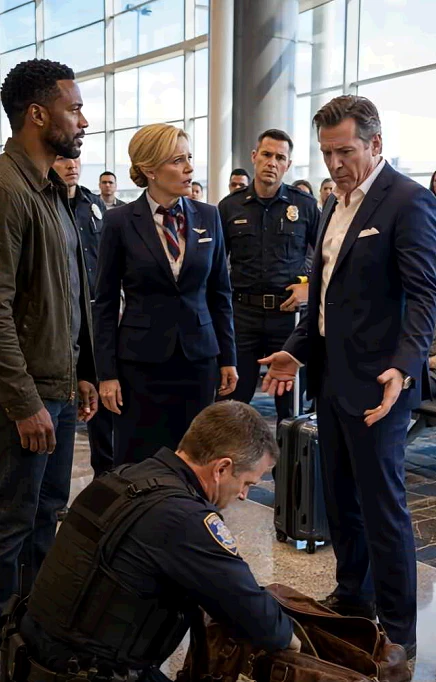
Not the accusation. Not the crowd gathering near Gate B17. Not the wealthy man in the navy suit telling three airport police officers that I had stolen his luggage.
The handcuffs.
Metal struck metal with a clean, unmistakable click, and something inside me returned to a lesson my grandfather had taught me when I was twelve years old.
“When people have already decided what you are,” he once said, “don’t waste your first breath proving them right.”
So I kept my hands where everyone could see them.
I did not raise my voice.
I did not step toward the man holding my grandfather’s duffel bag.
I simply stood beneath the bright airport lights and watched strangers decide who I was.
“He stole it,” the man in the navy suit repeated.
His name, I would soon learn, was Preston Vale.
He looked like the kind of man airports were designed to welcome. Silver at his temples. Hand-tailored suit. Shoes so polished they reflected the ceiling lights. A watch that probably cost more than my first car.
His voice carried the casual authority of someone accustomed to being believed before he finished speaking.
Beside him stood the senior flight attendant from our flight.
Her name tag read ELAINE PORTER.
“I witnessed the incident,” she said.
That sentence hurt more than Preston’s accusation.
Elaine had questioned my first-class ticket twice before takeoff.
The first time, she had smiled.
“Sir, economy boarding will begin shortly.”
I had shown her seat 2A.
She apologized.
Ten minutes later, she returned and asked to see my boarding pass again.
During the flight, she had offered everyone around me drinks by name while addressing me as “sir” with the chilly politeness people use when they are trying not to reveal they resent your presence.
Now she stood beside Preston like the final witness at a trial.
Murmurs moved through the terminal.
“Unbelievable.”
“People will steal anything.”
“Look at that bag.”
Then, from somewhere behind me, a man said softly, “He doesn’t look like he belongs in first class anyway.”
I heard every word.
I always heard those words.
People who say things quietly often imagine the person they are talking about becomes deaf out of courtesy.
The lead airport officer was a broad-shouldered man in his late forties whose badge identified him as Sergeant Daniel Mercer.
He held the cuffs but had not used them.
That mattered.
“Sir,” Mercer said to me, “I need you to stay where you are.”
“I’m staying.”
“Is that bag yours?”
“Yes.”
Preston laughed.
“Of course he says it is.”
Mercer glanced at him.
“Mr. Vale, I’ll speak to you in a moment.”
There was the smallest change in Preston’s face.
He was not used to waiting.
Mercer turned back to me.
“Can you prove the bag belongs to you?”
I looked down at it.
The leather was older than I was.
My grandfather, Isaiah Reed, had carried that duffel through Germany, Morocco, Chicago, Atlanta, and more courthouse corridors than I could count. One handle had been repaired with dark stitching. The brass zipper had a scratch shaped almost like a lightning bolt.
When I was eight, I had asked Grandpa Isaiah why he never replaced it.
He had rubbed the leather with his thumb.
“Some things earn the right to get old.”
That bag had.
It smelled faintly of cedar, leather conditioner, and another scent I could never name without thinking of him.
He had died eleven months earlier.
The duffel was the last thing in his house I had been unable to unpack.
Preston gripped its handles.
His knuckles were white.
“Read the luggage tag,” I said.
Something changed.
It was almost invisible.
Preston’s right eye twitched.
Mercer saw it.
So did I.
The officer stepped toward him.
“I’ll need to check the tag, Mr. Vale.”
“This is absurd.”
“Then checking should settle it.”
“He switched the tag.”
“You just told me he grabbed the bag after landing.”
“He could have changed it before that.”
Mercer paused.
“How?”
Preston opened his mouth.
Nothing came out immediately.
Elaine stepped in.
“Sergeant, I saw this passenger behaving suspiciously during the flight.”
I looked at her.
“Suspiciously?”
She would not meet my eyes.
Mercer crouched beside the duffel.
Preston released it reluctantly.
The officer flipped over the worn leather luggage tag.
He read the name.
Then he looked at me.
“MARCUS REED.”
The second officer leaned closer.
Preston exhaled through his nose.
“That proves nothing.”
“It proves something,” Mercer said.
Phones were raised everywhere now.
The same people who had wanted to witness my humiliation suddenly wanted to witness Preston’s.
Human curiosity changes allegiance quickly.
Mercer examined the duffel.
That was when his attention settled on the small side pocket.
Preston went still.
Elaine whispered, “No.”
Barely audible.
But I heard it.
Mercer heard it too.
He looked at her.
“Ma’am?”
“I said… nothing.”
His hand moved toward the zipper.
Elaine stepped forward.
“What are you doing?”
Her professional voice was gone.
Fear had replaced it.
Mercer slowly opened the pocket.
The sound of the zipper seemed impossibly loud.
Inside was a folded square of faded green cloth.
Mercer reached in.
My heart stopped.
I knew the cloth.
Grandpa Isaiah had kept it in the top drawer of his bedroom dresser for as long as I could remember.
But I had never known what was inside.
Mercer unfolded it.
A silver badge rested in his palm.
For several seconds, nobody spoke.
Then the officer beside him whispered, “Jesus.”
Mercer stared at the badge.
His expression did not show simple surprise.
It showed recognition.
Preston’s face drained of color.
Elaine covered her mouth.
Mercer raised his eyes toward Preston.
“Sir,” he said slowly, “why is there a federal marshal’s badge in the bag you claim is yours?”
The crowd erupted.
Preston took one step backward.
“That isn’t mine.”
“You’ve spent ten minutes insisting everything in this bag belongs to you.”
“I meant the bag.”
“You said it was your luggage.”
“I made a mistake.”
“A minute ago, you said he stole it.”
“I was confused.”
Mercer stood.
“No, Mr. Vale.”
His eyes never left Preston.
“You were very certain.”
Then he looked down at the badge again.
And I saw his fingers begin to tremble.
That frightened me more than anything that had happened yet.
“Sergeant?” I said.
Mercer turned the badge over.
There was an engraved number on the back.
His face changed completely.
He looked at me.
“Where did you get this?”
“It belonged to my grandfather.”
“What was his name?”
“Isaiah Reed.”
The airport disappeared from Mercer’s eyes.
For one long second, he looked like a man standing in another place, another year.
Then he whispered a sentence I had waited almost thirty years to hear without ever knowing I was waiting for it.
“Isaiah Reed didn’t die eleven months ago.”
I stared at him.
Mercer swallowed.
“He died thirty-two years ago.”
PART TWO — THE MAN WHO DIED TWICE
I thought I had misunderstood him.
“My grandfather died last September.”
Mercer’s eyes stayed on the badge.
“No.”
The word came quietly.
“He may have been buried last September. But Deputy U.S. Marshal Isaiah Reed was officially declared dead in 1994.”
The terminal seemed to tilt.
“That’s impossible.”
Mercer motioned to the other officers.
“Move everyone back.”
Preston immediately turned.
One officer blocked him.
“Where are you going?”
“I have a flight.”
“No, sir. You don’t.”
Elaine began backing away too.
Mercer pointed at her.
“Stay where you are.”
Her face tightened.
“I’m an airline employee.”
“And right now you’re part of an active police investigation.”
My attention stayed on Mercer.
“You knew my grandfather?”
He looked at me for a long moment.
“No.”
Then he corrected himself.
“Not personally.”
“What does that mean?”
He glanced at the growing crowd.
“Not here.”
Airport security cleared a private operations room behind the gate.
Twenty minutes later, I sat across from Mercer at a gray table while the duffel rested between us.
Preston and Elaine had been separated.
Two federal agents were already on their way.
Mercer placed the old badge beneath the fluorescent light.
“My father was a cop,” he said.
I waited.
“Baltimore County. Thirty-eight years.”
He pointed to the engraved number.
“Four-seven-one-nine.”
“Yes?”
“I grew up hearing that number.”
My throat tightened.
“Why?”
Mercer leaned back.
“In 1994, my father was a young officer assigned to assist a federal witness transport outside Baltimore. Something went wrong. A convoy route was leaked.”
I felt cold.
“There was an ambush?”
“Yes.”
“Who was the witness?”
“That part was sealed.”
“And Isaiah?”
“He was the deputy marshal leading the transport.”
I stared at the badge.
Mercer continued.
“My father was shot. Isaiah Reed dragged him behind a concrete barrier and kept him alive until help came.”
I had never heard this story.
Not once.
“Grandpa never mentioned it.”
“He wouldn’t have been able to.”
“Why?”
“Because according to the report, Isaiah disappeared that same night.”
My mouth went dry.
“Disappeared?”
“His vehicle was found burned near the Chesapeake. Blood in the driver’s seat. No body.”
“But you said he was declared dead.”
“Seven years later.”
I thought of Grandpa Isaiah gardening behind his little brick house in Maryland.
Sunday dinners.
Baseball games.
His terrible coffee.
His habit of checking every window before bed.
All at once, memories that had seemed ordinary rearranged themselves.
He had never allowed photographs of himself online.
He refused social media.
He paid cash whenever possible.
When I once suggested ancestry DNA testing, he had become unusually angry.
“Some doors are closed for good reason,” he told me.
At the time, I thought it was an old man’s stubbornness.
Now my hands were shaking.
“Why would a federal marshal fake his own death?”
Mercer looked toward the duffel.
“Maybe he didn’t.”
The door opened.
Two people entered.
The first was a compact woman with silver-streaked black hair and the calm, disciplined manner of someone who never wasted movement.
“Deputy Chief U.S. Marshal Lena Brooks.”
The second man wore a plain gray suit.
“Inspector Aaron Pike.”
Lena looked at me.
“Marcus Reed?”
“Yes.”
She looked at the badge.
Then she stopped breathing.
Not metaphorically.
She actually stopped.
Her hand went to the back of a chair.
“Where did you find that?”
Mercer explained.
Lena sat slowly.
“I knew Isaiah.”
My pulse hammered.
“When?”
“Before you were born.”
“Then tell me what’s happening.”
She studied my face.
There was grief in her eyes.
And something else.
Guilt.
“In 1994,” she said, “your grandfather was assigned to protect a witness connected to a money-laundering investigation involving organized crime, defense contractors, and several public officials.”
“Who was the witness?”
“The witness was never an adult.”
Silence.
I frowned.
“What does that mean?”
Lena folded her hands.
“It means the person Isaiah was protecting was a child.”
I felt something tighten behind my ribs.
“How old?”
“Ten months.”
I stared at her.
Mercer stared at her too.
Lena continued carefully.
“The child’s mother had agreed to testify. Before she could be moved, she was murdered.”
My voice barely worked.
“And the child?”
“Vanished during the ambush.”
A terrible thought approached me.
I did not want it.
But some truths enter a room before anyone invites them.
“When was I born?”
Lena did not answer.
I stood.
“When was I born?”
“Marcus—”
“Answer me.”
“February 9, 1993.”
I laughed once.
It sounded broken.
“That’s my birthday.”
“Yes.”
I looked from Lena to Mercer.
“No.”
No one spoke.
“My mother died when I was four.”
Lena’s eyes filled with sorrow.
“That is what Isaiah told you.”
I stepped backward.
“Stop.”
“Marcus—”
“My grandfather raised me after my mother died.”
“Yes.”
“You’re telling me he lied?”
“I’m telling you he protected you.”
The room became very quiet.
I sat down again because my knees were no longer trustworthy.
Lena spoke gently.
“Your name was not Marcus Reed when you were born.”
I closed my eyes.
“What was it?”
She answered.
“Marcus Vale.”
PART THREE — BLOOD NAMES
For several seconds, the name meant nothing.
Then it meant too much.
I opened my eyes.
“Vale?”
Nobody had to explain.
The man accusing me of theft ten minutes earlier was Preston Vale.
I looked toward the door.
“No.”
Lena nodded.
“Preston’s father, Jonathan Vale, was one of the central subjects of the investigation.”
“Who is Preston to me?”
“We don’t know yet.”
“Don’t lie to me.”
“I’m not.”
Her voice remained steady.
“Jonathan Vale had two sons documented at the time. Preston was nine. Another infant son had been born outside the marriage.”
My stomach turned.
“The witness.”
“Yes.”
“Me.”
“Yes.”
I stood so quickly the chair struck the wall.
All my life, I had been Marcus Reed.
Isaiah’s grandson.
Son of a mother named Denise who had supposedly died in a winter highway accident.
I had photographs of her.
Birthday cards.
A framed picture beside my bed until I was sixteen.
“Was Denise real?”
Lena lowered her eyes.
“She was Isaiah’s younger sister.”
“My mother?”
“No.”
The word cut deeper than I expected.
“She died in 1989.”
Before I was born.
I pressed my palms against the table.
The room blurred.
“Then every story—”
“Was designed to give you a history no one would investigate.”
I turned toward the duffel.
“And Preston?”
“That is what we need to understand.”
A knock interrupted us.
Inspector Pike opened the door.
“We found something.”
He placed a clear evidence bag on the table.
Inside was a small black electronic device.
“Tracker,” he said.
“Where?”
“Under the lining of the duffel.”
I stared.
“Mine?”
“No. Battery is fresh.”
Lena’s eyes hardened.
“Someone planted it recently.”
Pike nodded.
“Airport cameras show Preston near Reed’s bag at the arrival carousel before the confrontation.”
That matched what I remembered.
The shoulder bump.
The stare.
His smile.
“He knew the bag,” I said.
“Yes,” Lena replied.
“But how?”
Pike put another image on his tablet.
Airport surveillance showed Elaine speaking with Preston behind a service counter forty minutes before our flight boarded.
“They knew each other before today,” Pike said.
Elaine had told police she had never met him.
Lena stood.
“Separate interviews. Now.”
Preston lasted eleven minutes.
I did not see the interrogation, but I heard pieces later.
He began with outrage.
Threatened lawsuits.
Demanded attorneys.
Mentioned senators.
Then Lena placed the photograph of the tracker on the table.
His story changed.
He claimed Elaine had approached him.
Elaine said Preston had paid her.
Then Preston said he thought the duffel contained stolen property belonging to his family.
That was the first useful lie.
“What property?” Lena asked.
“I don’t know.”
“Then how did you know to track the bag?”
Silence.
“What did you expect to find?”
More silence.
Finally Preston said, “Documents.”
“What documents?”
“My father’s.”
Jonathan Vale had died six years earlier.
Officially, he had spent his last decade as a respected philanthropist.
Hospitals carried his family name.
Universities displayed his photograph.
Cable news had praised his charitable work after his death.
The federal case against him from the 1990s had quietly collapsed after witnesses disappeared, evidence was lost, and investigators were reassigned.
Isaiah Reed had vanished with the most important witness.
Me.
By evening, Gate B17 was only the beginning.
The duffel was taken to a secure federal office.
Every seam was photographed before anyone touched it.
I sat behind glass as an evidence technician examined the bag my grandfather had carried for three decades.
Inside were ordinary things.
Two shirts.
A shaving kit.
A paperback western.
Grandpa loved Louis L’Amour.
At the bottom was a cedar box I had packed myself.
His wedding ring.
A pocketknife.
Three photographs.
Then the technician found the false lining.
I remembered Grandpa repairing that section six or seven years earlier.
Or pretending to repair it.
Beneath the leather was a thin waterproof envelope.
Lena looked at me.
“You should open it.”
My hands felt numb.
Inside were four things.
A birth certificate.
A photograph.
A brass key.
And a letter.
The birth certificate listed my original name.
MARCUS JONATHAN VALE.
Mother: SARAH EVELYN CROSS.
Father: JONATHAN WILLIAM VALE.
The photograph showed a much younger Isaiah standing beside a dark-haired woman holding a baby.
Me.
The woman was beautiful.
Not glamorous.
Beautiful in the exhausted, radiant way new mothers sometimes are.
On the back, Isaiah had written:
Sarah and Marcus. Three days before everything changed.
I touched her face with one finger.
“My mother.”
Lena nodded.
I unfolded the letter.
Marcus,
If you are reading this, then either I am gone or someone has finally forced open a door I spent my life holding shut.
I lied to you.
I will not insult you by calling those lies anything else.
But every lie was built around one truth: I loved you.
Your mother, Sarah, was braver than anyone I ever knew. She discovered what Jonathan Vale and others were doing and agreed to testify. She knew it might cost her everything.
It did.
The night they came for us, I failed to save her.
But I saved you.
I was ordered to surrender you to a compromised protection detail. I refused.
That decision ended my career and my name.
From that night forward, I became your grandfather because a grandfather could love you openly in ways a fugitive marshal could not explain.
I wanted to tell you a thousand times.
I was afraid the truth would lead them back to you.
If Preston Vale ever comes looking for this bag, do not trust his fear.
He is not afraid of what is inside.
He is afraid of what he did.
My breath caught.
I read that sentence twice.
Lena leaned over.
“What?”
I handed her the letter.
Her expression changed.
“What did Preston do?” I asked.
No one answered.
We had assumed Preston was involved because of his father.
The letter said otherwise.
Preston himself was hiding something.
Thirty-two years earlier, he had been nine years old.
“What could a nine-year-old boy have done?” Mercer asked.
That was when Inspector Pike picked up the photograph again.
“Maybe,” he said quietly, “the answer isn’t what he did at nine.”
He turned the photograph over.
There was something none of us had noticed.
A second line beneath Isaiah’s note.
Find Locker 317 before Preston does.
The brass key was stamped:
317.
PART FOUR — THE LOCKER
The key did not belong to the airport.
It belonged to Union Station in Washington, D.C.
Or rather, it had belonged there.
Banks of public lockers had been removed years ago during renovations.
Locker 317 should have ceased to exist.
Yet an old internal facilities map showed something strange.
Thirty-seven original lockers had been sealed behind a maintenance wall instead of demolished.
Number 317 was among them.
By midnight, a federal team stood inside a restricted service corridor beneath Union Station.
I should not have been there.
Lena told me that three times.
I went anyway.
“Isaiah left the key to me.”
“He also spent thirty years trying to keep you alive.”
“And now he’s dead.”
Lena looked at me.
“That doesn’t make his caution less valuable.”
“No. It makes his time run out.”
She finally stopped arguing.
A maintenance worker removed a section of wall paneling.
Dust rolled into the light.
Behind it stood a row of rusted green lockers.
313.
314.
315.
Then 317.
The key turned.
Inside was a battered metal document case.
Nothing else.
Pike carried it to a secure table.
The lock had already been broken years earlier and replaced with a simple latch.
Inside were cassette tapes, paper records, photographs, and one tiny handheld tape recorder wrapped in plastic.
The date written across it was August 18, 1994.
The night of the ambush.
Lena inserted batteries.
For a moment there was only static.
Then Isaiah’s voice filled the room.
Younger.
Stronger.
But unmistakably his.
“This is Deputy Marshal Isaiah Reed. Federal witness transport has been compromised. Route was leaked from inside.”
I gripped the edge of the table.
His breathing was heavy.
Gunshots sounded far away on the recording.
Then a woman’s voice.
Sarah.
My mother.
“Isaiah, take him.”
“I’m not leaving you.”
“Take my baby!”
My eyes filled.
The recording erupted in noise.
A vehicle door slammed.
Someone screamed.
Then another voice appeared.
A child’s voice.
High.
Terrified.
“I didn’t mean to tell him.”
Isaiah said, “Preston? Preston, look at me.”
My skin went cold.
The boy was crying.
“My dad asked where they were taking the baby. He said he just wanted to help.”
Isaiah’s voice hardened.
“Where is your father?”
“I don’t know.”
“Preston, what did you tell him?”
“The road. I told him the road.”
Silence filled the secure room.
Mercer whispered, “My God.”
Nine-year-old Preston had revealed the convoy route.
Perhaps innocently.
Perhaps manipulated by his father.
His mistake had led directly to the ambush.
But that alone did not explain thirty-two years of fear.
The tape continued.
Isaiah said, “Listen to me, son. None of this is your fault. You are a child.”
Then Preston’s young voice said something that changed everything.
“No. Dad said if I helped, he’d let Mom come home.”
Lena stopped the tape.
“His mother?”
Pike was already searching records.
Preston’s mother, Catherine Vale, had supposedly died from illness eight months before the ambush.
But there was no public death certificate.
Only a family announcement.
Pike looked up.
“She didn’t die.”
“Where is she?” I asked.
He searched longer.
Then frowned.
“There’s no record after 1993.”
We continued the tape.
Isaiah told young Preston to hide.
More gunfire.
Then Sarah screamed.
The recording cut out.
That was it.
I stared at the machine.
Preston had spent his entire adult life carrying the knowledge that a childhood betrayal helped his father find us.
But why chase the duffel now?
Why risk exposure?
Lena answered that question at sunrise.
“Because Isaiah contacted him.”
She held up a recovered phone record from my grandfather’s house.
Three weeks before he died, Isaiah had called Preston Vale.
The call lasted fourteen minutes.
My anger rose.
“What did they discuss?”
“We don’t know.”
“Preston does.”
This time, I was allowed to watch the interrogation through glass.
Preston looked different without his suit jacket.
Smaller.
Older.
His arrogance had collapsed into exhaustion.
Lena placed the recorder on the table.
“We found Locker 317.”
His eyes closed.
That was confession before words.
“You knew about it,” Lena said.
“Yes.”
“What did Isaiah tell you?”
Preston’s lips trembled.
“That he was dying.”
Grandpa had known.
He had never told me.
Cancer, Preston said.
Aggressive.
Untreatable.
Isaiah had called him because he wanted the truth brought into daylight after his death.
“He told me to confess,” Preston whispered.
“To what?”
“My father.”
“That isn’t an answer.”
Preston looked toward the mirrored glass.
For one terrible second, I felt as though he knew I was behind it.
“He said Marcus deserved to know what happened to his mother.”
My chest tightened.
“What happened?” Lena asked.
Preston began crying.
Not elegantly.
Not quietly.
His face folded like that of the nine-year-old boy on the tape.
“I told my father the route.”
“We know.”
“No.”
He shook his head violently.
“That isn’t the worst thing.”
Lena waited.
Preston covered his face.
“I saw her afterward.”
My heart stopped.
“Sarah?”
“Yes.”
“After the ambush?”
“Yes.”
Lena leaned forward.
“Was she alive?”
Preston nodded.
My knees nearly gave way.
“My father lied. He told everyone she died during the attack.”
“Where did he take her?”
“I don’t know.”
“Preston.”
“I swear.”
“You expect me to believe you spent thirty-two years knowing Sarah Cross survived and never asked where she went?”
“I asked once.”
“And?”
“My father broke three of my ribs.”
Lena sat back.
Preston wiped his face.
“He said if I ever spoke her name again, I’d join her.”
A silence followed.
Then Preston gave us something nobody expected.
“My father wasn’t the one who kept her.”
“Who was?”
He looked toward the glass again.
“The government.”
PART FIVE — THE WOMAN IN THE WINDOW
Conspiracy sounds foolish until paperwork proves it.
By noon, the old Vale case had been reopened at levels far above the airport police department.
Files that had been sealed for three decades began moving.
Names appeared.
Two retired federal supervisors.
A former Justice Department official.
A contractor.
One judge.
The corruption Isaiah had discovered was larger than Jonathan Vale.
Vale had paid people.
But federal employees had protected him.
Sarah Cross had survived the ambush.
She was taken into custody afterward.
Then she disappeared inside a witness protection system that had already been compromised.
There was no death certificate.
No burial.
No confirmed remains.
Nothing.
For the first time in my life, my mother was no longer a dead woman in a photograph.
She was a question.
The investigation moved quickly after that.
People who had been silent for thirty years were suddenly old enough to fear dying with secrets.
A retired deputy director called Lena.
A former clerk found a transfer document.
A nurse remembered a frightened young woman brought to a secure medical facility under the name Evelyn Grant.
Then a single address appeared.
A small town in Virginia.
Two hours from Washington.
I sat in the passenger seat while Lena drove.
Neither of us spoke much.
“What if it isn’t her?” I finally asked.
“Then we keep looking.”
“What if it is?”
Lena took a long time to answer.
“Then you let her be whatever thirty-two years made her.”
The address belonged to a modest white house on a tree-lined street.
Wind chimes hung from the porch.
A blue sedan sat in the driveway.
My entire life narrowed to one front door.
I could not move.
Lena remained beside the car.
“This part is yours.”
I walked alone.
Each step felt absurd.
How does a forty-two-year-old man walk toward his mother for the first time?
Like a child?
Like a stranger?
Like an accusation?
I reached the porch.
Before I could knock, the door opened.
A woman stood there.
Early sixties.
Dark hair gone mostly silver.
Thin face.
Brown eyes.
My eyes.
She stared at me.
Her hand rose to her mouth.
I had imagined many things on the drive.
Confusion.
Fear.
Denial.
I had not imagined recognition.
She whispered my name immediately.
“Marcus.”
The sound nearly destroyed me.
“You know me?”
She began to cry.
Not loudly.
Her shoulders simply shook.
“My baby.”
I stopped breathing.
She crossed the porch and put both hands against my face.
I was twelve again.
Eight.
Four.
An infant.
Every age I had ever been seemed to exist at once.
I wanted to demand answers.
Instead I said, “Are you Sarah?”
“Yes.”
“Are you my mother?”
“Yes.”
I broke.
There is no dignified word for it.
I cried against the shoulder of a woman I had not known existed that morning.
She held me as though thirty-two years were something arms could close around.
Inside, photographs covered the living-room walls.
None of me.
Of course none of me.
But there was one photograph of Isaiah.
Young.
Standing beside Sarah.
“He told me you were safe,” she said.
“You spoke to him?”
“Once a year.”
I pulled away.
“What?”
Her face fell.
“He couldn’t tell you.”
“He lied to me until he died.”
“He kept you alive.”
“So did you.”
“I tried.”
“No.”
Anger arrived behind grief.
“You were two hours away.”
Her eyes filled.
“You think I was free?”
I stopped.
She showed me the scars.
One at her shoulder.
One beneath her hairline.
Then she told me the rest.
After the ambush, corrupt officials moved her through unofficial safe houses.
For six years, she was told that Jonathan Vale was searching for me.
She was told contacting me would expose my location.
When Vale’s organization weakened, she demanded to see me.
By then Isaiah refused.
Not because he wanted to steal me.
Because one of the compromised officials was still active and watching Sarah.
They made the most painful agreement two parents could make.
Sarah would remain dead.
Isaiah would remain dead.
I would remain Marcus Reed.
“I hated him sometimes,” she whispered.
“So did I.”
“But every year he sent one thing.”
She opened a wooden cabinet.
Inside were folders.
School photographs.
Copies of report cards.
A newspaper clipping from when I graduated college.
My wedding announcement.
Then my divorce notice.
A photograph of me holding Grandpa Isaiah’s hand in the hospital.
“He gave you my life.”
“He gave me proof you had one.”
We sat for hours.
Then I asked the question that had been waiting beneath everything.
“Why did Preston come after the bag?”
Sarah’s expression changed.
“You think Preston was trying to protect his father?”
“That seems to be what everyone thinks.”
“No.”
She stood.
“Preston has been trying to destroy his father’s legacy for twenty years.”
I stared at her.
“He accused me of stealing.”
“Because he panicked.”
“That’s a generous interpretation.”
“I didn’t say it was a good man’s panic.”
Sarah looked toward the window.
“It was a frightened boy’s.”
She knew Preston.
After Jonathan Vale died, Preston had found her.
He apologized.
Again and again.
She never forgave him completely.
But she eventually understood something.
At nine years old, he had been manipulated by the same father who later beat him for asking questions.
“So why the duffel?” I asked.
“Because Preston believed Isaiah had put something in it that could destroy innocent people along with the guilty.”
“What?”
Sarah looked at me.
“The list.”
My skin prickled.
“What list?”
“A list of everyone Isaiah believed was involved in the compromised witness program.”
“That sounds like evidence.”
“It was suspicion, Marcus. Some names were proven. Some weren’t.”
“And Preston wanted it destroyed?”
“He wanted to find it before it became public.”
I thought of him at Gate B17.
His accusation.
His certainty.
His terror when the pocket opened.
“He could have approached me.”
“He was ashamed.”
“That excuses nothing.”
“No.”
Sarah nodded.
“It doesn’t.”
Then she said something strange.
“But you should ask why Elaine helped him.”
I had almost forgotten the flight attendant.
She had taken money.
She had lied.
She had helped frame me.
“What about her?”
Sarah looked toward the front door.
Someone knocked.
Three slow knocks.
Lena entered first.
Behind her stood Sergeant Mercer.
And behind Mercer was Elaine Porter.
She was not handcuffed.
I stood immediately.
“What is she doing here?”
Elaine looked twenty years older than she had at the airport.
Her polished hair had come loose.
Her eyes were swollen from crying.
“I asked to come.”
“Why?”
She looked at Sarah.
Sarah closed her eyes.
“Tell him.”
Elaine could barely speak.
“Marcus… I’m sorry.”
“That isn’t an answer.”
“No.”
She swallowed.
“It isn’t.”
She reached into her purse slowly.
Mercer watched her hands.
Elaine removed an old photograph.
She held it toward me.
Three young people stood together.
Isaiah.
Sarah.
And another woman.
Elaine.
Much younger.
Almost unrecognizable.
I looked from the photograph to her.
“What is this?”
Elaine’s voice broke.
“Your mother wasn’t the only witness that night.”
My eyes moved to Sarah.
Sarah was crying again.
Elaine continued.
“I worked for Jonathan Vale’s private aviation company before I became a flight attendant. I was twenty-one. I copied flight manifests, payments, names. I gave them to Sarah.”
“You were an informant?”
“Yes.”
“Then why accuse me?”
“Because Preston told me the bag had resurfaced.”
She looked ashamed.
“He said Isaiah had hidden records that would expose everyone. Including me.”
“But you helped him.”
“I did.”
“Why be afraid of being exposed for doing the right thing?”
Her face collapsed.
“Because I didn’t always do the right thing.”
Silence.
Elaine looked at Sarah.
“I gave Jonathan the original location of Sarah’s safe house.”
Sarah’s jaw tightened.
Elaine continued crying.
“I regretted it. I tried to fix it. But that first betrayal started everything.”
I stared at her.
The woman who had questioned whether I belonged in first class had once helped put my mother in danger.
“You recognized me on the plane.”
“Yes.”
“That’s why you kept checking my boarding pass.”
“Yes.”
“You knew who I was?”
“The moment I saw your name.”
“And you still helped Preston accuse me?”
She nodded.
There are apologies too small for the damage they are asked to carry.
Elaine’s was one of them.
Mercer finally spoke.
“She has agreed to cooperate fully.”
“With what?”
Lena placed a folder on Sarah’s table.
“The investigation.”
I almost laughed.
“What investigation? We already know what happened.”
Lena looked at me carefully.
“No, Marcus.”
She opened the folder.
“We know what happened thirty-two years ago.”
Inside was a recent photograph.
My grandfather.
Isaiah Reed.
Taken eight months before his funeral.
Standing outside a bank.
Beside him was Jonathan Vale.
I stared at it.
“That’s impossible.”
Jonathan Vale had supposedly been dead six years when the photograph was taken.
Lena laid down a second photograph.
Same two men.
Different location.
Different date.
Then a third.
My mind could not absorb it.
“What am I looking at?”
Sarah stood behind me.
When she saw the photographs, she gasped.
“I thought Jonathan died.”
“So did everyone,” Lena said.
I looked at her.
“And Isaiah?”
Lena’s expression became grim.
“The body buried under Isaiah Reed’s name last September was cremated before federal authorities became involved.”
My pulse began pounding again.
“What are you saying?”
“We exhumed the urn records this afternoon.”
“That makes no sense.”
“The DNA sample from Isaiah’s old medical file does not match the tissue sample taken before cremation.”
I could hear the clock ticking on Sarah’s wall.
Nothing else.
“Then who did I bury?”
“We don’t know.”
My mouth went dry.
“And my grandfather?”
Lena took a long breath.
“We don’t know that either.”
Then Sarah made a sound behind me.
A small, wounded gasp.
She was staring through the front window.
Everyone turned.
Across the street stood an elderly man beneath a maple tree.
Gray coat.
Cane in his right hand.
Thin white hair moving in the wind.
Thirty-two years vanished from my body.
I knew the tilt of his shoulders.
I knew the way he rested more weight on his left leg.
I knew that face.
“Grandpa?”
The man looked directly at me.
Sarah whispered, “Isaiah.”
I ran for the door.
By the time I reached the sidewalk, he was already walking toward a dark sedan.
“Isaiah!”
He stopped.
For one second, he turned.
Our eyes met.
He smiled.
The same tired, crooked smile he had given me every Sunday morning of my childhood.
Then he raised one finger to his lips.
Not goodbye.
A warning.
The sedan door opened.
Before Mercer could cross the street, Isaiah climbed inside.
The car pulled away.
I stood in the road, shaking.
Lena was already shouting the license plate into her phone.
Sarah came beside me.
I could barely speak.
“He’s alive.”
“Yes.”
“Why would he fake his death again?”
No one answered.
Then Mercer looked down.
Something lay near the curb where Isaiah had been standing.
A small envelope.
My name was written across it in the handwriting I had known my entire life.
MARCUS.
I opened it.
Inside was a single page.
Son,
If you found Sarah, then I finally kept the promise that mattered most.
If you found the locker, then you know enough to understand why I had to disappear again.
But there is one thing you still do not know.
Jonathan Vale was never the man hunting us.
He was the man helping me hide you.
The person who ordered the ambush is still alive.
You met that person today.
Do not trust the badge.
Do not trust the uniform.
And whatever you do, do not trust the man standing beside you when you read this.
My blood turned to ice.
Slowly, I raised my head.
Sarah stood to my left.
Lena was near the porch.
Elaine was crying by the doorway.
And Sergeant Daniel Mercer stood directly beside me.
The same officer who had taken out the handcuffs at Gate B17.
The same officer who had recognized Isaiah’s badge.
The same officer who claimed his father had been saved in the ambush.
Mercer looked at the letter in my hand.
Then at my face.
His expression changed.
Not much.
Just enough.
His right hand drifted toward his holster.
Lena shouted.
“Daniel!”
But Mercer was already moving.
I stepped back.
He stopped.
For one strange moment, neither of us breathed.
Then Mercer smiled.
It was not the smile of the patient officer from the airport.
It was the smile of a man who had spent thirty-two years waiting for one old leather bag to reappear.
“You really do have Isaiah’s eyes,” he said.
Lena drew her weapon.
“Hands away from your belt!”
Mercer laughed softly.
“You still don’t understand.”
“Get your hands up!”
He raised them.
Slowly.
Almost peacefully.
And then the most impossible thing happened.
Sarah walked past me.
Straight toward him.
“Mom?”
She did not stop.
Mercer looked at her.
His face softened.
“Sarah.”
She stood inches away.
Then she slapped him.
Hard.
The sound cracked across the quiet street.
“You told me my son was dead.”
Mercer’s smile disappeared.
I stared at her.
“What?”
Sarah turned toward me, shaking.
“He wasn’t a child of the officer Isaiah saved.”
She pointed at Mercer.
“He was there that night.”
Mercer looked barely fifty.
Impossible.
Unless—
Lena understood first.
“Daniel Mercer isn’t his real name.”
Sarah nodded.
“No.”
Her eyes burned into his.
“His name is David Vale.”
Preston’s older brother.
Jonathan Vale’s eldest son.
The second documented child everyone had forgotten because he had supposedly died overseas in 1998.
Except he hadn’t.
He had changed his identity.
Entered law enforcement.
Built a respectable life beside the very system his family had once corrupted.
The wealthy man at Gate B17 had not been the mastermind.
He had been terrified of his own brother.
Mercer—David—looked at me.
And suddenly I understood why the badge had frightened him.
Not because he recognized a hero’s number.
Because he recognized the badge of the man who knew what he had done.
David Vale had been seventeen during the ambush.
Old enough to drive.
Old enough to carry a weapon.
Old enough to lead his father’s men to the convoy after nine-year-old Preston innocently revealed the route.
“You killed my mother?” I asked.
Sarah answered before he could.
“He tried.”
David stared at her.
“You were supposed to stay dead.”
Sarah’s face became strangely calm.
“So were you.”
Sirens approached in the distance.
David looked toward them.
Then back at me.
“You want the truth, Marcus?”
“I’ve had enough truth for one lifetime.”
“No.”
He smiled faintly.
“You’ve only had Isaiah’s version.”
He lowered his hands slightly.
Lena shouted.
“Hands up!”
David obeyed.
This time fully.
He knew he was finished.
As officers arrived, placed him against a patrol car, and locked cuffs around his wrists, I thought about Gate B17.
About that first metallic click.
About strangers deciding who the criminal was before evidence existed.
That morning, the handcuffs had been meant for me.
By sunset, they were around the wrists of the officer who had been holding them.
David looked over his shoulder as police led him away.
“You think this ends with me?”
I said nothing.
He laughed.
“It never ends with the man in handcuffs.”
Then he was gone.
I stood beside my mother on a quiet Virginia street while somewhere ahead of us Isaiah Reed—the grandfather who was not my grandfather, the father who had raised me, the dead man who had somehow died twice and survived both funerals—disappeared into the evening.
A week later, investigators found the sedan abandoned outside Richmond.
No fingerprints.
No Isaiah.
Only one thing rested on the driver’s seat.
The old faded green cloth that had once wrapped his federal marshal’s badge.
Inside it was a note.
This one was not addressed to me.
It was addressed to Sarah.
She read it alone first.
Then she handed it to me.
Sarah,
I gave Marcus a false grandfather because I was afraid he would never have a real family.
I was wrong.
He had one all along.
Bring him home.
I looked at my mother.
She took my hand.
And for the first time in forty-two years, I understood that home was not the name on my birth certificate, the blood in my veins, the house where I had grown up, or even the truth people had hidden from me.
Home was the person who stayed.
Isaiah had stayed until staying became dangerous.
Sarah had loved me from a distance because coming closer might have killed me.
And I had spent my whole life believing an old leather duffel contained my grandfather’s history.
It did not.
It contained mine.
Months later, Preston Vale pleaded guilty to conspiracy, obstruction, and making a false report. Elaine Porter testified against David and several surviving members of the old network, accepting punishment for her own role in exchange for no promises except the chance to finally tell the truth.
David Vale was indicted on charges tied to the 1994 ambush, murder, attempted murder, conspiracy, identity fraud, and decades of obstruction.
His arrest broke open cases nobody knew were connected.
Judges retired suddenly.
Former officials hired lawyers.
Old families that had spent decades polishing their names discovered that money could buy silence for a long time, but not forever.
As for Isaiah?
No one found him.
At least, that is what the official record says.
Every year on my birthday, however, a plain envelope arrives with no return address.
Inside is always a postcard from somewhere different.
Montana.
Arizona.
Maine.
Once, Alaska.
There is never much written on the back.
Usually only one sentence.
Keep your eyes open, son.
Last February, the postcard came from a small coastal town in Portugal.
This time there were two sentences.
I smiled when I read them.
Your mother still makes terrible coffee.
Tell her I was right.
I drove to Sarah’s house that afternoon.
She opened the door before I knocked.
I handed her the postcard.
She read it.
Then she laughed for the longest time.
And when she finally stopped, I noticed two coffee cups sitting on the kitchen table.
One belonged to her.
The other was still warm.
I looked toward the back door.
It was open.
The curtain moved gently in the breeze.
“Mom?”
Sarah smiled.
For the first time, she looked younger than her years.
“Some things,” she said, “earn the right to stay a mystery.”
On the table beside the second cup lay a battered brass luggage tag.
The name engraved into the leather was almost worn away.
But I could still read it.
ISAIAH REED.
I picked it up.
Outside, somewhere beyond the trees, a car engine started.
I ran to the porch.
The road was empty.
But this time I did not feel abandoned.
I smiled.
Because at last I understood.
The quietest man in my family had spent thirty-two years teaching me one lesson.
Never mistake silence for weakness.
Never mistake confidence for truth.
And never decide who a man is simply because someone in a better suit tells you first.
“`