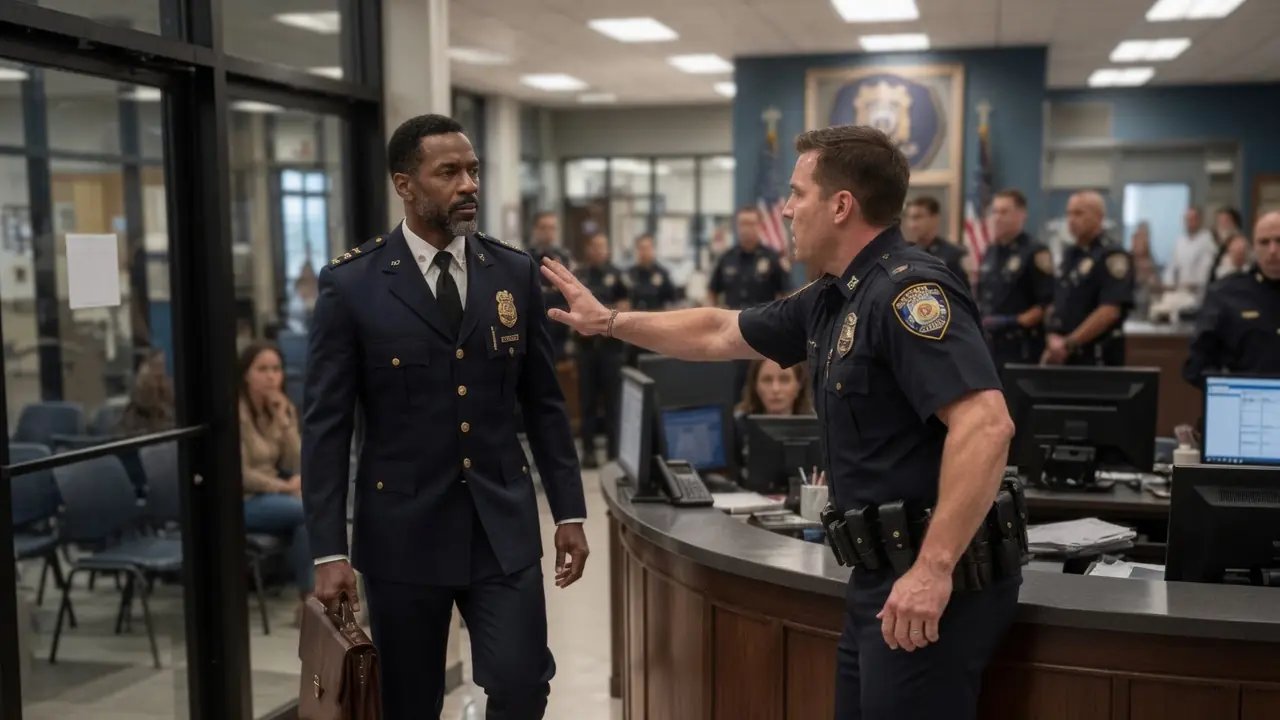
At exactly 8:50 on Monday morning, Sergeant Garrett Caldwell grabbed Marcus Reed by the shoulder, twisted his arm behind his back, and drove him against the curved front desk of Riverside Police Department. Marcus’s leather briefcase struck the polished floor and burst open, scattering sealed reports, personnel files, and photographs beneath the shoes of officers who did nothing to stop the assault. A receptionist gasped, while three patrolmen near the hallway watched with the casual interest of men who had seen this kind of humiliation before. Nobody asked Marcus’s name.
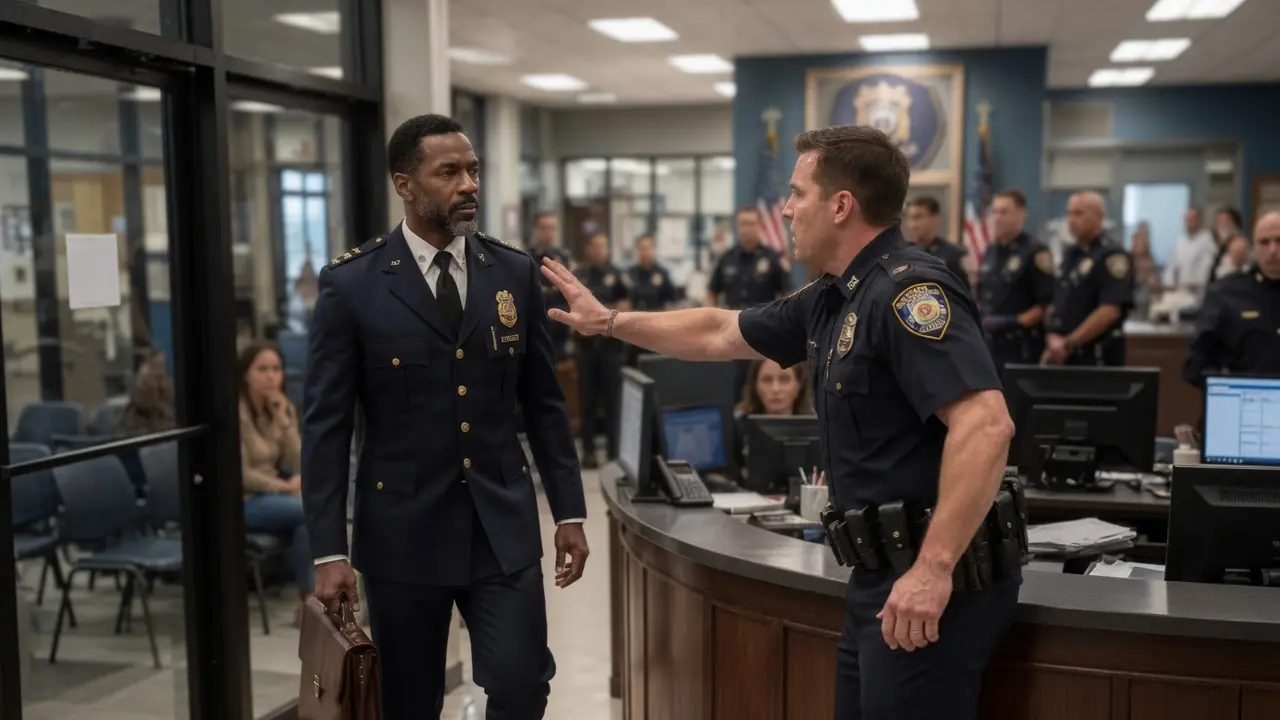
Caldwell pressed his forearm across the back of Marcus’s neck. He was forty-five, thick through the shoulders, with close-cut brown hair and the restless anger of a man who treated every unfamiliar face as a challenge to his authority. His uniform was perfectly pressed, his boots shined, and the silver sergeant’s stripes on his sleeves suggested experience. Nothing about his conduct suggested discipline.
Marcus kept both hands visible even as Officer Kyle Denton seized his wrists and locked them in steel cuffs. His cheek scraped against the desk, but his expression remained controlled. The gold badge pinned to his dark navy command coat was partly hidden beneath Caldwell’s forearm, though enough of it remained visible for anyone willing to look. The officers surrounding him had already decided what they were seeing.
“Impersonating an officer inside a police station,” Denton said, tightening the cuffs. “That takes nerve.”
Marcus turned his head slightly. “Read the badge.”
Caldwell pushed him harder. “You don’t give orders here.”
Behind the reception counter, dispatcher Emily Ross looked from Marcus’s uniform to the digital schedule glowing on her monitor. The city had announced the appointment of Riverside’s new police chief two weeks earlier, but most officers had seen only one official photograph during a rushed email briefing. The image showed Marcus in glasses, standing beside the mayor under different lighting, with a shorter beard than he wore now.
Emily moved her hand toward the desk phone.
Caldwell noticed. “Don’t call anyone. I’ve got this.”
Marcus heard the words and understood immediately that Caldwell was not afraid of making a mistake. He was afraid of someone interrupting him before he had finished demonstrating control.
Riverside Police Department occupied a renovated municipal building in the center of a city that had spent years pretending its problems were administrative. The lobby looked modern, with glass doors, bright ceiling panels, polished tile, and a large department seal mounted behind the reception desk. Beyond those clean surfaces lay missing evidence, altered complaints, unexplained cash seizures, and a culture where officers protected the department by protecting one another.
Marcus had been appointed to change that.
The mayor had offered him a formal arrival ceremony, complete with reporters and city council members. Marcus declined. He wanted to enter the department on an ordinary morning and see how it behaved when no one expected a performance. Only the mayor, city attorney, and the state’s Office of Public Integrity knew he would arrive early and alone.
The brown briefcase on the floor contained the reason.
For six months, state investigators had quietly reviewed allegations involving Riverside officers. Evidence envelopes arrived at the county laboratory lighter than when they left the station. Cash seized during vehicle searches disappeared from official totals. Internal complaints were marked resolved without interviews. Several civilians claimed they were threatened after requesting body-camera footage.
One name appeared repeatedly: Sergeant Garrett Caldwell.
Marcus had read every file before accepting the position. He knew Caldwell supervised the front desk on Monday mornings, approved evidence transfers, and controlled access to the department’s complaint system. What Marcus had not known was how quickly the man would reveal himself.
“Search the briefcase,” Caldwell ordered.
Officer Denton crouched beside the scattered documents. Most folders were sealed with red labels reading CONFIDENTIAL — OFFICE OF PUBLIC INTEGRITY. One carried Caldwell’s name in bold black letters.
Denton froze.
“What?” Caldwell demanded.
“There’s something here with your name.”
Marcus felt the pressure against his neck increase.
Caldwell kicked the folder beneath the desk before anyone else could see it. “Evidence planted by an impersonator.”
A woman seated in the waiting area stood halfway from her chair. She was middle-aged, wearing a grocery-store uniform beneath a worn jacket, and had been waiting to report that her son’s property had vanished after an arrest.
“That man told you to check his badge,” she said. “Why won’t you check it?”
Caldwell turned toward her. “Sit down before I remove you.”
Marcus memorized her face.
Around them, phones continued ringing. A printer produced citation forms. An officer walked past carrying coffee and deliberately looked away. The department had not stopped functioning because a man was pinned against its desk; it had simply adjusted around him.
That normalcy disturbed Marcus more than the cuffs.
He had spent twenty-two years in law enforcement, beginning as a patrol officer in a neighborhood where residents trusted firefighters more than police. He rose through investigations, professional standards, and citywide operations by learning that corruption rarely survived through one powerful person alone. It survived because ordinary people decided silence was safer than conflict.
Marcus had come to Riverside expecting resistance. He had not expected the department to provide such a complete demonstration before he introduced himself.
Caldwell leaned close. “Where did you get the uniform?”
“It was issued by the city.”
“Who made the badge?”
“The same office that will collect yours.”
Denton laughed nervously, but Caldwell did not. He twisted Marcus’s cuffed wrists upward until the metal cut deeper into his skin.
“You think you’re clever?”
“I think every camera in this lobby is recording you.”
That made several officers glance toward the ceiling.
Caldwell smiled. “Those cameras haven’t worked in months.”
Marcus had suspected as much. The maintenance records inside his briefcase showed that Riverside paid a technology contractor nearly eighty thousand dollars to replace the lobby surveillance system. Yet state technicians had found no evidence that new cameras were ever installed.
The contractor belonged to Caldwell’s brother-in-law.
Marcus looked toward the small black dome above the entrance. “Then you just admitted the city paid for equipment that does not work.”
Caldwell’s expression hardened.
Before he could respond, a radio crackled behind the counter.
Emily Ross leaned toward the speaker. Her eyes remained fixed on the station schedule.
“Riverside dispatch, confirm status of incoming executive arrival,” a voice said.
Nobody answered.
The voice returned, sharper this time.
“Riverside dispatch, state command requesting confirmation. Newly appointed Chief Marcus Reed was scheduled to enter your lobby at 8:50. His security transponder shows him inside the building. Confirm visual contact.”
Silence fell so suddenly that the hum of the ceiling lights became audible.
Caldwell’s hand loosened.
Emily looked at the photograph on her monitor, then at the man bent over the desk.
Her face lost all color.
“Confirmed,” she whispered into the radio. “Chief Reed is… inside the lobby.”
The officers behind Marcus stopped moving.
Denton looked down at the gold badge now fully visible on Marcus’s coat. The words around its center were unmistakable:
CHIEF OF POLICE — RIVERSIDE
Caldwell stepped backward. “No.”
Marcus slowly raised his head.
The lobby doors opened behind them, and Deputy Chief Elena Torres entered with City Attorney Daniel Price and three investigators from the Office of Public Integrity. They had been waiting in a vehicle across the street, prepared to enter only after Marcus completed his initial assessment.
They had heard the radio traffic.
Elena stopped when she saw the cuffs.
She was forty-eight, composed, and known for speaking most softly when she was angriest. She looked first at Marcus’s wrists, then at Caldwell.
“Remove them.”
Caldwell reached for the key. “Chief, there was a misunderstanding.”
Marcus remained against the desk. “Let Officer Denton remove them. I want your hands where everyone can see them.”
The room went still again.
Denton unlocked the cuffs, avoiding Marcus’s eyes. Red marks circled both wrists. One had begun to swell.
Marcus straightened his coat, recovered his badge, and looked around the lobby. He did not shout. He did not threaten anyone. He simply picked up one of the documents scattered near his shoes.
It was the personnel complaint filed six months earlier by Officer Rachel Kim, who alleged that Caldwell ordered her to rewrite a use-of-force report after another officer struck a handcuffed teenager.
The complaint had been marked withdrawn.
Rachel insisted she had never withdrawn it.
Marcus placed the file on the desk.
“Sergeant Caldwell, surrender your badge, weapon, radio, and access card.”
Caldwell stared at him. “You cannot suspend me over an identification mistake.”
“This is not about one mistake.”
“You walked in without introducing yourself.”
“I attempted to speak. You chose force before verification.”
“You looked suspicious.”
Marcus glanced at his full command uniform. “Explain what appeared suspicious.”
Caldwell said nothing.
Marcus pointed toward the folder hidden beneath the desk. “Then explain why you kicked a state corruption file out of sight after seeing your name.”
Denton looked at Caldwell.
That movement was small, but it changed the room. For the first time, one of Caldwell’s own officers seemed less afraid of Marcus than of the man he had followed.
Caldwell reached toward his belt.
Elena stepped forward immediately. “Hands away from the weapon.”
“I’m surrendering it.”
“Slowly.”
He removed the firearm and placed it on the counter. Then came the radio, badge, access card, and handcuff key. Each object landed with a quiet sound that carried through the station.
Marcus turned toward Denton. “You are temporarily relieved of duty pending review.”
Denton’s face tightened. “I was following my sergeant’s order.”
“You handcuffed a man without asking his identity, stating an offense, or checking the badge on his chest.”
“He told me the uniform was fake.”
“And you decided belief replaced verification.”
Marcus looked toward every officer in the lobby.
“That ends today.”
Caldwell tried to leave through the side corridor, but two integrity investigators blocked him. Daniel Price handed him a preservation notice ordering him not to delete messages, access department computers, contact witnesses, or enter evidence-storage areas.
Caldwell laughed bitterly. “You came here planning this.”
Marcus picked up his briefcase. “I came here planning an audit. You planned the rest.”
The first search began within the hour.
State technicians secured the department’s servers before anyone could alter the records. Investigators sealed the evidence room, financial office, body-camera storage, and internal-affairs archive. Every supervisor surrendered access credentials.
The audit quickly revealed that the department’s corruption was broader than the initial complaints suggested.
Riverside had purchased sixty new body cameras eighteen months earlier. Payment records showed every unit delivered and activated. Investigators found only thirty-eight cameras in service.
Twelve remained unopened in a locked storage room.
Ten were missing entirely.
The technology contractor submitted invoices claiming all sixty had been installed. Caldwell approved each invoice. His brother-in-law’s company received the money, then transferred a portion through a consulting firm controlled by Caldwell’s wife.
The lobby cameras had never been replaced.
Caldwell had not merely known they were broken. He helped ensure they remained broken.
Investigators then opened the evidence vault.
Cash records showed more than four hundred thousand dollars seized during the previous three years. The physical count was nearly one hundred and thirty thousand dollars lower. Several narcotics packages were underweight, and jewelry seized during burglary investigations did not match photographs taken at crime scenes.
Each discrepancy led back to a small group of supervisors.
Caldwell signed most transfer logs.
Lieutenant Peter Shaw approved disposal orders for evidence connected to cases that were still active.
Officer Denton’s name appeared on multiple vehicle seizures involving drivers who were never charged.
Marcus ordered an immediate independent review.
The woman from the waiting area, whose name was Linda Parker, became the first civilian interviewed. Her twenty-one-year-old son had been arrested for an unpaid traffic warrant. Officers seized his phone, work laptop, and six hundred dollars in cash.
The charges were resolved, but the property room returned only the phone.
When Linda filed a complaint, Caldwell told her no laptop or cash had ever been recorded.
She had brought purchase receipts and bank records to the station that morning, hoping someone new might listen. Instead, she watched officers assault the man appointed to change the department.
“I thought they were going to do to you what they did to everyone else,” she told Marcus.
“They almost did.”
“Why didn’t anybody stop them?”
Marcus looked through the interview-room window at officers being called one by one into formal questioning.
“That is what we are going to find out.”
The answer emerged slowly.
Some officers participated directly in the thefts. Others falsified reports. Several knew what was happening but feared retaliation. New recruits learned quickly that questioning Caldwell led to undesirable shifts, failed evaluations, or complaints appearing in their files.
Officer Rachel Kim had challenged an altered report.
Within a month, she was reassigned from investigations to overnight property patrol. Her overtime disappeared, and anonymous complaints accused her of insubordination. When she refused to withdraw her allegation, someone accessed the internal system using her credentials and marked the case closed.
Rachel still had the email in which Caldwell warned her to “choose loyalty before paperwork destroys your career.”
Marcus reinstated her complaint and placed her under whistleblower protection.
The investigation expanded beyond missing property.
Traffic-stop data showed Riverside officers disproportionately searched vehicles driven by Black and Latino motorists, particularly those entering from neighboring counties. Reports repeatedly used identical phrases: “nervous behavior,” “inconsistent travel explanation,” and “odor associated with contraband.”
In dozens of cases, no illegal items were found.
Drivers still lost cash through civil forfeiture.
A private towing company stored seized vehicles and charged daily fees. Its owner was Lieutenant Shaw’s cousin. When drivers could not pay, the company auctioned the cars to buyers connected to Riverside officers.
One vehicle appeared in Caldwell’s home garage.
It had been seized from a nurse who was never charged with a crime.
When investigators served a warrant at Caldwell’s house, they found the vehicle, missing evidence jewelry, department ammunition, and three body cameras that had been listed as destroyed.
They also recovered a laptop containing duplicate internal-affairs records.
Caldwell had maintained private files on officers, city officials, lawyers, and residents. Each file listed personal weaknesses, financial problems, family disputes, and incidents that could be used as pressure.
Marcus’s file was new.
It contained articles about his appointment, the address of his home, and photographs of his teenage son leaving school.
The discovery changed the investigation from institutional fraud to a direct threat against Marcus’s family.
He sat alone in his new office after viewing the photographs. That morning, his son Isaiah had asked whether being chief meant Marcus would finally have more control over his schedule.
Marcus had promised to attend Isaiah’s debate final on Friday.
Now officers were being placed outside the school.
Elena entered without knocking. “Your son is safe.”
“I brought him into this.”
“No. Caldwell did.”
“I accepted the position knowing the department was compromised.”
“You did not know they were tracking your child.”
Marcus looked at the photo of Isaiah walking toward a city bus, unaware someone had photographed him from across the street.
“I should call him.”
“You should tell him the truth.”
Marcus smiled without humor. “Parents spend years convincing their children we can protect them from anything.”
“Your son is old enough to know protection does not mean danger never appears.”
Marcus called.
Isaiah listened quietly. He was sixteen, perceptive, and already tired of adults assuming his father’s calm meant he felt no fear.
“Are you quitting?” Isaiah asked.
“No.”
“Good.”
Marcus paused. “That is all you have to say?”
“No. I’m angry. But if you quit because they tried to scare us, then they learn it works.”
Marcus closed his eyes.
His son sounded more certain than he felt.
By the end of the first week, nine Riverside officers were suspended. Three civilian employees were placed on administrative leave, and the district attorney reopened forty-seven cases involving disputed evidence.
The city council held an emergency public meeting.
Residents filled the chamber, carrying complaint letters, property receipts, photographs, and court documents. Some had spent years being told their stories were isolated misunderstandings.
Now the pattern was visible.
Marcus addressed them without standing behind a podium.
“What happened to me in that lobby was wrong,” he said. “But it would be a failure if this department changed only because the person assaulted happened to be the new chief.”
The room became quiet.
“Authority should not depend on whether the person being mistreated has a title powerful enough to punish the officer afterward. Every resident deserved the verification, restraint, and dignity I was denied.”
Linda Parker sat in the front row.
Rachel Kim stood beside the wall with several officers who had agreed to testify.
Marcus continued.
“This investigation will not end with suspensions. Property will be returned. False reports will be corrected. Wrongful cases will be reviewed publicly. Anyone who retaliates against witnesses will lose the protection of this department.”
The reforms began immediately.
Riverside’s evidence room was transferred to civilian management under independent oversight. Every item received a digital photograph, weight, barcode, and dual-person verification. Cash went directly into a controlled account rather than remaining inside station lockers.
Body cameras activated automatically when officers left patrol vehicles.
Turning one off required a verbal explanation recorded by the system. Missing footage triggered outside review rather than internal dismissal.
Civilians could submit complaints through a state-hosted portal that Riverside supervisors could not alter.
Searches, seizures, and use-of-force incidents were reviewed by rotating panels that included legal experts and community representatives.
Marcus also changed promotion rules.
Supervisors would no longer advance based primarily on arrest totals or loyalty recommendations. Complaint history, accuracy, de-escalation, evidence handling, and testimony from junior officers became part of every review.
Some officers resigned rather than accept the new standards.
Marcus approved each resignation without negotiation.
Caldwell’s trial began eight months later.
Prosecutors charged him with evidence theft, fraud, unlawful detention, retaliation, falsifying public records, conspiracy, and misuse of confidential information. Lieutenant Shaw and the contractor who billed the city for nonexistent cameras faced related charges.
Caldwell’s attorney argued that the lobby confrontation had been an unfortunate misunderstanding exaggerated by Marcus for political advantage.
The prosecution played the station radio recording.
“Confirming arrival of newly appointed Chief Marcus Reed. Scheduled arrival time was 8:50 a.m.”
Then jurors watched footage captured by a visitor’s phone.
Caldwell’s hand was pressed against Marcus’s neck. Denton tightened the cuffs. Marcus repeatedly asked them to check the badge.
Most damaging was the moment Caldwell kicked the corruption folder beneath the desk.
The action demonstrated that he understood exactly why Marcus was there before the radio confirmed his identity.
Rachel testified about the altered use-of-force report.
Linda described the missing laptop and cash.
Financial experts traced city payments from the camera contractor into Caldwell’s family accounts.
The physical evidence recovered from his home matched items reported missing from Riverside’s vault.
Caldwell took the stand against his attorney’s advice.
He claimed the department required strong leadership and that officers sometimes had to ignore procedure to control dangerous situations. The prosecutor asked what danger Marcus presented while carrying a briefcase and wearing a command badge.
Caldwell replied, “He walked in like he owned the place.”
Marcus heard the answer from the gallery.
It explained everything.
Caldwell did not attack because he believed Marcus was dangerous. He attacked because Marcus entered without displaying fear.
The jury convicted him.
Shaw and the contractor were also convicted, while several officers accepted plea agreements requiring restitution and testimony. Denton received a reduced sentence after cooperating, though Marcus rejected requests to restore his position.
Following orders did not erase responsibility.
The city established a restitution program funded through recovered assets, insurance settlements, and the sale of unlawfully obtained property. Linda’s son received compensation for the missing laptop and cash. The nurse recovered the value of her vehicle. Other families received payments for legal expenses, lost work, and property that could not be returned.
More than thirty criminal cases were dismissed or retried after evidence problems were confirmed.
Riverside’s reform did not happen quickly.
Trust returned in small, uncomfortable steps. Officers attended public review meetings where residents could question them directly. Supervisors were required to explain complaint outcomes in language civilians could understand.
Rachel Kim became head of Professional Standards.
Emily Ross, the dispatcher who confirmed Marcus’s identity over the radio, helped design an alert system ensuring executive appointments, warrants, and legal notices reached every shift without depending on one supervisor.
Marcus kept the curved front desk.
Some council members wanted it replaced because of what happened there. Marcus refused.
Instead, he placed a small plaque on the lobby side where officers and residents could see it:
VERIFY BEFORE FORCE. AUTHORITY DOES NOT EXCUSE ASSUMPTION.
One year after his arrival, Marcus entered the lobby at 8:50 again.
This time, no ceremony had been announced.
The waiting area held residents filing reports. Officers moved between desks. Phones rang and printers hummed, just as they had the morning Caldwell attacked him.
The difference was visible in the details.
A young officer sat beside an elderly man and carefully explained a property receipt. Another turned on his body camera before beginning a tense conversation. A supervisor intervened when a resident raised his voice, not by threatening him, but by moving the discussion to a quieter room.
Linda Parker now worked part-time as a civilian community liaison.
She saw Marcus enter and smiled.
“No briefcase today?”
Marcus held up an empty hand. “I thought I would try arriving without creating a crisis.”
Rachel approached from the hallway carrying a stack of completed audit reports.
“Chief, the annual evidence count is finished. No unexplained discrepancies.”
“That should not feel like a victory.”
“Not eventually,” she said. “Today, it does.”
Marcus looked toward the desk where his face had been pressed against the wood. The polished surface still carried a faint scratch near the edge.
He could have ordered it repaired.
He chose not to.
Isaiah once asked why his father continued working inside a building that had greeted him with violence. Marcus answered that leaving would have protected him, but staying gave him the chance to protect everyone who entered after him.
The radio call had turned every badge in Riverside pale because it revealed whom the officers had attacked.
The investigation that followed forced the city to confront a harder truth: Marcus’s identity should never have been the reason the assault became unacceptable.
He had entered as the new police chief.
But even if he had been a stranger, a confused visitor, or an ordinary resident carrying no gold badge at all, he still deserved the chance to say his name before anyone put him in handcuffs.