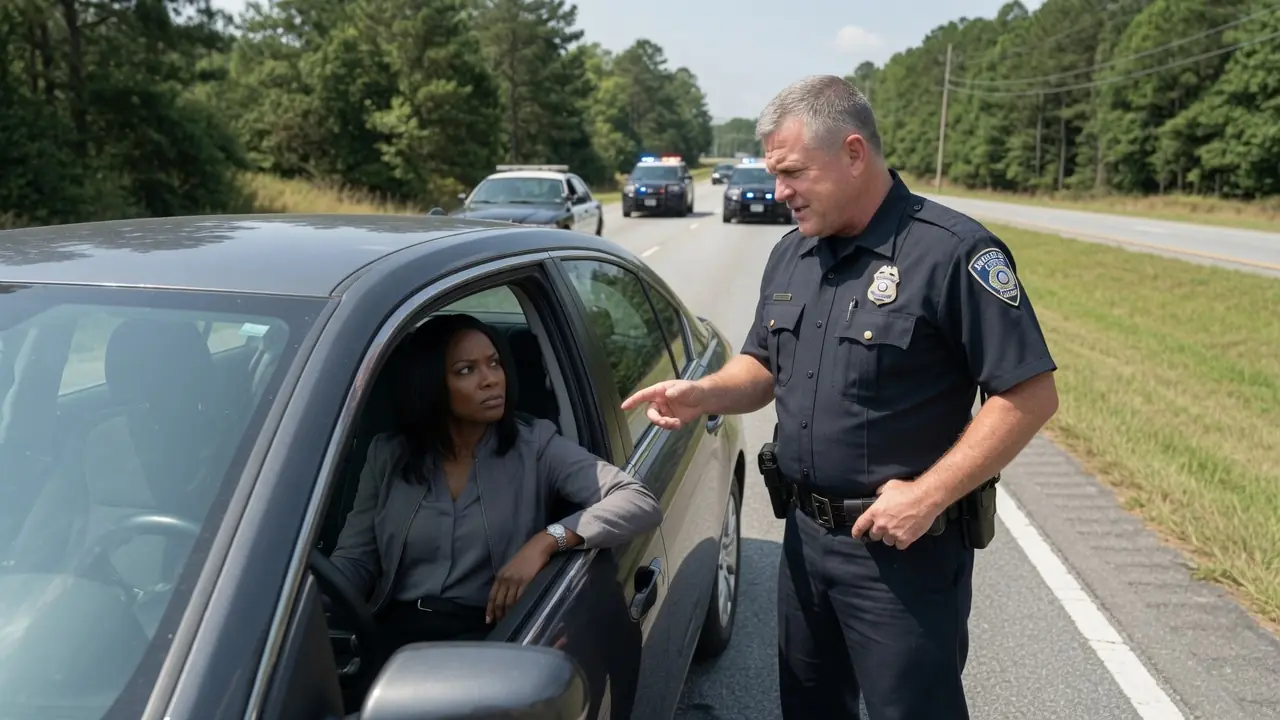
“Give me five hundred dollars now, or I’ll plant drugs in your car, seize it, and make sure no judge believes you.”
Officer Randall Burke leaned through the open driver’s window as though extortion were simply another traffic procedure. His broad body blocked the afternoon light, and one hand rested close to the weapon on his belt while the other remained open, waiting for money. Behind him, his patrol cruiser sat angled across the rural Georgia highway, hidden from passing traffic by a bend lined with pine trees.
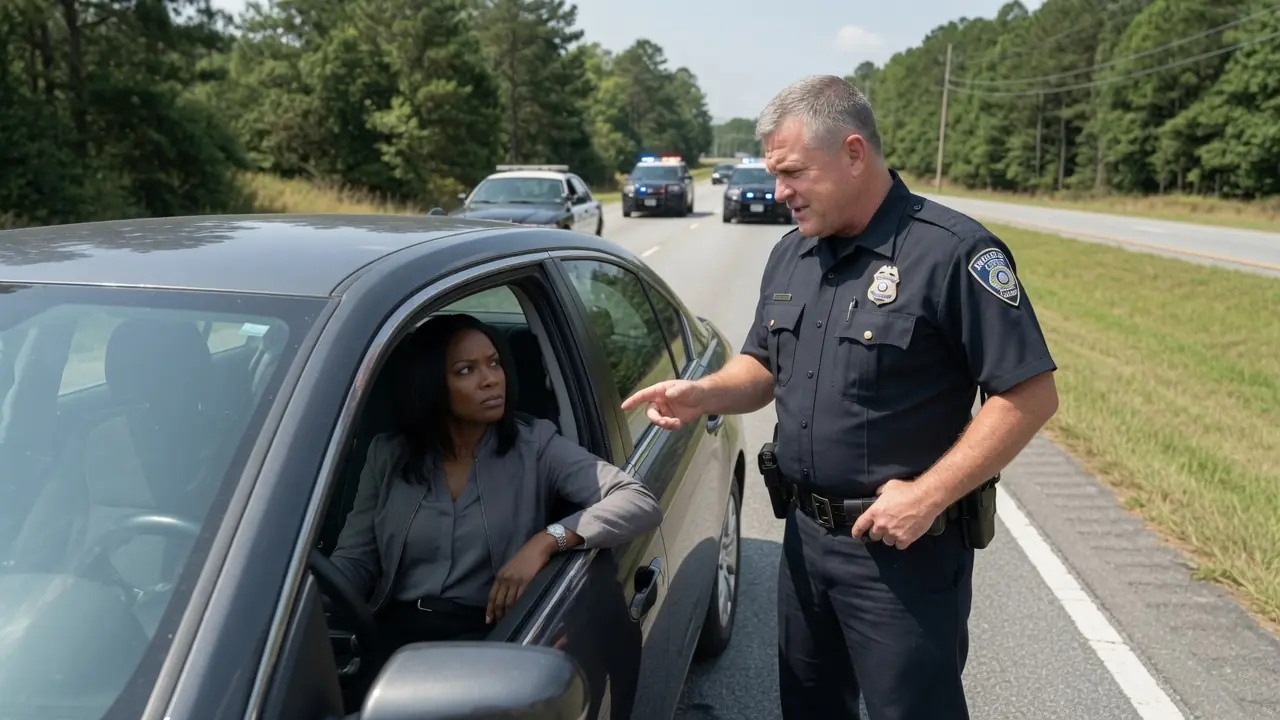
Vanessa Cole kept both hands where he could see them.
She was thirty-five, composed, and dressed casually in a gray zip-up jacket over a dark blouse. Her straight black hair rested against her shoulders, and a silver watch marked the time precisely: 4:17 p.m. Beneath the center console, a concealed microphone was recording every word.
“You stopped me for driving three miles over the limit,” Vanessa said.
Randall smiled without warmth. “That was before I smelled marijuana.”
“There is no marijuana in this car.”
“I haven’t searched it yet.”
“You don’t have probable cause.”
His expression changed when she used the phrase.
Most drivers he targeted became frightened the moment he mentioned drugs, jail, or vehicle seizure. They apologized, begged, and reached for whatever cash they carried. Vanessa’s calmness did not make him suspicious of her identity; it made him eager to punish her.
“You people always think knowing a few legal words makes you untouchable,” Randall said. “Open your purse.”
Vanessa looked toward the body camera attached to his uniform. The indicator light was off.
“Why isn’t your camera recording?”
“It malfunctioned.”
“Again?”
Randall’s eyes narrowed. “What does that mean?”
“It means departmental records show your camera malfunctioned during eleven stops in six months.”
For the first time, the officer stepped back.
Vanessa reached slowly beneath her jacket and removed a black credential wallet. She opened it beside the window, revealing a gold shield and federal identification.
“You just tried to rob the FBI agent investigating you.”
Randall stared at the badge.
Shock passed through his face, but it lasted only a second. Then arrogance returned, strengthened by the protection he believed surrounded him. He reached toward his radio and gave a quiet laugh.
“That badge means nothing out here,” he said. “My captain owns this county and buries every complaint.”
Vanessa tapped the concealed microphone beneath the dashboard.
“Perfect,” she replied. “He’s the second name on my wire, and those black SUVs are coming for both of you.”
Randall turned toward the highway.
Three dark federal vehicles appeared around the distant curve.
He grabbed his radio.
“Captain, we have a problem.”
The response came immediately.
Captain Warren Doyle’s voice crackled through the speaker. “Control the scene. I’m three minutes out.”
Vanessa heard the order clearly.
Randall reached through the window and seized her wrist.
“Get out of the car.”
“You are being recorded.”
“Not by my camera.”
“By four federal devices.”
His grip tightened.
Vanessa did not resist. She had spent eight months building the case, and she knew one emotional reaction could give Randall something to use later. Instead, she stated the time, location, his name, and the fact that he was physically removing her after seeing federal credentials.
Randall yanked the door open.
He ordered Vanessa onto the shoulder and placed her against the rear quarter panel. Gravel pressed beneath her shoes while he searched her jacket and removed the badge from her hand. He looked at it again, perhaps hoping the letters would rearrange themselves into something less dangerous.
“You could have bought that online,” he said.
“The verification number is printed beneath my photograph.”
“I don’t answer to your agency.”
“You will.”
The first federal SUV was less than half a mile away.
Randall suddenly raised his radio.
“Suspect became aggressive after presenting fraudulent law-enforcement credentials,” he reported. “Possible armed impersonator. Requesting immediate assistance.”
Vanessa almost smiled.
He was writing the lie in real time, exactly as previous victims had described. His reports always transformed calm drivers into threats. Refusal became aggression, questions became obstruction, and money discovered during searches became evidence of criminal activity.
“Say it clearly,” Vanessa told him. “You’re inventing an armed threat after attempting to extort me.”
Randall forced her hands behind her back.
“You won’t sound so clever in my holding cell.”
The first black SUV stopped across the lane.
Federal agents exited with weapons kept low but ready. Supervisory Special Agent Daniel Price stepped forward, wearing body armor marked with large yellow letters. Two additional vehicles blocked both directions of the highway.
“Officer Burke,” Daniel called. “Release Agent Cole and step away.”
Randall kept one hand on Vanessa.
“She presented fake credentials and threatened me.”
Daniel held up his phone. “Her live transmitter has been feeding audio to our command vehicle for fifteen minutes.”
Randall stopped breathing for a moment.
Vanessa turned her head toward him. “Including the part where you offered to plant drugs.”
The officer released her wrist.
Daniel ordered him to move toward the center of the road with his hands visible. Randall complied slowly, glancing between the agents and the tree line as though searching for an escape path. Before he reached them, another patrol cruiser raced around the bend.
Captain Warren Doyle had arrived.
He was fifty-three, tall, and heavy through the shoulders, with silver hair and a reputation for defending his officers regardless of evidence. He exited with his service weapon drawn and immediately aimed it toward Vanessa.
“Get on the ground!”
Federal agents shifted positions.
Daniel stepped between them. “Captain Doyle, lower your weapon.”
“She assaulted my officer.”
“We have the entire incident recorded.”
Warren’s eyes moved toward Randall.
The two men communicated silently. Randall gave the smallest shake of his head, confirming the situation was worse than the captain understood. Warren lowered his weapon but did not holster it.
“This is county jurisdiction,” he said.
“Not anymore,” Daniel replied.
Warren looked toward Vanessa. “You entered my county running an unauthorized operation.”
“I entered your county driving on a public road,” she said. “Your officer selected me.”
“We received reports about suspicious vehicles.”
“No report existed before the stop.”
Warren’s confidence flickered.
The federal investigation had begun because of a woman named Angela Price, a sixty-seven-year-old retired schoolteacher. She was driving home from church when Randall stopped her on the same stretch of highway. He claimed her registration was invalid, searched her car, and found eighteen hundred dollars she had withdrawn to repair her roof.
Randall accused her of carrying drug money.
He offered to let her leave if she surrendered the cash. Angela refused, so he arrested her for obstruction and seized the money as suspected criminal proceeds. The charges disappeared two weeks later, but the cash was never returned.
Angela filed four complaints.
Warren dismissed every one.
He wrote that Randall followed departmental procedure and that Angela’s age may have caused confusion about the encounter. When she requested body-camera footage, the department reported that the file had been corrupted.
Angela was not confused.
She contacted the FBI.
Investigators began comparing similar stops across the county. They found dozens of drivers, most of them Black or Latino, who described nearly identical threats. Randall targeted motorists traveling alone, preferably outside town and away from businesses with cameras.
He asked whether they carried cash.
If they did, he invented a reason to search. If they refused, he threatened arrest, drugs, weapons, vehicle forfeiture, or immigration consequences. Some drivers surrendered fifty dollars; others lost thousands.
Randall rarely kept the money alone.
Bank records showed unexplained deposits into accounts controlled by Warren’s wife. A towing company owned by the captain’s brother received abandoned or seized vehicles and sold many of them at private auctions. The county evidence room showed missing cash entries, incomplete property forms, and signatures belonging to employees who denied signing anything.
The corruption was organized.
What federal agents lacked was a direct confession connecting Randall to Warren.
Vanessa had just obtained it.
Daniel informed both officers that they were being temporarily detained while investigators secured the scene. Randall’s face became pale, but Warren remained combative.
“You cannot arrest a police captain based on one roadside misunderstanding.”
“No one said you were under arrest,” Vanessa replied.
Warren looked toward her. “Then I’m leaving.”
“You may try.”
He took one step toward his cruiser.
Two agents blocked him.
Daniel requested the captain’s phone, department radio, and weapon. Warren refused until a federal prosecutor called and read the terms of an emergency preservation warrant. The phone was taken before he could delete anything.
A message arrived while an agent held it.
R: She’s federal. They heard everything.
The captain’s reply had not yet been sent.
Investigators searched Randall’s cruiser.
Inside the trunk, they found several small bags containing marijuana, prescription pills, and white powder later identified as crushed pain medication. None were listed in evidence records. A magnetic container hidden beneath the spare tire held more than nine thousand dollars in cash.
Vanessa stood beside the car while every item was photographed.
Randall watched from the roadside.
“You planted that,” he said.
Daniel looked at him. “The search is being recorded by six cameras.”
“She had access to my vehicle.”
“I never left my car until you pulled me out,” Vanessa replied.
Randall turned toward Warren. “Tell them.”
The captain said nothing.
That silence frightened Randall more than the agents.
For years, Warren had promised that every complaint, missing video, and altered report would disappear. He protected Randall because the roadside robberies funded a larger operation involving cash, towing contracts, vehicle auctions, and campaign donations.
Now Warren was calculating whether sacrificing one officer might save himself.
“You acted alone,” the captain said.
Randall stared at him.
“What?”
“I never authorized illegal searches or theft.”
“You told me which roads to use.”
Warren’s jaw tightened. “Stop talking.”
“You took half.”
“Officer Burke, be quiet.”
Randall laughed in disbelief. “Now I’m Officer Burke?”
Federal agents allowed the argument to continue.
Vanessa did not interrupt. Desperate partners often produced more evidence against one another than interrogation could obtain. The hidden microphone captured every word as loyalty collapsed on the shoulder of the highway.
Randall pointed toward Warren. “He gave me the list of drivers carrying cash.”
Daniel looked at him. “What list?”
Warren shouted, “Do not answer.”
Randall ignored him.
“Bank withdrawals. Business deposits. Insurance checks. People the branch manager flagged.”
The operation was larger than federal investigators had known.
A vice president at Community First Bank had been sharing information about customers who withdrew large amounts of cash. Warren passed the names, vehicle descriptions, and expected travel routes to Randall. The officer stopped them, seized the money, and filed reports suggesting criminal suspicion.
Victims who complained faced intimidation.
Some received code violations, tax reviews, or surprise visits from deputies. One mechanic lost his towing permit after refusing to sign a false statement. A restaurant owner’s teenage son was stopped six times in one month.
Fear kept most people silent.
Vanessa asked Randall for the banker’s name.
Warren stepped toward him. “Not another word.”
An agent moved between them.
Randall’s anger broke through the last of his caution. “Martin Keene. Community First. He called Captain Doyle every Thursday.”
Warren closed his eyes.
That confession turned the roadside stop into an immediate financial-crimes operation. Agents contacted the federal courthouse and obtained expanded warrants before sunset. Teams entered the sheriff’s administration building, the county evidence room, the towing company, and Martin Keene’s bank office simultaneously.
The evidence room was worse than expected.
Cash envelopes listed in reports were empty. Seized jewelry had disappeared, and vehicle titles carried signatures from people who denied approving transfers. Several narcotics packages contained substances different from those recorded during arrests.
Investigators found a private ledger hidden behind filing cabinets.
It listed driver names, amounts seized, vehicle values, and percentages assigned to initials. “RB” appeared beside Randall Burke, “WD” beside Warren Doyle, and “MK” beside Martin Keene.
The entries extended back seven years.
More than two million dollars had been stolen.
That evening, Randall and Warren were formally arrested.
News cameras gathered outside the federal building as agents escorted them from separate vehicles. Warren wore no uniform, but Randall still had his patrol shirt beneath a borrowed jacket. Without the badge and gun, both men looked smaller than their victims remembered.
Vanessa watched from an office window.
She felt no celebration.
The arrests did not return lost homes, repair damaged reputations, or erase nights people spent in jail because they refused to pay. Justice began with stopping the crime, but restoration required much more.
Angela Price arrived the following morning.
She carried the same folder of complaints she had submitted repeatedly. Vanessa met her in a conference room and explained that investigators found a ledger entry corresponding to her eighteen hundred dollars.
Angela listened silently.
“Will I get it back?” she asked.
“Yes.”
“That’s not what I mean.”
Vanessa waited.
“Will someone admit I told the truth?”
The question revealed the deeper injury.
Randall stole her money, but Warren stole her credibility. His official letter described her as confused, emotional, and unable to remember events accurately. Friends quietly wondered whether she misunderstood the stop.
Vanessa slid a document across the table.
It was a formal federal finding stating that Angela’s account matched recovered evidence and that her complaints were improperly dismissed.
Angela read the first page.
Her hands trembled.
“I want this sent to everyone who received the captain’s letter.”
“It will be.”
Only then did she cry.
Over the following months, more victims came forward. A construction worker named Luis Ortega lost four thousand dollars intended for employee wages. Randall threatened to report him to immigration authorities despite Luis being a citizen born in Texas.
Nurse Renee Jackson surrendered seven hundred dollars after Randall claimed her prescription medication belonged to a patient. A college student lost his car because he could not afford storage fees after the towing company held it for six weeks.
Each story followed the same structure.
Randall created the threat.
Warren legitimized it.
The bank supplied targets, and the towing company converted property into profit.
The federal indictment contained racketeering, extortion, civil-rights violations, theft, evidence tampering, conspiracy, money laundering, and obstruction charges. Prosecutors also charged two evidence technicians, the towing-company owner, and Martin Keene.
Warren attempted to negotiate first.
He offered information against Randall in exchange for avoiding prison. Prosecutors rejected the proposal because records proved the captain controlled the operation. Randall then agreed to cooperate and described every payment, false arrest, and warning system.
His testimony helped recover hidden assets.
It did not save him.
At trial, Randall’s attorney claimed he suffered financial pressure and acted under the captain’s authority. The prosecution played the recording from Vanessa’s car.
“Give me five hundred now,” Randall’s voice filled the courtroom, “or I’ll plant drugs, seize your car, and make sure no judge believes you.”
The jury heard his confidence.
They also heard Warren’s voice ordering him to control the scene before the captain arrived. Bank records, messages, ledger entries, and witness testimony supported every part of the case.
Vanessa testified for two days.
The defense attorney attempted to portray the operation as entrapment.
“You deliberately drove through Officer Burke’s patrol area while carrying cash,” he said.
“I drove legally on a public highway.”
“You expected him to stop you.”
“We believed he might.”
“And you created the opportunity for him to request money.”
“No. He created that opportunity repeatedly for years.”
“You provoked him by questioning his camera.”
“I asked why it was off.”
“You showed a badge only after the conversation escalated.”
“I showed it after he threatened to plant drugs.”
The attorney paced before the jury. “Would an ordinary driver have challenged him that way?”
Vanessa looked toward Angela and the other victims.
“Many ordinary drivers did,” she said. “That is why some were jailed, robbed, and disbelieved.”
The courtroom became silent.
Warren’s defense was equally unsuccessful. His attorney argued the captain could not control every officer’s private conduct. Prosecutors responded with messages, payments, target lists, and his direct intervention whenever complaints appeared.
A recorded call between Warren and the bank officer became decisive.
“Don’t flag too many in one month,” Warren said. “We need drivers who won’t have money for lawyers.”
The jury convicted both men.
Randall received a lengthy federal prison sentence and permanent loss of law-enforcement certification. Warren received an even longer sentence because he organized the conspiracy, intimidated victims, and abused command authority.
Martin Keene lost his banking license and went to prison for supplying private customer information.
The towing company was seized.
Its auction lot contained fourteen vehicles linked to questionable stops. Nine were returned to their previous owners, while the remaining victims received compensation from recovered assets.
The county created a restitution fund using seized houses, accounts, vehicles, and cash. Every known victim received repayment with interest, reimbursement for towing and legal costs, and formal correction of false arrest records.
Angela received her eighteen hundred dollars.
She framed the check instead of depositing it immediately.
“It proves they had it,” she told Vanessa.
The state eventually replaced the money so Angela could keep the original document.
Reform came slowly.
Every patrol vehicle received cameras that activated automatically during traffic stops. Officers could no longer search cars based solely on vague odor claims without additional documentation. Cash seizures required immediate electronic receipts, supervisor review, and independent evidence-room confirmation.
No single captain controlled complaints.
Civilian investigators reviewed allegations involving theft, biased policing, missing footage, or retaliatory arrests. The county also created an online system allowing drivers to confirm every item seized before leaving a stop.
Some officers resisted.
They complained that oversight treated them like criminals. Vanessa answered during a public meeting that honest officers benefited when misconduct became harder to hide.
“Trust is not created by demanding belief,” she said. “It is created by making abuse difficult and truth easy to verify.”
A year after the operation, Vanessa drove the same highway again.
The trees, curves, and empty shoulder looked unchanged. A new patrol officer monitored traffic near the location where Randall stopped her. When he pulled over a speeding driver, his camera activated automatically before he left the cruiser.
He introduced himself, explained the reason for the stop, and returned the driver’s documents without threats.
The encounter lasted six minutes.
Nothing dramatic happened.
Vanessa considered that the most meaningful result of the case.
Randall Burke robbed drivers because he believed a badge could transform theft into law. Warren Doyle protected him because he believed official reports mattered more than the people describing what happened.
For years, they were right often enough to become fearless.
Then Randall stopped Vanessa Cole.
He saw a Black woman traveling alone and assumed she would either pay or become another voice his captain could silence. He threatened drugs, jail, seizure, and a fabricated report without realizing every word was traveling directly to federal agents.
When she showed her FBI badge, he went pale.
But the badge was never the reason his conduct became criminal.
It was criminal when he did it to Angela, Luis, Renee, and every driver whose name never appeared in the news. Vanessa’s credentials only prevented him from burying the final complaint.
The real evidence was not the gold shield in her hand.
It was the confidence in his voice when he believed no one important was listening.
This time, everyone was.