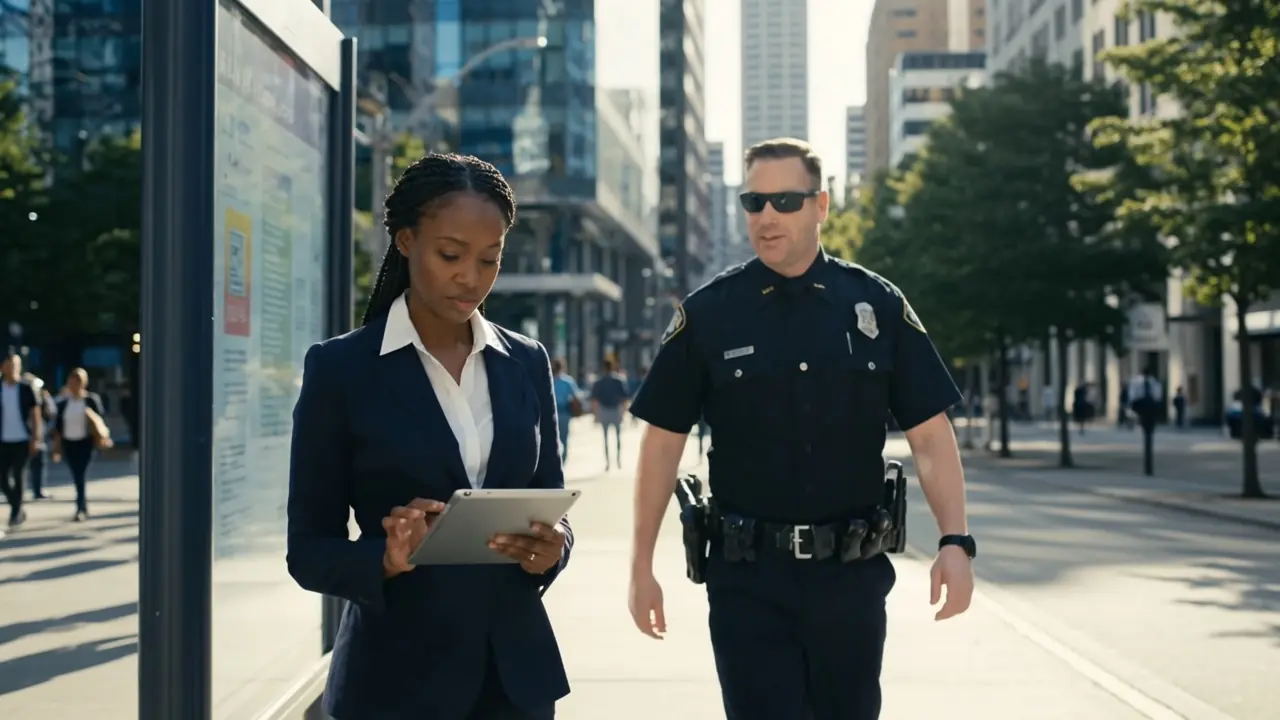
Officer Derek Vaughn thought Simone Carter was just another person standing in the downtown plaza. She looked professional in a tailored navy suit, but to him, that only made her confidence more irritating when she refused his commands. She held a secured tablet against her chest while pedestrians moved between the glass government buildings surrounding them. Ten minutes later, Derek would learn that she was not watching the investigation—she was running it.
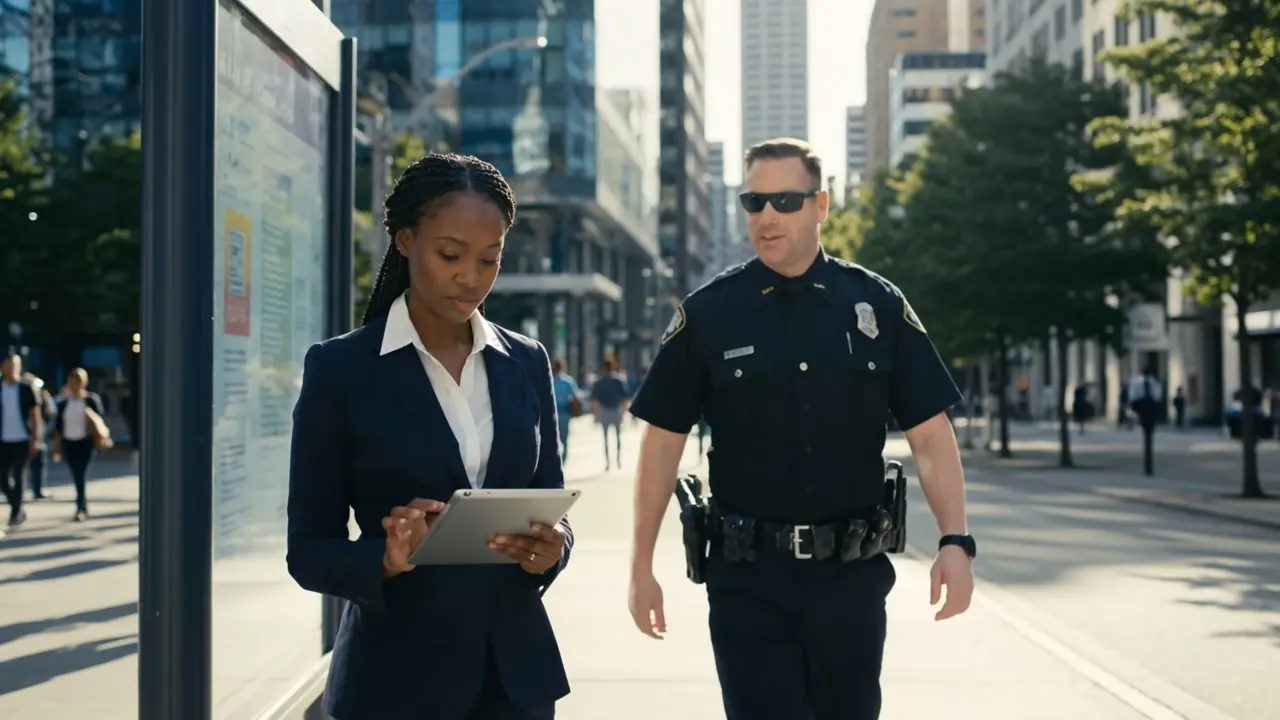
“You’ve been standing here recording officers without permission,” Derek said, stepping directly into her path. “Hand me that tablet now.”
Simone stopped near the public transit map and studied the badge beneath his nameplate. Derek Vaughn, badge number 4176, stood with one hand close to his utility belt and black sunglasses covering his eyes. His body camera was active, but its angle pointed slightly toward the pavement instead of her face. Simone noticed that immediately.
“Your badge does not give you permission to search me or silence a witness,” she replied.
Derek’s mouth tightened. “Refuse again, and I’ll arrest you before anyone here can help.”
Simone turned the tablet just enough for him to see the first page. “Do it. Your badge number is already on the investigation I’m running.”
For half a second, the officer stopped moving.
Then he laughed.
It was the dismissive laugh of a man who believed authority protected him from embarrassment. Derek looked from the encrypted government emblem on the screen to Simone’s calm expression and decided she was bluffing. In his experience, frightened people often invoked lawyers, government agencies, or imagined connections when they realized he controlled the encounter.
“You expect me to believe you’re conducting some kind of investigation?” he asked.
“I expect you to identify the legal basis for detaining me.”
“I’m investigating suspicious activity.”
“What activity?”
“You’ve been observing officers, entering information into that device, and photographing police vehicles.”
Simone glanced toward the opposite side of the plaza. Two patrol officers were questioning a teenage delivery cyclist beside a restaurant entrance while a third searched the insulated bag attached to his bicycle. The teenager had consented only after an officer threatened to impound the bike.
Simone had photographed the patrol car number, not the officers.
“That is not a crime,” she said.
“It becomes one when you interfere.”
“I haven’t spoken to anyone.”
“You’re speaking to me.”
“You approached me.”
Derek removed his sunglasses. His pale blue eyes carried the impatience of someone unaccustomed to having his version of events challenged in real time. People passing nearby had begun slowing, though no one stopped completely. Simone understood their hesitation.
Public confrontations with police attracted witnesses, but fear often kept those witnesses moving.
“Unlock the tablet,” Derek said.
“No.”
“Then place your hands behind your back.”
“Are you arresting me?”
“I’m detaining you until I identify what information you’ve collected.”
Simone maintained eye contact. “A detention requires reasonable suspicion connected to a specific offense. Observing public employees in a public plaza does not meet that standard.”
Derek reached for the tablet.
Simone stepped back.
His other hand immediately moved toward his cuffs. “Stop resisting.”
“I am holding my own property.”
“You pulled away from an officer.”
“Because you attempted an unlawful seizure.”
The nearby delivery cyclist turned toward them. One of the officers beside him followed his gaze, then exchanged a look with his partner. Derek’s voice rose, not because Simone threatened him, but because the growing audience threatened his control.
“Put it on the ground,” he ordered.
Simone lowered the tablet carefully onto a concrete bench. She did not want Derek claiming she had swung it, hidden it, or used it as a weapon. She raised both empty hands where his body camera could see them.
“My name is Simone Carter,” she said clearly. “I am not consenting to a search of my person or property.”
Derek seized her left wrist.
He twisted her arm behind her back and pressed her against the transit display. Simone felt the edge of the metal frame against her shoulder, but she did not struggle. Her training taught her to remain physically compliant while repeating the facts.
“I am not resisting,” she said. “I am requesting a supervisor.”
“You don’t get to direct my investigation.”
“Then your investigation will explain itself on video.”
Derek secured one cuff.
The second clicked around her other wrist.
Several people had stopped now. A woman in hospital scrubs held her phone at chest level, openly recording. A construction worker near the curb asked why Simone was being arrested.
Derek turned toward him. “Keep moving unless you want to join her.”
The man remained where he was.
Simone looked toward the officer’s camera. “The time is 2:14 p.m. Officer Derek Vaughn has handcuffed me after demanding access to confidential material without a warrant.”
“Confidential material?” Derek repeated. “So you admit you’re carrying restricted information in public.”
“I am authorized to possess it.”
“We’ll determine that.”
He reached for the tablet.
Simone’s voice hardened. “That device contains protected witness statements. Opening it without authorization could compromise an active federal inquiry.”
Derek picked it up anyway.
The screen had locked automatically.
“Give me the code.”
“No.”
His jaw flexed. “You’re making this worse.”
“For whom?”
One of the other officers approached from across the plaza. Officer Nolan Pierce was younger than Derek and visibly uncomfortable with what he saw. He looked at Simone in cuffs, the gathering witnesses, and the government security markings on the tablet.
“What happened?” Nolan asked.
“She was surveilling us,” Derek said.
Simone answered at the same time. “I documented a public vehicle number while observing an officer interaction.”
Derek pointed toward her. “Do not interrupt.”
Nolan studied the tablet. “That looks like an inspector-general device.”
“It could be fake.”
“The serial tag is government inventory.”
“Then she can explain why she has it.”
Simone turned her head as far as the cuffs allowed. “Agent Nolan Pierce, your body camera is correctly positioned. Please preserve this interaction and contact Captain Elena Morris.”
Nolan’s face changed.
Derek noticed. “You know her?”
“No,” Nolan replied carefully. “But Captain Morris told us a review team would be downtown this week.”
Derek’s grip tightened around the tablet.
“What review team?”
Nolan lowered his voice. “The Department of Justice inquiry.”
Silence settled between the officers.
Simone watched the realization approach Derek without fully reaching him. Pride intervened before reason could. Instead of stepping back, he doubled down.
“Anyone can memorize a captain’s name,” he said. “We’re taking her to headquarters.”
Nolan hesitated. “We should call the captain first.”
“I’m the senior officer here.”
“That doesn’t mean—”
“Return to your assignment.”
Nolan remained still.
Simone recognized the choice forming in him. He had likely watched Derek cross lines before. Perhaps he had remained silent, rewritten reports, or convinced himself that seniority meant experience rather than protection.
Today, too many cameras were recording.
Nolan stepped away and activated his radio. “Dispatch, request Captain Morris to Central Plaza. Possible contact with federal review personnel.”
Derek turned sharply. “Cancel that.”
Nolan did not.
The radio operator acknowledged the request.
Derek pulled Simone away from the transit display. “You’re going into my vehicle.”
She walked without resistance.
As they crossed the plaza, she saw the teenage cyclist still standing beside his open delivery bag. His name was Mateo Ruiz, seventeen years old, and he had been stopped three times in six weeks by officers assigned to Derek’s unit.
His mother had already given Simone a statement.
Mateo recognized her.
“Ms. Carter?” he called.
Derek stopped.
The teenager looked frightened but continued. “You’re the lawyer who talked to my mom.”
Derek turned toward Simone. “You know him?”
“I interviewed his family.”
“For what?”
“For an investigation into repeated unlawful searches conducted by officers in this district.”
Mateo pointed toward Derek. “He was there last time.”
Derek stared at him.
One of the officers near the bicycle lowered his eyes. The plaza had shifted from an ordinary stop into something far more dangerous for the unit—not because anyone carried a weapon, but because separate stories were beginning to connect in public.
Derek pushed Simone toward the patrol car.
“Get in.”
She stopped beside the rear door. “You should wait for your captain.”
“You should have thought about that before obstructing me.”
“You are creating evidence faster than my team could have requested it.”
His face flushed.
He opened the rear door, but before he could guide Simone inside, an unmarked black sedan entered the plaza’s restricted vehicle lane. A government SUV followed it. Both stopped behind Derek’s cruiser.
Captain Elena Morris exited first.
She was a tall Latina woman in her late forties with twenty-three years in law enforcement and no patience for preventable disasters. Behind her came Special Agent Thomas Reed of the Department of Justice and two attorneys from the Civil Rights Division.
Derek went pale.
Captain Morris took in the scene without rushing. She saw Simone handcuffed beside the cruiser, Derek holding the secured tablet, Nolan standing nearby, and at least six civilians recording.
“Officer Vaughn,” she said. “Remove those cuffs.”
Derek tried to speak confidently. “Captain, this woman was conducting unauthorized surveillance and refused to identify herself.”
Morris looked directly at Simone. “Ms. Carter, are you injured?”
“My shoulder hurts, but I do not believe it is serious.”
The captain’s gaze returned to Derek. “I gave you an order.”
He unlocked the cuffs.
Simone brought her arms forward slowly. Red marks circled both wrists. Special Agent Reed photographed them while another attorney retrieved the tablet from Derek using gloves.
Derek’s voice became defensive. “No one told me the investigation team would be operating without credentials.”
Simone reached inside her jacket and removed a leather identification wallet. Derek had never asked whether she possessed credentials. He had ordered her not to move before demanding the tablet.
She opened it.
SIMONE CARTER — SPECIAL COUNSEL, CIVIL RIGHTS INVESTIGATIONS UNIT
Derek read the title twice.
Captain Morris’s expression remained controlled, but anger showed in the tension around her mouth. “Ms. Carter is leading the independent investigation into this district’s street-enforcement practices.”
“I had reasonable suspicion.”
“Of what crime?”
“She was recording officers.”
“Legal.”
“She had confidential information.”
“You discovered that after attempting to seize it.”
“She refused orders.”
“Unlawful orders do not become lawful because they are repeated.”
Derek looked toward the surrounding witnesses. “She baited me.”
Simone flexed her sore wrists. “I was standing beside a transit display taking notes.”
“You knew who I was.”
“I knew your badge number because it appears in eleven complaints.”
The number struck him visibly.
“Eleven?”
“Nine formal civil-rights complaints, one internal allegation involving missing footage, and one pending witness statement.”
Derek turned toward Captain Morris. “You opened an investigation without notifying me?”
Morris answered coldly. “Independent investigations do not begin by warning the subject.”
The hospital worker stepped forward with her phone. “I recorded from the moment he grabbed her.”
The construction worker raised his hand. “I heard her ask for a supervisor before he cuffed her.”
Mateo pointed toward the officers who had searched his delivery bag. “They stopped me for no reason again.”
The separate incident Derek had tried to hide behind suddenly became part of the same scene. Simone looked toward Agent Reed.
“Secure all body-camera footage from the officers present,” she said. “Preserve dispatch traffic, patrol vehicle location history, and the original emergency call that initiated the cyclist stop.”
Derek stared at her.
She had moved from detainee to investigator without changing her tone.
That was what unsettled him most.
Captain Morris ordered Derek to surrender his badge, service weapon, and department phone pending review. He did so reluctantly, each movement slower than the last.
“You’re suspending me because I made a stop?” he asked.
“No,” Morris replied. “I’m suspending you because every decision you made during that stop revealed why the investigation exists.”
The Department of Justice inquiry had begun four months earlier after a public defender noticed a pattern. Black residents, Latino delivery workers, homeless veterans, and teenage cyclists were being stopped throughout the downtown district under vague descriptions like “suspicious presence” and “possible observation of criminal activity.” Searches produced almost nothing, yet resistance and obstruction charges rose dramatically.
Derek Vaughn appeared in more reports than any other officer.
His written statements followed a predictable structure. The person appeared nervous. The person avoided eye contact. The person questioned commands. The person moved a hand unexpectedly.
Body-camera footage frequently began after the moment officers claimed created suspicion.
Complaints disappeared inside the department’s review system. Supervisors classified them as misunderstandings, insufficient evidence, or lawful discretion. Several younger officers admitted privately that Derek taught them how to write reports capable of surviving review.
Simone’s team had arrived in Atlanta to determine whether the problem involved one officer or an institutional practice.
The plaza incident answered part of that question.
Derek had not recognized Simone as powerful, so he treated her exactly as complainants said he treated them. He saw observation as hostility, legal knowledge as resistance, and refusal of consent as proof of guilt.
The public arrest gave investigators more than footage.
It gave them witnesses who had no connection to the earlier complaints.
Over the next several weeks, Simone interviewed dozens of people. Mateo described being searched repeatedly while delivering food to office buildings. A nursing student named Jasmine Lee recalled Derek accusing her of carrying stolen medical supplies because she had textbooks and scrubs inside her backpack.
A retired Army veteran named Charles Benton said Derek ordered him off a public bench because business owners disliked seeing homeless people nearby. Charles was not homeless; he lived three blocks away and waited there for his physical-therapy appointment.
Each story sounded small when isolated.
Together, they formed a system.
The investigation revealed that Derek’s unit informally tracked “productive stops.” Officers who conducted more searches received preferred shifts and stronger performance evaluations, even when the searches produced nothing. Arrests for obstruction were praised because they demonstrated officer initiative.
Supervisors rarely asked whether the original stop had been justified.
Derek did not create the culture alone. But he had mastered it.
He trained younger officers to describe ordinary behavior in threatening language. Looking around became “scanning for escape routes.” Holding a phone became “concealing an unidentified object.” Asking for a reason became “verbally resisting lawful commands.”
Nolan Pierce eventually requested a private interview.
He entered the conference room carrying a flash drive and years of guilt. Nolan admitted Derek encouraged officers to delay body-camera activation until after gaining control of a subject.
“He said the beginning was usually confusing,” Nolan explained. “He said the camera only needed the part that justified the arrest.”
Simone looked at him. “And you followed that instruction?”
“Sometimes.”
“Why?”
“Because officers who challenged him became isolated. Bad schedules, no backup, poor evaluations.”
“That explains your fear. It does not erase your responsibility.”
“I know.”
Nolan handed her the drive.
It contained copies of messages, unofficial training notes, and reports Derek instructed him to modify. The evidence expanded the inquiry to include two sergeants and a lieutenant who approved the practices.
The city announced administrative hearings six months after the plaza arrest.
Derek appeared with a union attorney and claimed Simone had manipulated the encounter to create a dramatic case. His lawyer argued that anyone carrying confidential government records in public deserved scrutiny.
Then the body-camera footage played.
It showed Simone answering questions, stating her identity, offering access to identification, and refusing only the search of her secured tablet. It showed Derek ignoring Nolan’s warning, grabbing Simone, and threatening bystanders.
Most damagingly, it captured Derek saying, “People like you always think knowing a few legal words makes you untouchable.”
He had forgotten that line.
The hearing panel had not.
Derek was dismissed for dishonesty, unlawful detention, attempted unauthorized search, misuse of authority, and a sustained pattern of discriminatory enforcement. His state certification was referred for revocation.
Two supervisors were demoted.
The lieutenant who altered complaint findings resigned before his hearing. Nolan received a suspension and final disciplinary warning, but his cooperation helped expose practices that would otherwise have remained hidden.
Simone supported neither revenge nor easy forgiveness.
She wanted a structure that did not depend on one courageous witness appearing at the right time. The department adopted automatic review of obstruction arrests, strict camera-activation rules, and written justification for searches producing no evidence.
Civilian investigators gained access to complaint files.
Dispatchers were prohibited from converting explicitly biased calls into neutral descriptions without preserving the caller’s language. Officers could no longer claim they had been sent to investigate “suspicious activity” when the original complaint was simply that a Black teenager, Latino worker, or homeless-looking person occupied a public space.
Mateo’s citation was dismissed.
The city compensated him for the repeated stops, and his mother used part of the settlement to help him purchase a small delivery van after graduation. Jasmine Lee completed nursing school and later joined the department’s civilian advisory board.
Charles Benton began speaking to police recruits about dignity, disability, and the danger of confusing discomfort with criminal suspicion.
A year after the incident, Simone returned to the same downtown plaza.
She stood beside the transit map holding a new tablet while pedestrians crossed between office towers. The space looked ordinary again—food carts, cyclists, attorneys, tourists, and workers sharing the same concrete square.
Captain Morris met her near the bench where the first tablet had rested.
“The latest numbers are in,” Morris said. “Unlawful-search complaints are down. Obstruction arrests dropped forty percent.”
“Are officers simply documenting less?”
“We audited the cameras. The change appears real.”
Simone nodded.
Progress did not erase what happened, and statistics could not measure every moment of fear created by authority. But fewer people were being handcuffed because an officer disliked the way they answered.
That mattered.
A young patrol officer approached a man filming an arrest near the fountain. Simone and Morris watched from a distance.
The officer did not demand the phone.
He asked the man to remain outside the working perimeter and confirmed that recording was legal. The interaction lasted less than twenty seconds.
Nothing dramatic happened.
Simone smiled.
“The ordinary moments are the point,” she said.
Captain Morris looked toward her. “You know, Vaughn said you ruined his career.”
“No. He documented it.”
The first time Derek saw Simone in the plaza, he saw a Black woman holding a tablet where he believed she did not belong. He never asked why she was there because he trusted his assumptions more than her answers.
He thought he had found someone easy to intimidate.
She knew he was about to create the clearest evidence her investigation had received.
Only one of them was right.
And ten minutes later, when the cuffs came off and his badge went into an evidence envelope, Officer Derek Vaughn finally learned who had been standing in front of him.
Not another suspicious person.
Not a powerless witness.
The woman running the investigation.