Dr. Adrian Cross heard the woman hit the pavement before he saw her fall.
The sound was small compared with the morning traffic beyond Riverside Park, little more than the slap of a shoe, a sharp gasp, and then the dull impact of a body against asphalt. Adrian had been running twenty yards behind her along the shaded jogging path, keeping an easy pace beneath the green canopy of late-summer trees. He looked up just as the young woman folded sideways near a park bench and did not move again.
Adrian accelerated immediately.
By the time he reached her, two other joggers had stopped several feet away. One woman held both hands over her mouth. An older man stood frozen with his phone in one hand, apparently unable to decide whether to call someone or help.
Adrian dropped to his knees.
“Ma’am?”
No response.
He tapped her shoulder.
“Can you hear me?”
Nothing.
He looked at her chest.
No normal breathing.
He placed two fingers against her neck.
No pulse.
Adrian’s entire world narrowed.
“You.”
He pointed at the older man.
“Call 911. Tell them we have an adult female in cardiac arrest at Riverside Park, east jogging path near the fountain entrance.”
The man blinked.
“Cardiac—”
“Call now.”
That broke the paralysis.
The man dialed.
Adrian turned toward the other jogger.
“Find an AED. Park office, gym, anywhere. Ask everyone.”
She ran.
Adrian positioned his hands.
One over the other.
Center of the chest.
Then he began compressions.
Hard.
Fast.
Precise.
He had done this thousands of times.
Hospital rooms.
Emergency departments.
Parking lots.
Airports.
Restaurants.
Once on an airplane somewhere over Kansas.
Cardiac arrest did not care about titles or surroundings.
It cared about time.
Every minute without effective circulation reduced the chance of survival.
The woman beneath him appeared to be in her late twenties.
Blonde hair.
White athletic top.
Pale-gray leggings.
No obvious trauma.
No signs suggesting she had been struck or attacked.
Adrian continued.
“One, two, three…”
The older man was speaking rapidly into his phone.
“Yes, he’s doing CPR.”
Pause.
“No, I don’t know him.”
Pause.
“He just ran over.”
Adrian ignored the conversation.
His arms locked straight.
Chest recoil.
Depth.
Rate.
The skills were automatic.
But his mind remained alert.
Young woman.
Sudden collapse.
Possible arrhythmia.
Maybe congenital condition.
Maybe undiagnosed cardiomyopathy.
Maybe something no one would know until later.
For now, circulation.
Then defibrillation.
That was the priority.
The first police cruiser arrived before the ambulance.
Adrian heard tires on the park access road.
Then boots.
Two officers ran onto the jogging path.
Officer Derek Harlan was first.
Thirty-nine years old.
Nine years with Columbus-area law enforcement.
Solid build.
Dark hair.
Navy uniform.
His partner, Officer Matthew Keene, followed several yards behind.
Harlan had received a dispatch that was dangerously incomplete.
“Female down. Caller reports male on top of her. Possible assault in progress. CPR mentioned but unconfirmed.”
The dispatcher had been trying to clarify.
Harlan arrived before clarification caught up.
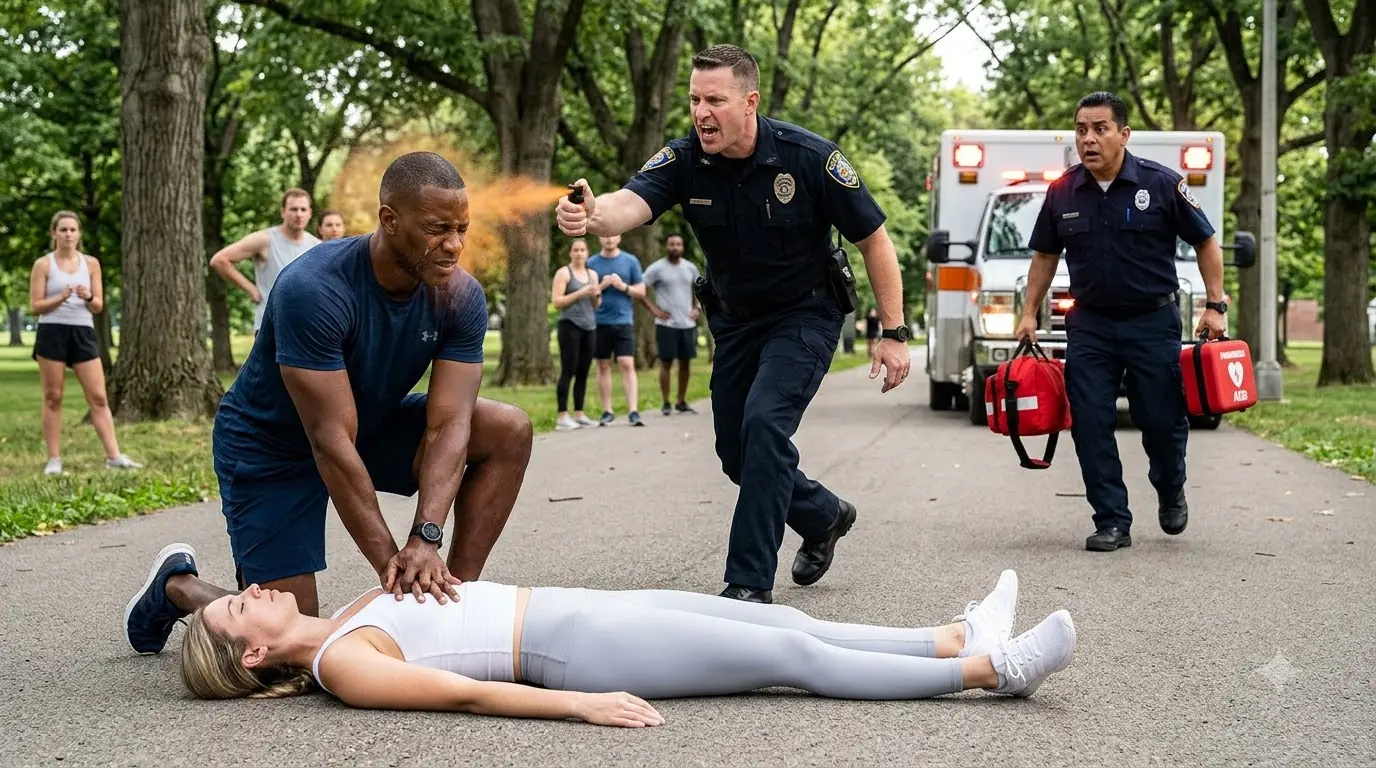
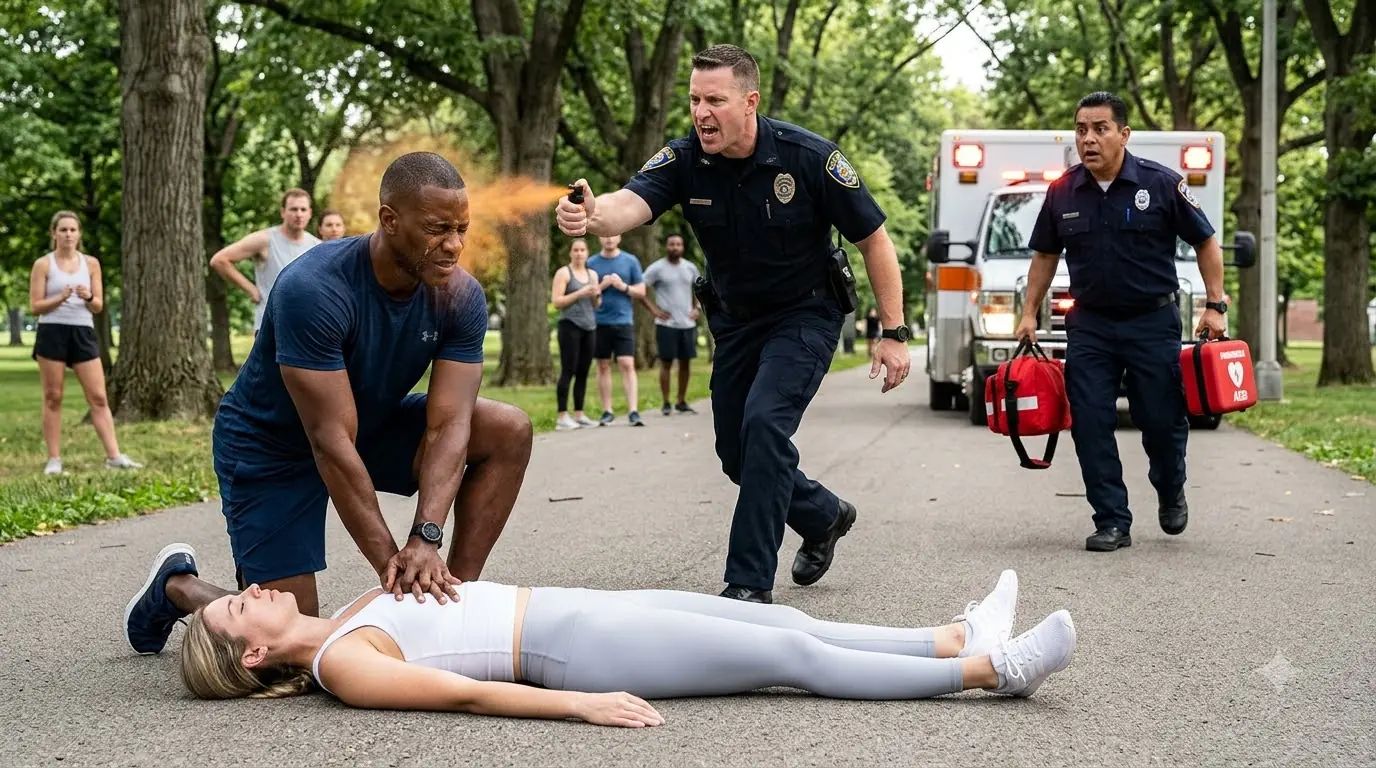
What he saw from forty yards away was a muscular Black man kneeling over a young white woman lying motionless on the pavement.
His hands moved repeatedly against her chest.
Several people stood nearby.
Harlan did not see the medical context first.
He saw the image his mind assembled.
“Police!”
Adrian heard the shout.
He kept compressing.
Harlan ran closer.
“Get away from her!”
Adrian looked up once.
“She’s in cardiac arrest.”
“Move away from the woman!”
“No pulse. Ambulance?”
Harlan slowed but did not stop.
“Get your hands off her.”
Adrian’s face tightened.
“I’m a physician. She needs continuous CPR.”
The older man with the phone shouted:
“He’s helping her!”
Harlan raised one hand.
“Everybody back.”
Adrian continued compressions.
Harlan closed the distance.
“Sir, I am ordering you to step away.”
Adrian’s voice sharpened.
“And I am telling you she will die if compressions stop.”
Those words should have changed the encounter.
They almost did.
Officer Keene arrived behind Harlan and immediately noticed the rhythm of Adrian’s movement.
“Derek.”
Harlan did not turn.
“What?”
“I think he’s doing CPR.”
Adrian snapped:
“I am doing CPR.”
Harlan’s adrenaline had already committed him to control.
He saw a man refusing a direct order.
He saw hands continuing to move.
He heard urgency as defiance.
“Step away now.”
Adrian looked at him.
“No.”
That single word became the point of no return.
Harlan moved closer.
Adrian continued compressions.
“Call EMS.”
“They’re coming.”
“Then let me work.”
“You don’t tell me what to do.”
Adrian stared at him for half a second.
“That woman has no pulse. This is not about you.”
Harlan’s jaw tightened.
The woman who had gone looking for the AED returned at a run.
“I found one!”
She carried a bright red public-access defibrillator.
Adrian pointed.
“Bring it here.”
Harlan stepped between them.
“Back up.”
The woman froze.
Adrian could not believe what he was seeing.
“Officer.”
His voice became lower.
“Move.”
Harlan’s hand went toward the pepper-spray canister on his belt.
Keene saw it.
“Derek, wait.”
Adrian looked from Harlan to the canister.
“You cannot interrupt resuscitation.”
“Last warning.”
Adrian did not stop.
Harlan drew the spray.
The older man shouted:
“What are you doing?”
Adrian turned his face slightly but kept his hands moving.
Harlan fired a short burst.
The spray struck Adrian across the upper face.
Pain came instantly.
Fire.
Eyes.
Nose.
Throat.
Adrian recoiled.
His body instinctively twisted away.
For perhaps two seconds, compressions stopped.
Two seconds.
It felt like an hour.
Then Adrian forced his eyes nearly shut, leaned back over the woman, and resumed.
“Derek!”
Keene grabbed Harlan’s wrist.
“What the hell are you doing?”
Harlan pulled free.
“He refused—”
“He’s doing CPR!”
Adrian coughed.
His eyes streamed.
He could barely see.
Still, his palms found the same place.
Compressions resumed.
The AED woman rushed forward now despite Harlan.
“I’ve got it.”
Adrian’s voice came strained.
“Open it.”
She did.
“Pads.”
Her hands shook.
Adrian tried to guide her.
“Upper right chest. Lower left side.”
The woman hesitated.
Adrian could not see properly.
“Follow the pictures.”
The AED began giving automated instructions.
“Analyzing heart rhythm. Do not touch patient.”
Adrian lifted his hands.
Everyone froze.
“Shock advised.”
Adrian coughed violently.
“Clear.”
The woman pressed the flashing button.
Emily Carter’s body jerked slightly.
“Resume CPR.”
Adrian immediately returned to compressions.
Then the ambulance arrived.
The siren cut off near the park entrance.
Two paramedics jumped out.
Luis Mendoza was first.
Forty-six.
Twenty-one years in emergency medical services.
He carried the cardiac monitor.
His partner, Rachel Kim, carried the airway bag.
Luis saw the scene.
Woman down.
AED open.
Officer standing with pepper spray in hand.
Man doing compressions.
Then Luis saw the man’s face.
Even red and streaming with tears, he recognized him.
Luis stopped.
“Dr. Cross?”
Adrian looked toward the voice.
“Luis.”
Luis stared.
Then everything about his expression changed.
“Jesus Christ.”
He dropped beside Emily.
Rachel began preparing airway equipment.
Luis looked at Harlan.
“What happened to him?”
Keene answered before Harlan could.
“Pepper spray.”
Luis’s eyes snapped toward Harlan.
“You sprayed him?”
Harlan pointed toward Adrian.
“He refused commands.”
Luis stared as though he had heard something incomprehensible.
“That is Dr. Adrian Cross.”
No response.
Luis continued.