PART ONE — SEAT 2B
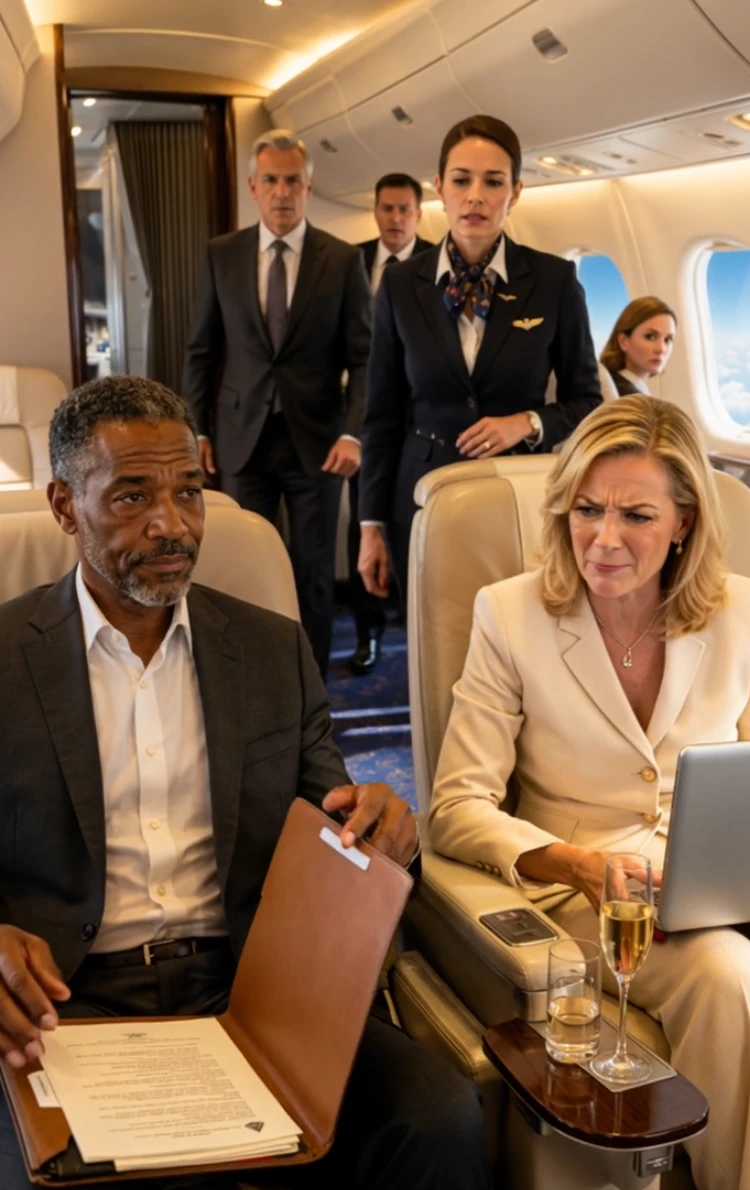
The first thing Marissa Vale noticed about the man in seat 2B was that he did not move when she arrived.
That alone irritated her.
People moved for Marissa.
They moved in hotel lobbies when they recognized her. They shifted at charity dinners so she could have the better chair. They surrendered conference rooms, dinner reservations, and entire afternoons when her assistant called.
At fifty-two, Marissa had spent nearly three decades learning what power looked like when it entered a room.
Usually, it looked like other people standing up.
But the Black man in seat 2B remained exactly where he was.
He appeared to be in his late fifties, perhaps sixty, wearing a charcoal suit that was expensive but not flashy. His shirt was white, open at the collar, and on his lap rested a battered brown leather folder whose corners had gone soft with age.
He looked up when Marissa stopped beside him.
Not deferentially.
Not nervously.
Simply because another human being had entered his field of vision.
“You’re in my row,” she said.
He glanced at the number above the seats.
“Looks that way.”
Marissa waited for the rest.
There was no rest.
She set her handbag down sharply.
“My assistant usually books the adjoining seat.”
“Then your assistant missed this one.”
Marissa stared.
Across the aisle, an older gentleman lowered the newspaper he had been reading.
The boarding line behind Marissa began to stall.
A flight attendant approached with the smooth urgency of someone accustomed to preventing small inconveniences from becoming public dramas.
“Is everything all right, Ms. Vale?”
Marissa turned toward her.
“No. It isn’t.”
The attendant’s nametag read **CAROLINE**.
Caroline glanced at the boarding pass in Marissa’s hand and then at the man.
“Mr. Reed is correctly seated in 2B.”
“I didn’t ask whether he was correctly seated.”
The man’s expression did not change.
Marissa lowered her voice.
“My company has a travel agreement with this airline.”
“Yes, ma’am,” Caroline said.
“We spend nearly three million dollars a year on executive travel.”
“I understand.”
“Then understand this.”
Marissa leaned closer.
“I will not spend three hours squeezed beside someone I do not know.”
Caroline’s face tightened.
“Would you like me to see whether another first-class seat is available?”
“For him?”
Caroline hesitated.
Marissa pointed toward the aisle.
“Either he is reassigned a seat, or your airline forfeits my company’s business forever.”
For a second, nobody spoke.
Then the man in 2B laughed.
It was not loud.
That made it worse.
Marissa’s head snapped toward him.
“What did you say to me?”
The man did not repeat himself.
He simply leaned back, folded his hands over the worn leather folder, and looked toward the window as the final passengers moved into the cabin.
Marissa sat down stiffly in 2A.
“You find something funny?”
“No.”
“You laughed.”
“I did.”
“Then you found something funny.”
He turned slightly.
“I found something familiar.”
Marissa narrowed her eyes.
“Do I know you?”
“No.”
“Then I suggest you stop acting as though you do.”
The aircraft door closed.
Caroline made one final effort.
“Ms. Vale, Mr. Reed, we’ll be departing shortly. I’d appreciate it if we could keep things comfortable.”
The man looked at her.
“For everyone?”
Caroline blinked.
“For everyone, sir.”
Marissa smiled.
“You heard her.”
He met her gaze.
“Embarrassing for whom?”
The smile remained on Marissa’s face, but something underneath it tightened.
A few minutes later, the plane taxied away from the gate.
Dallas slid past the windows in long strips of concrete, glass, and August heat.
Marissa opened her laptop.
The logo of **Vale Meridian Group** appeared on the screen.
She had become CEO seven years earlier after the death of her father, Charles Vale, the company’s legendary founder.
Vale Meridian employed nearly twelve thousand people. It owned hotel-management firms, logistics contracts, high-end commercial properties, and a growing corporate travel division.
Marissa had built her identity around protecting it.
Her father had taught her that companies were not families.
They were kingdoms.
“You cannot be sentimental about a kingdom,” Charles Vale had once told her. “Every throne exists because someone else isn’t sitting on it.”
Marissa had believed him.
She still did.
The plane climbed.
Caroline brought champagne.
Marissa accepted a glass.
The man beside her asked for water.
“You see this?” Marissa said suddenly.
He looked at her laptop.
“This company pays for seats like mine. Hotels like mine. Rooms people like you wait outside of.”
Across the aisle, the older gentleman stopped raising his glass.
Caroline stood frozen with the bottle in her hand.
The man studied Marissa for several seconds.
Then he looked toward the corner of her laptop.
A notification had appeared.
**BOARD EMERGENCY UPDATE — MAJORITY CONTROL TRANSFER CONFIRMED**
His eyes paused on it.
“You really didn’t read it,” he said.
Marissa frowned.
“What are you talking about?”
He opened the leather folder.
Inside lay one sheet of paper, face down.
Then the cockpit door opened.
The captain stepped out.
Behind him came a silver-haired man in a dark suit carrying a tablet.
Marissa recognized him immediately.
Daniel Kovacs.
Senior vice president of corporate accounts for the airline.
She had met him twice.
Both times he had been very eager to please her.
Now he walked straight toward seat 2B.
Caroline stopped breathing.
Daniel looked at the man beside Marissa.
“Mr. Reed,” he said carefully, “we need to speak with you immediately.”
The stranger rested one hand on the face-down document.
Then he looked at Marissa.
“My name is Malcolm Reed,” he said.
His voice remained almost gentle.
“And as of forty-two minutes ago, Ms. Vale, I control fifty-three percent of your company.”
—
## PART TWO — THE MAN HER FATHER ERASED
Marissa did not understand the sentence.
She heard it.
She simply could not make it fit inside reality.
“That’s impossible.”
Malcolm said nothing.
Daniel Kovacs glanced at Caroline.
“Could we have some privacy?”
Privacy was impossible in first class.
Everyone nearby was pretending not to listen.
The older gentleman across the aisle had abandoned the effort completely.
Marissa grabbed her laptop.
The notification remained.
She clicked.
A secured message from the board appeared.
Her eyes moved too quickly at first.
Then slower.
Then very slowly.
**Emergency transaction completed.**
**Reed Capital Consortium has acquired controlling voting interest.**
**Effective immediately.**
Her mouth went dry.
“No.”
She scrolled.
A second message waited beneath the first.
**Mandatory board conference scheduled upon landing.**
Marissa looked at Malcolm.
“You’re Reed Capital?”
“I’m Malcolm Reed.”
“I asked if you’re Reed Capital.”
“Yes.”
She laughed once, but there was no humor in it.
“Reed Capital is a shell.”
“Sometimes a shell is useful.”
“You couldn’t have accumulated that many shares without disclosure.”
“We didn’t.”
“We?”
“Several shareholders agreed to act together.”
“Who?”
“You’ll learn soon enough.”
Marissa’s mind began calculating.
That was how she survived fear.
Numbers.
Voting blocks.
Trusts.
Preferred shares.
Convertible debt.
Her father’s estate still held seventeen percent.
Or it had.
Two board members together held nearly nine.
The employee retirement trust held another eleven.
Then there were institutional investors.
She looked at Malcolm again.
“You’ve been planning this.”
“For thirty-one years.”
That answer stopped her.
Thirty-one.
Marissa was twenty-one when her father took Vale Meridian public.
“What does that mean?”
Malcolm closed the leather folder.
Daniel Kovacs stepped closer.
“Mr. Reed, the captain asked whether you’d prefer to use the crew rest area for the call.”
“No. I’m fine here.”
Daniel nodded.
Marissa looked between them.
Then something occurred to her.
“You knew he was on this flight.”
Daniel’s silence answered her.
She turned to Caroline.
“You knew?”
“No, ma’am.”
“You were about to move him.”
Caroline went pale.
“I was trying to de-escalate—”
“You were about to move him because I told you to.”
Caroline swallowed.
Malcolm looked out the window.
The irony settled over Marissa like cold rain.
Ten minutes earlier, she had assumed the airline attendant’s discomfort was evidence of her own importance.
Now she realized Caroline had nearly made a disastrous mistake.
Yet somehow, the discovery did not shame Marissa.
It angered her.
She turned on Malcolm.
“You set this up.”
He looked back.
“You think I scheduled your behavior?”
“You chose this seat.”
“Yes.”
“You knew I’d be here.”
“Yes.”
“So this is theater.”
“No.”
“It absolutely is.”
Malcolm’s eyes sharpened.
“I chose this seat because I wanted one conversation before lawyers got involved.”
“You could have called.”
“You don’t answer calls from people like me.”
Marissa’s jaw tightened.
“You don’t know anything about me.”
“I know more than you think.”
He opened the leather folder again.
This time he turned the document over.
At the top was a photograph.
Faded.
Taken decades earlier.
Two young men stood outside a low brick warehouse beneath a hand-painted sign.
**REED & VALE FREIGHT SYSTEMS**
One of the men was unmistakably Charles Vale.
Marissa’s father.
The other was Malcolm Reed.
Thirty years younger.
Marissa stared at the picture.
“No.”
Malcolm said nothing.
“My father founded Vale Meridian.”
“That is the story he told.”
“He built it from nothing.”
“He built it from something.”
Malcolm tapped the photograph.
“From this.”
Marissa looked again.
Her father was smiling.
Not the controlled half-smile from corporate portraits.
A real smile.
His arm was around Malcolm’s shoulders.
“What was this?”
“Our company.”
“Your company?”
“Ours.”
Malcolm leaned back.
“Your father and I met in 1986. We were loading overnight freight at Dallas Love Field. Neither of us had money. Neither of us had connections.”
His voice grew quieter.
“But we had an idea.”
In those days, Malcolm explained, small medical suppliers struggled to move emergency parts and equipment between Texas hospitals quickly.
Charles knew sales.
Malcolm knew routing systems.
Together they rented a warehouse and bought two battered vans.
They slept on folding cots.
They drove nights.
They repaired engines themselves.
They built software before most small logistics firms understood what software could do.
“The routing algorithm was mine,” Malcolm said.
Marissa stared at him.
“No.”
“Yes.”
“My father created Meridian routing.”
“No.”
“He received awards for it.”
“I know.”
“He testified before Congress about transportation efficiency.”
“I watched it on television.”
Marissa’s voice rose.
“You expect me to believe he stole it?”
Malcolm’s face did not move.
“I expect you to keep listening.”
In 1991, Malcolm’s wife, Evelyn, became ill.
Cancer.
Aggressive.
Expensive.
Insurance covered far less than they expected.
Malcolm began missing meetings.
Charles began managing investors.
Then came a buyout proposal.
“Your father told me we were weeks away from insolvency,” Malcolm said.
“He offered to buy my interest so I could pay for Evelyn’s treatment.”
Marissa looked toward the window.
“I signed.”
“How much?”
“Two hundred and eighty thousand dollars.”
She almost laughed.
Vale Meridian was now worth billions.
Malcolm saw the reaction.
“At the time, it felt like salvation.”
“What happened to your wife?”
“She died eight months later.”
The words were plain.
That made them land harder.
Marissa’s anger faltered.
Only briefly.
“And then?”
“A year after Evelyn died, I discovered your father had already secured financing before he bought me out. The company was never near insolvency.”
Marissa shook her head.
“No.”
“He falsified projections.”
“No.”
“He moved the software patents into a new corporation three days before my sale.”
“My father would never—”
“He did.”
“You have proof?”
Malcolm looked at the folder.
“I have more than proof.”
Marissa stared at the photograph.
For the first time in years, she remembered something small.
Her father at dinner.
She had been twelve.
A Black man had appeared on television, accepting an engineering award.
Charles had changed the channel so quickly that the remote slipped from his hand.
At the time, Marissa had thought nothing of it.
Now she felt an old room opening inside her memory.
A room she had never known was locked.
—
## PART THREE — THE KINGDOM
The plane moved through a bank of clouds.
For several minutes, the cabin windows turned white.
Marissa closed her laptop.
She suddenly did not want to see anything reflected in the screen.
“My father is dead,” she said.
“I know.”
“So whatever grievance you had with him—”
“Had?”
“—has nothing to do with me.”
Malcolm nodded slowly.
“That is what I hoped.”
She looked at him.
“What does that mean?”
He sighed.
“I spent years deciding whether children inherit the moral debts of their parents.”
“I don’t owe you anything.”
“I agree.”
The answer surprised her.
Malcolm continued.
“You did not steal my company. You did not alter contracts. You did not lie to investors in 1991.”
“Then why do this?”
“Because seven years ago, when your father died, you inherited power.”
“And?”
“And you chose what to do with it.”
Marissa’s expression hardened again.
Now she understood.
This was not archaeology.
This was accusation.
“You bought my company because you dislike how I run it?”
“No.”
“You’re going to lecture me about layoffs?”
“Among other things.”
Marissa gave a brittle laugh.
“You know what people like you never understand about companies this size?”
Across the aisle, the older gentleman looked away.
Malcolm remained still.
“Tell me.”
“Sentiment destroys them.”
Marissa leaned toward him.
“I closed failing regional offices because they were losing money. I renegotiated pensions because the old structure was unsustainable. I cut executive waste. I sold properties that weren’t performing.”
“You cut health benefits for fourteen hundred warehouse employees.”
“They had alternatives.”
“Did they?”
“They had the marketplace.”
Malcolm watched her.
“What was the deductible?”
Marissa did not answer.
“Seven thousand dollars,” he said.
“You came prepared.”
“A fifty-nine-year-old forklift operator named Henry Sloan died last February.”
“That is not my responsibility.”
“He postponed cardiology tests because of the deductible.”
Marissa’s voice sharpened.
“Companies cannot be responsible for every personal tragedy.”
“No.”
Malcolm nodded.
“But people are responsible for what they choose when they know the consequences.”
She looked toward Caroline.
The attendant pretended to organize glassware.
Marissa lowered her voice.
“You’re enjoying this.”
“No.”
“Yes, you are. The quiet voice. The folder. The audience.”
Malcolm’s face changed then.
Not much.
But enough.
“I buried my wife at forty-three.”
Marissa stopped.
“I raised my son alone. I spent ten years rebuilding from nothing while your father appeared on magazine covers explaining ideas I wrote on yellow legal pads at two in the morning.”
His voice remained controlled, but a vein stood at his temple.
“I imagined this conversation hundreds of times.”
Marissa said nothing.
“In every version, I shouted.”
He looked down at his hands.
“But age changes the fantasies you can afford.”
The plane emerged from the clouds.
Sunlight struck the cabin.
For the first time, Marissa noticed how tired Malcolm looked around the eyes.
Not weak.
Tired.
The tiredness of a man who had carried something too long.
“What do you want?”
“A board meeting.”
“No. From me.”
Malcolm studied her.
“I wanted to know whether Charles Vale’s daughter was different from him.”
The sentence struck harder than she expected.
She glanced away.
“And your little experiment in seat 2B gave you your answer?”
“Yes.”
Marissa flushed.
“You baited me.”
“I sat down.”
“You knew exactly what would happen.”
“I suspected.”
“You wanted me to fail.”
Malcolm looked almost sad.
“No, Ms. Vale. I wanted very badly to be wrong.”
That silenced her.
The aircraft hummed around them.
At last Marissa asked, “What happens when we land?”
“The board meets.”
“You remove me?”
“That depends.”
“On you.”
“Partly.”
Marissa laughed.
“You own fifty-three percent.”
“Not exactly.”
“What does that mean?”
Malcolm glanced at the folder again.
“You assumed Reed Capital bought your company.”
“That is what the filing says.”
“The consortium bought the voting interest.”
“Same thing.”
“No.”
He turned the folder around.
Inside were documents.
Lots of them.
Not one.
Marissa saw signatures.
Trust instruments.
Share assignments.
Employee-benefit documents.
“What is this?”
“The part you didn’t read.”
A chill moved through her.
“Who owns Reed Capital?”
Malcolm did not answer immediately.
Instead, he asked, “How much do you know about the Vale Meridian employee retirement trust?”
“Enough.”
“Do you?”
“It holds eleven percent.”
“Held.”
She stared.
“What does that mean?”
“Three years ago, your board changed the trust structure.”
“I know.”
“You converted part of its holdings into preferred instruments.”
“To stabilize voting control.”
“Your control.”
“To stabilize the company.”
Malcolm’s gaze hardened.
“You weakened the employees’ voting rights.”
“Legally.”
“Yes.”
The word sounded like an indictment.
Marissa sat back.
“So?”
“So a group of long-term shareholders began buying.”
“Reed Capital.”
“Among others.”
“And now you control them.”
“No.”
Marissa became still.
“Then who does?”
Malcolm looked toward the cabin behind them.
For the first time since the confrontation began, he smiled.
“Almost everyone you stopped seeing.”
—
## PART FOUR — THE VOTE
When the aircraft began descending toward New York, Marissa had not touched her champagne in nearly two hours.
Caroline collected glasses.
She approached Malcolm first.
“Mr. Reed, may I get you anything before landing?”
“No, thank you.”
Then she turned to Marissa.
“Ms. Vale?”
Marissa looked at her.
Caroline’s face was professional.
But something had changed.
Marissa recognized it because she had spent her life recognizing status.
Caroline was no longer afraid of her.
“No.”
Caroline nodded and moved away.
Marissa stared at the seatback.
“That’s quick.”
“What is?”
“People changing sides.”
Malcolm looked at her.
“Maybe they were never on your side.”
She gave him a cold look.
“You’re very good at little sayings.”
“I’ve had time.”
The wheels lowered beneath them.
A low mechanical vibration ran through the cabin.
Marissa opened her phone.
Dozens of messages waited.
Board members.
Her attorney.
Her CFO.
Her younger brother, Stephen, whom she had not spoken to in nearly a year.
One message from him read:
**CALL ME BEFORE YOU DO ANYTHING. PLEASE.**
She ignored it.
“What does Stephen have to do with this?”
Malcolm did not answer.
Her head turned.
“You know my brother?”
“Yes.”
“How?”
“He contacted me eighteen months ago.”
Marissa felt the floor disappear.
“Stephen?”
“Yes.”
“No.”
“He came to my office.”
“My brother doesn’t even work for the company.”
“Not anymore.”
“He quit.”
“He resigned because you closed the Tulsa distribution center.”
“That center was failing.”
“Four hundred and eighteen people worked there.”
“It was failing.”
“Stephen proposed a restructuring.”
“It was naïve.”
“Maybe.”
Malcolm looked toward her phone.
“But he was the first member of your family who asked what your father had done to me.”
Marissa stared at him.
“He knew?”
“Not everything.”
“You told him?”
“He found me.”
“How?”
“Your mother.”
Marissa’s face lost all color.
“My mother has been dead for twelve years.”
“I know.”
“What are you talking about?”
Malcolm reached into the folder.
He removed an envelope.
The handwriting on the front made Marissa’s heart stop.
She knew it instantly.
Her mother’s handwriting.
**For Malcolm — if Charles never tells Marissa the truth.**
Marissa did not take it.
For several seconds, she could not move.
“My mother knew you?”
“Yes.”
“How?”
“She kept the books for us during the first two years.”
Marissa closed her eyes.
The cabin seemed suddenly smaller.
Her mother, Helen Vale, had always been presented in family history as the quiet wife who supported Charles while he built an empire.
She had never spoken about the early company.
Never.
“She knew what he did?”
“Eventually.”
“And said nothing?”
“She confronted him.”
“How do you know?”
“She wrote to me.”
Marissa looked at the envelope.
“How long have you had that?”
“Sixteen years.”
“And you never contacted me?”
“Your mother asked me not to while Charles was alive.”
“My father outlived her by five years.”
“Yes.”
“Why honor that?”
“Because she was frightened of what he would do.”
Marissa’s anger rose again, desperate and familiar.
“My father was not some monster.”
Malcolm’s face softened.
“No person is only one thing.”
She hated him for saying it.
Because it sounded reasonable.
And reason was harder to fight than accusation.
The plane touched down.
Tires screamed against the runway.
Several passengers exhaled.
Marissa barely noticed.
When they reached the gate, nobody in first class stood immediately.
Daniel Kovacs returned.
“Ms. Vale, Mr. Reed, there is a conference room prepared in the terminal.”
Marissa smiled without warmth.
“Of course there is.”
They walked through the jet bridge together.
Not side by side.
Malcolm slightly ahead.
Marissa behind him.
She noticed people looking.
She wondered whether they knew.
Then she realized she had spent years assuming people were always looking because they recognized her.
Maybe some had only been looking.
The conference room overlooked the runway.
Inside sat six people.
Three board members.
Vale Meridian’s general counsel.
Stephen Vale.
And an older Black woman Marissa had never seen.
Stephen stood.
“Marissa.”
She ignored him.
Her eyes moved to the woman.
“Who is she?”
Malcolm entered behind her.
The woman stood slowly.
She was perhaps seventy.
Elegant.
Silver hair.
A cane in one hand.
Her eyes were fixed on Marissa with an expression that was neither hostile nor kind.
Malcolm said, “This is Evelyn’s sister, Dr. Lillian Reed.”
Marissa looked at him.
“What is she doing here?”
Lillian answered.
“Voting.”
Marissa frowned.
“Voting what?”
Her general counsel cleared his throat.
“Marissa, please sit.”
“No.”
“Sit down.”
She turned.
It was Stephen.
Her younger brother had never spoken to her that way.
“Do not order me around.”
“Then consider it a request.”
She looked at Malcolm.
“This is your board coup?”
Malcolm walked to the table.
“No.”
He placed the leather folder down.
“This is the correction.”
General counsel opened a file.
“Reed Capital Consortium holds fifty-three-point-four percent of voting rights.”
“I know.”
“However, Mr. Reed personally owns only six percent.”
Marissa froze.
“What?”
“The remainder is held in trust.”
She looked at Malcolm.
“For whom?”
He did not answer.
Stephen did.
“For the employees.”
Silence.
Marissa laughed.
Nobody joined her.
“You’re joking.”
“No,” Stephen said.
“The warehouse employees?”
“All eligible current employees,” said counsel.
“Drivers, maintenance crews, administrative staff, hotel workers, logistics teams, everyone,” Malcolm added.
Marissa stared around the room.
“You handed my company to employees?”
“Not your company,” Malcolm said.
The words were quiet.
“It never was.”
—
## PART FIVE — THE LAST PAGE
The board meeting lasted two hours.
Marissa fought everything.
She challenged the legality of the trust.
The acquisition price.
Proxy coordination.
Fiduciary standing.
Disclosure timing.
Her lawyer answered some questions.
The general counsel answered others.
Each answer made the same fact more solid.
She had lost control.
Not to Malcolm.
Not to a competitor.
Not to a private-equity firm.
To the people whose benefits she had cut, whose pensions she had restructured, whose offices she had closed, and whose names she had stopped learning years ago.
At 9:14 that evening, the motion came.
Stephen read it.
“Motion to remove Marissa Vale as chief executive officer of Vale Meridian Group, effective immediately.”
Marissa stared at her brother.
“You’re doing this?”
His eyes were wet.
“Yes.”
“After everything Dad built for us?”
Stephen looked down.
“That sentence is exactly why.”
The vote passed.
Six to one.
Marissa’s own vote was the only opposition.
She sat without moving.
Then she laughed.
It was a strange sound.
Almost peaceful.
“So that’s it.”
Nobody answered.
She looked at Malcolm.
“You spent thirty-one years planning revenge.”
“No.”
“You took my company.”
“I corrected ownership.”
“You humiliated me.”
“You humiliated yourself before I said my name.”
That landed.
Marissa looked away.
Through the glass wall, jets moved across the wet runway beneath white lights.
New York rain had begun.
She picked up her handbag.
Then noticed the envelope.
Her mother’s envelope.
Still sitting near Malcolm’s folder.
“You said that was for you.”
“It was.”
“You opened it?”
“Years ago.”
“What did she say?”
Malcolm looked at Stephen.
Then Lillian.
Finally, he pushed the envelope toward Marissa.
“There is a second letter inside.”
Marissa slowly opened it.
Two pages.
One addressed to Malcolm.
The other:
**My dearest Marissa.**
Her throat tightened.
She began reading.
Her mother described guilt.
Fear.
Charles’s obsession with building something nobody could take away.
His love for his children.
His capacity for cruelty.
His betrayal of Malcolm.
Then came a paragraph that made Marissa stop.
She read it again.
“No.”
Stephen lowered his eyes.
Marissa looked at Malcolm.
“No.”
Malcolm said nothing.
Her hands began shaking.
“What is this?”
No one answered.
She read aloud.
“‘There is one truth Charles never allowed me to tell you, and I pray you forgive me for my cowardice.’”
Her voice broke.
She continued.
“‘Before I married Charles, there was someone else.’”
Marissa looked at Malcolm.
The room seemed to tilt.
“No.”
Lillian covered her mouth.
Stephen whispered, “Keep reading.”
Marissa’s eyes dropped to the page.
“‘You were already growing inside me when Charles proposed.’”
She stopped breathing.
The next sentence waited.
She did not want to see it.
She read anyway.
“‘Malcolm Reed is your biological father.’”
Nobody moved.
Outside, a jet rolled past in the rain.
Marissa stared at Malcolm.
All the anger left her face at once.
Not because she forgave him.
Not because she believed it.
Because somewhere beneath fifty-two years of certainty, something old and impossible had just found a name.
“You knew?”
Malcolm’s eyes shone.
“Yes.”
“How long?”
“Sixteen years.”
“And you sat beside me today?”
“Yes.”
“You let me—”
His voice cracked for the first time.
“I needed to know who you had become before I told you who I was.”
Marissa stood so quickly her chair struck the wall.
“You watched me make a fool of myself.”
“I watched my daughter look at me and see exactly what Charles trained her to see.”
The sentence broke something in the room.
Marissa’s face crumpled.
“No.”
Malcolm rose.
She backed away.
“No.”
He stopped.
“I am not asking you to call me anything.”
“You bought my company.”
“I helped employees buy their company.”
“You removed me.”
“The board removed you.”
“You destroyed my life.”
Malcolm looked at her for a long time.
“No, Marissa.”
His voice was gentle now.
“I stopped helping you live someone else’s.”
She began crying.
Not elegantly.
Not quietly.
She covered her face with both hands.
Stephen moved toward her.
She turned away.
Lillian remained still.
Malcolm did too.
Eventually Marissa lowered her hands.
Her makeup had streaked.
For perhaps the first time in her adult life, she did not seem to care.
“Why didn’t my mother tell me?”
“She tried,” Malcolm said.
“She wrote letters.”
“Charles found some.”
“And?”
“He threatened to take you and Stephen away.”
Marissa shook her head.
“You should have told me after he died.”
“Yes.”
“Why didn’t you?”
Malcolm looked down.
“Cowardice.”
The word surprised everyone.
Including him.
“I told myself I was protecting you. Then I told myself you would never believe me. Then I watched what you were doing to the company and told myself I needed proof before I came near you.”
He looked up.
“Somewhere along the way, caution became fear.”
Marissa sat again.
“My entire life is a lie.”
“No,” Lillian said.
Everyone turned toward her.
The older woman walked slowly to the table.
“Your life is your life.”
She sat opposite Marissa.
“Some of what you were told about where it began was a lie. That is not the same thing.”
Marissa looked at her.
“You hate me.”
“No.”
“You should.”
Lillian’s expression tightened.
“I hated Charles for many years.”
She glanced at Malcolm.
“Then I watched hatred consume pieces of my brother that grief had already damaged.”
Malcolm looked away.
“I will not give you that inheritance too.”
Marissa cried silently.
The board members left gradually.
Then counsel.
Daniel Kovacs had long since disappeared.
At midnight, only four people remained.
Marissa.
Stephen.
Malcolm.
Lillian.
The storm outside deepened.
Marissa picked up her mother’s letter again.
At the bottom was one final paragraph.
She read it three times.
Then looked at Malcolm.
“She says you kept something.”
He nodded.
“What?”
Malcolm opened the leather folder one last time.
From a hidden sleeve in the back, he removed a yellow legal pad.
The paper was brittle.
Covered in handwriting.
Equations.
Routes.
Early software logic.
At the top, in faded ink:
**M. REED — MERIDIAN PROJECT**
Marissa touched the page.
“This is where it started?”
“Yes.”
She looked at him.
“Why bring it?”
“I thought I might need evidence.”
“For the board?”
“No.”
He looked at her.
“For you.”
She closed her eyes.
For several seconds, she simply breathed.
Then she asked the question Malcolm had waited sixteen years to hear.
“Did you ever want to find me?”
His answer came instantly.
“Every day.”
Marissa broke again.
This time she did not turn away when Stephen put an arm around her.
Malcolm remained across the table.
He did not move toward her.
Perhaps that was why she finally stood.
She crossed the room slowly.
Stopped in front of him.
He looked older up close.
More human.
Less like an enemy.
“You should have told me.”
“I know.”
“I don’t forgive you.”
“I understand.”
“I may never.”
“I understand.”
She looked at the man she had tried to have removed from first class.
Then at the folder that had carried the truth of her birth, her company, and her father’s betrayal onto an airplane.
Finally she whispered, “But I want to know what happened.”
Malcolm’s mouth trembled.
“All of it?”
“All of it.”
He nodded.
So they sat.
Until three in the morning.
He told her about a warehouse with a leaking roof.
About two vans that rarely started on the first try.
About Charles Vale before ambition hardened him.
About Helen before fear silenced her.
About Evelyn.
About the software.
About the night Marissa was born.
And about the one time Malcolm had stood outside the hospital nursery window while Helen held the newborn child he was not allowed to claim.
“You saw me?”
Marissa asked.
“Yes.”
“What did I look like?”
Malcolm smiled through tears.
“Angry.”
For the first time all day, Marissa laughed.
A real laugh.
Small.
Broken.
But real.
Six months later, Vale Meridian held its annual shareholders meeting in Dallas.
There was no private executive entrance.
Marissa entered through the same doors as everyone else.
She was no longer CEO.
She had declined a board seat.
Instead, she had spent months traveling to distribution centers, hotels, freight terminals, and regional offices she had once known only as lines on reports.
At first, employees avoided her.
Some confronted her.
Some refused to shake her hand.
She listened anyway.
She established a restitution fund from the majority of her personal inheritance.
Not because Malcolm asked.
He did not.
She sold the private jet her father had left her.
That money restored retiree medical assistance for hundreds of former employees.
People praised her.
She hated the praise.
“This is not generosity,” she told Stephen. “It’s repayment.”
He understood.
Malcolm never returned as CEO.
That surprised almost everyone.
Instead, the employees elected a new board.
A former warehouse manager became chairwoman.
A hotel housekeeper with twenty-seven years of service joined the compensation committee.
A driver from Oklahoma joined the safety board.
And Malcolm accepted one position.
Chief historical adviser.
Marissa teased him when she heard.
“That sounds made up.”
“It mostly is.”
On the anniversary of Evelyn Reed’s death, Marissa accompanied Malcolm to the cemetery.
They stood together beside the grave.
Marissa brought yellow roses.
“Would she have liked me?” she asked.
Malcolm took a long time to answer.
“She would have challenged you.”
Marissa smiled faintly.
“That wasn’t my question.”
“No.”
He looked at the stone.
“She would have loved you.”
Marissa swallowed.
Rain began softly.
They walked toward the car.
Before getting in, Malcolm stopped.
“There’s something else.”
Marissa laughed.
“No.”
“What?”
“No more life-altering folders.”
He smiled.
“This is smaller.”
He handed her an old photograph.
Helen.
Young.
Laughing.
Holding a newborn baby.
Beside her stood Malcolm.
His hand rested lightly against the child’s tiny head.
Marissa stared.
“I thought Dad never let you near me.”
“He didn’t know.”
She turned the photograph over.
Her mother had written one sentence on the back.
**So one day she will know she was loved before anyone taught her what power meant.**
Marissa pressed the photograph against her chest.
For most of her life, she had believed power meant never being forced to move.
Never surrendering the better seat.
Never letting anyone make you smaller.
But standing beside Malcolm Reed in a quiet cemetery beneath a Texas sky, she finally understood something her father had never learned.
Sometimes power was not making another person stand.
Sometimes it was having the courage to sit beside them.
And listen.