PART ONE — THE WOMAN IN 12A
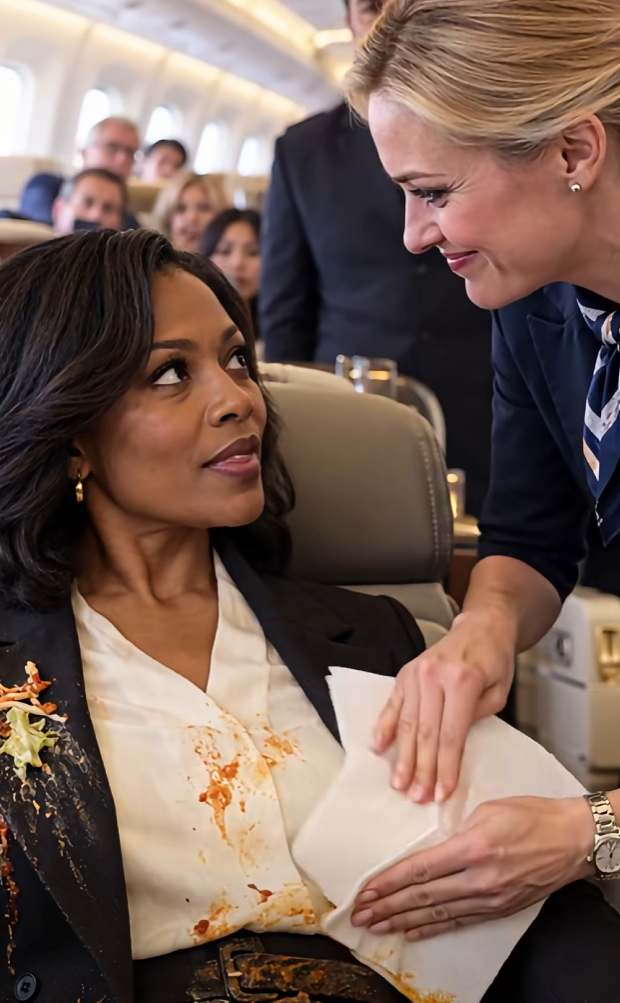
The first thing Maya Washington noticed was not the cold pasta sliding down her blazer.
It was the laughter.
Small, uncertain, cowardly laughter—the kind people make when they know something cruel has happened but are too frightened to object.
For one suspended second, the first-class cabin seemed to hold its breath.
A piece of wilted lettuce clung to the lapel of Maya’s black blazer. Sour tomato dressing streaked the cream blouse beneath it. A noodle dropped onto her knee, hung there briefly, and then slipped onto the carpet beside her polished shoe.
Jessica stood over her holding the empty plastic meal container.
“Here’s your scraps,” she said.
She did not whisper it.
She wanted the cabin to hear.
Maya slowly lifted her eyes.
Jessica was perhaps thirty-five, blonde hair pulled into a severe airline bun, navy uniform immaculate, red lipstick carefully applied. Her expression carried the particular confidence of someone who had mistaken a uniform for authority and authority for immunity.
Maya said nothing.
That seemed to irritate Jessica.
“Oh,” Jessica added, reaching for a napkin. “I’m sorry. Let me clean that.”
The apology had barely left her lips before she pressed the napkin against Maya’s blazer and rubbed hard.
The sauce spread.
Someone gasped.
Across the aisle, an older gentleman lowered his newspaper.
Two rows behind them, a woman named Sarah Kim quietly raised her phone.
Maya watched Jessica’s hand move back and forth across the ruined fabric.
She could have stopped her.
She could have shouted.
She could have demanded a supervisor before the second swipe.
Instead, Maya let Jessica finish.
When the attendant stepped back, satisfaction flickering in her eyes, Maya examined the stain.
“Thank you,” she said.
Jessica blinked.
It was not the answer she had expected.
“Excuse me?”
“I said thank you.”
There was no sarcasm in Maya’s tone. No trembling either.
That unsettled Jessica more than anger would have.
Maya had spent fifty-two years learning that people often revealed more when they believed you were too weak to stop them.
Her late father, James Washington, used to tell her that.
“Never interrupt a person who is showing you exactly who they are,” he would say.
He had been a city bus mechanic for thirty-seven years, a man with cracked hands and three work shirts, two of which always smelled faintly of machine oil. He had never held a corporate title, never flown first class, never sat in a boardroom.
But he had understood power better than most executives Maya knew.
Jessica folded her arms.
“Ma’am, I need to see your boarding pass.”
Maya reached into the leather tote beside her and handed it over.
Jessica looked at the ticket.
Then at Maya.
Then back at the ticket.
“Seat 12A?”
“Yes.”
Jessica’s mouth tightened.
“This cabin is first class.”
“I’m aware.”
“These seats cost extra.”
Maya tilted her head slightly.
“So I’ve heard.”
A few passengers smiled despite themselves.
Jessica noticed.
The color in her cheeks deepened.
“Do you have identification?”
Maya produced her driver’s license.
Jessica studied it for an unnecessarily long time.
Behind her, Sarah Kim spoke softly into her phone.
“She spilled food all over this woman, and now she’s checking whether she belongs in first class.”
Sarah had not originally intended to livestream anything. She was a forty-one-year-old pediatric physical therapist from Seattle flying to Atlanta for her mother’s seventieth birthday.
But five minutes earlier she had watched Jessica refuse Maya a second bottle of water while serving the passenger beside her without hesitation.
Then came the meal.
Then came the insult.
Now Sarah’s viewer count had climbed past three hundred.
Comments raced across her screen.
WHAT AIRLINE IS THIS?
GET HER NAME.
WHY IS NOBODY HELPING THAT WOMAN?
Sarah looked toward Maya.
What disturbed her most was the woman’s calm.
There was pain there—Sarah was sure of it—but it was buried beneath discipline.
Jessica looked at the boarding pass again.
“Passengers sometimes make mistakes.”
Maya’s gaze did not move.
“What mistake do you believe I made?”
Jessica hesitated.
“Well… people sometimes misread their seat assignments.”
“Is seat 12A difficult to read?”
The older gentleman across the aisle coughed to hide a laugh.
Jessica’s jaw tightened.
“I’m going to verify this with the captain.”
She walked away carrying Maya’s license.
Sarah lowered her phone slightly.
“Ma’am,” she whispered, “do you want me to call someone?”
Maya glanced toward her.
“That’s kind of you.”
“What she did was wrong.”
“Yes.”
“You don’t seem surprised.”
Maya gave the smallest smile.
“That doesn’t mean I’m not disappointed.”
Her phone buzzed.
She looked down.
BOARD MEETING MOVED TO 3:00 P.M. EST.
She dismissed the notification.
Another sat beneath it.
12 MISSED CALLS — ANDERSON.
Maya stared at the name.
Something heavy moved behind her ribs.
Anderson Hall had worked beside her for nineteen years.
He had been there when the company had four regional routes, three aging aircraft, and enough debt to frighten every bank in New York.
He had also been there six months earlier when Maya quietly began asking questions nobody else on the board seemed eager to answer.
Why had maintenance expenses risen nineteen percent while actual maintenance hours declined?
Why were veteran employees being replaced with temporary contractors?
Why had customer complaints involving discrimination doubled in a year?
And why had CEO Richard Vale personally blocked an external audit?
Maya locked the phone.
Not yet.
At the front of the cabin, Jessica returned with Mike Torres, the senior flight attendant.
Mike was broad-shouldered, graying slightly at the temples, and wore the exhausted expression of a man who had already decided whose side he was on before hearing both versions.
“Ma’am,” he said, “we’re going to need you to move.”
The cabin went silent.
Maya looked up.
“Move where?”
“We have an open seat farther back.”
“My assigned seat is here.”
Mike exhaled.
“Look, we’re trying to handle this calmly.”
“So am I.”
“But you’re making people uncomfortable.”
A woman in row 11 turned sharply.
“She’s making people uncomfortable?”
Mike ignored her.
Jessica stepped closer.
“She’s been uncooperative since boarding.”
Sarah nearly laughed from disbelief.
“That’s not true,” she said.
Mike turned.
“Ma’am, please stay out of this.”
“I watched the whole thing.”
“So did I,” the older gentleman across the aisle said.
Jessica’s face changed.
The cabin was no longer passive.
Maya’s phone buzzed again.
This time, she picked it up.
Anderson’s message contained one sentence.
Maya, the board is waiting for your approval to remove the CEO.
She read it twice.
Then something astonishing happened.
Maya smiled.
Not broadly.
Not triumphantly.
Just enough.
Jessica noticed.
“What?” she demanded.
Maya placed the phone facedown.
“Nothing.”
But Jessica suddenly looked less certain.
And for the first time that afternoon, she had reason to be.
PART TWO — WHAT SILENCE COSTS
Three hours earlier, Maya had stood alone in the quiet bedroom of her Washington townhouse, fastening the same modest gold earrings her mother had given her thirty years before.
On the dresser beside her rested a photograph of James and Evelyn Washington on their fortieth anniversary.
Her father had died eight years earlier.
Her mother had followed two winters ago.
Maya still spoke to them before difficult days.
“I may finally do it today,” she had whispered to the photograph.
The empty room gave no answer.
For nearly a year, Maya had been chairman of the board of Meridian Atlantic Holdings, the parent company of Meridian Airways.
Almost nobody outside banking circles knew her face.
That was deliberate.
Richard Vale was the public figure—the television interviews, magazine profiles, charity galas, and polished speeches about “family culture.”
Maya preferred numbers, employees, and long conversations nobody photographed.
She owned no private jet.
She flew commercial whenever practical.
And when possible, she booked anonymously through the same reservation system customers used.
Richard had mocked her for it.
“You’re chairman of the board,” he once told her. “You don’t need to experience the product like a mystery shopper.”
“Maybe that’s precisely why I do,” Maya replied.
Six months earlier, she began receiving anonymous envelopes.
No return addresses.
Inside were photocopied maintenance reports, employee complaints, disciplinary notices, and handwritten statements.
One line appeared repeatedly.
Management protects the people who protect management.
At first, Maya assumed it was an angry employee.
Then she found numbers that matched.
Complaints against certain supervisors disappeared.
Others were rewritten.
Employees who reported discrimination found themselves transferred, demoted, or disciplined.
Three flight attendants had independently named a regional training director named Jessica Barnes.
The same Jessica now standing beside Maya in first class.
That was why Maya had recognized her name the moment she boarded.
She had not expected Jessica to be working the flight.
And she certainly had not expected to become part of the evidence.
“Ma’am.”
Mike’s voice brought her back.
“Are you going to cooperate?”
Maya looked at him.
“I have cooperated with every reasonable request.”
“We’re asking you to relocate.”
“Why?”
Mike hesitated.
Jessica answered.
“Because this cabin has become disruptive.”
Maya’s eyes moved over the passengers.
“Who created the disruption?”
Neither attendant replied.
Sarah’s livestream had passed seven thousand viewers.
Someone had already screen-recorded the original spill.
Comments were multiplying too quickly to read.
Maya looked toward Sarah.
“Are you recording?”
Sarah stiffened.
“Yes. I’m sorry if—”
“Don’t apologize.”
Jessica’s head snapped toward Maya.
“Recording crew members without permission may violate company policy.”
The older gentleman across the aisle finally folded his newspaper.
“Lady, I’ve been flying for fifty years. I’m pretty sure passengers aren’t bound by your employee handbook.”
Laughter rippled through the cabin.
Mike raised his hand.
“All right. Enough.”
Then the cockpit door opened.
Captain Daniel Mercer stepped out.
He was sixty-one, silver-haired, and had flown for Meridian for almost twenty-eight years.
“Is there a problem?”
Jessica immediately moved toward him.
“Captain, we have a passenger refusing to relocate after creating a disturbance.”
Sarah muttered, “Unbelievable.”
Maya remained seated.
Captain Mercer looked at her stained clothes.
Then at the overturned food container.
Then at Jessica.
“What happened to her jacket?”
Jessica answered too quickly.
“There was an accident.”
Maya spoke for the first time.
“She dropped my meal on me.”
Jessica spun.
“That is not what happened.”
Maya’s eyebrows rose.
“It isn’t?”
“She became argumentative.”
“Before or after you spilled the food?”
Mike stepped in.
“Captain, perhaps we should resolve this after landing.”
Maya studied him.
That sentence told her something.
Mike did not want facts.
He wanted silence.
Captain Mercer looked uncertain.
“Ma’am, may I see your boarding pass?”
Jessica handed it to him.
He studied it.
“12A. Everything appears valid.”
Jessica folded her arms.
“That’s not the issue now.”
“What is the issue?”
“She’s being confrontational.”
The captain looked at Maya.
Maya sat covered in sauce, hands folded quietly in her lap.
“I see,” he said.
Jessica’s confidence weakened.
Captain Mercer handed the boarding pass back.
“Ms. Washington stays in 12A.”
Mike frowned.
“Captain—”
“That’s the end of it.”
He turned to Maya.
“I apologize for the inconvenience.”
Maya looked directly into his eyes.
“With respect, Captain, this is considerably beyond inconvenience.”
He held her gaze.
Something in her tone made him straighten.
“You’re right.”
Jessica whispered, “This is ridiculous.”
Maya heard her.
“So did the captain.”
Mercer’s expression hardened.
“Jessica, forward galley. Now.”
For the first time, Jessica looked frightened.
She followed him reluctantly.
Mike remained behind.
Maya looked up at him.
“You told me I was making people uncomfortable.”
His face reddened.
“I was trying to de-escalate.”
“No.”
Her voice remained quiet.
“You were trying to relocate the person who had been mistreated because confronting the person responsible was harder.”
Mike stared at her.
Several passengers went still.
“That distinction matters,” Maya continued. “Especially in your profession.”
Mike opened his mouth, but nothing came out.
Maya’s phone buzzed again.
ANDERSON: We have six votes. Yours makes seven. Richard is finished.
She stared at the screen.
Seven votes.
The number she had spent months building.
Seven votes to remove a man who once called her “the conscience of the company” while secretly authorizing policies she believed were hollowing it out.
But something still bothered her.
She typed:
WAIT.
Anderson replied immediately.
Why?
Maya looked toward the forward galley.
Because I just found the piece we were missing.
PART THREE — THE MAN BEHIND THE COMPANY
Richard Vale had built his reputation on charm.
At sixty-three, he possessed silver hair, perfect posture, and a voice so calm that bad news sounded like reassurance.
He joined Meridian as CEO twelve years earlier, when the company was struggling.
Under his leadership, profits tripled.
Routes expanded.
The stock rose.
Shareholders loved him.
Maya did too, once.
Not romantically.
Professionally.
Richard understood people.
Or Maya had believed he did.
Years earlier, when her mother suffered a stroke, Richard sent flowers to the hospital and personally moved a quarterly meeting.
When Maya’s father died, he attended the funeral.
He stood beside her beneath the cold November rain and said, “Family comes before business.”
She had never forgotten it.
That made the evidence worse.
The first hint came from a terminated mechanic named Leonard Price.
Leonard mailed Maya copies of internal work orders showing deferred repairs classified under cheaper codes.
Then came employee complaints.
Then severance agreements.
Then confidential settlements.
Every path eventually led upward.
But never directly to Richard.
Someone always signed beneath him.
Someone else approved.
Someone else “misinterpreted.”
Maya needed proof that Richard knew.
As the aircraft taxied toward the runway, Captain Mercer returned.
Jessica did not.
He leaned toward Maya.
“Ms. Washington, I want you to know the incident has been documented.”
Maya studied him.
“By whom?”
“I filed a preliminary report.”
“Did Jessica?”
Mercer hesitated.
“She has been removed from cabin duties for the remainder of the flight.”
Maya nodded.
“And Mr. Torres?”
The captain glanced toward Mike.
“We’ll review everything after arrival.”
“Who reviews it?”
“Corporate employee relations.”
Maya almost smiled.
There it was.
The department named in three anonymous complaints for suppressing misconduct.
“Captain,” she said, “how long have you worked for Meridian?”
“Twenty-eight years.”
“Have you ever seen a complaint disappear?”
His face changed.
Not much.
Enough.
Maya leaned back.
“That wasn’t a rhetorical question.”
Mercer looked toward the cockpit.
Then lowered his voice.
“Yes.”
“How often?”
“I don’t know.”
“You do.”
He swallowed.
“More than once.”
Sarah, still filming from a discreet angle, caught every word.
Maya continued.
“And why didn’t you say anything?”
The captain’s eyes hardened with something that looked less like anger than shame.
“Because I have fourteen months until retirement.”
The answer landed heavily.
Maya looked at him for a long moment.
Her father had once worked beside a man who discovered brake defects on a city fleet.
The man stayed quiet because he needed two more years for his pension.
Three months later, a bus crashed.
No one died.
But six people were injured.
James Washington never forgot it.
“Fear can explain silence,” he told Maya afterward. “But it doesn’t erase what silence costs.”
Maya repeated those words now.
Captain Mercer stared at her.
“My father taught me that.”
The captain looked away.
When he returned to the cockpit, Sarah lowered her phone.
“Who are you?” she whispered.
Maya smiled faintly.
“Today?”
Sarah nodded.
“A passenger in 12A.”
Sarah gave an incredulous laugh.
“No. I don’t think you are.”
Maya’s phone vibrated.
Anderson was calling.
This time she answered.
“Anderson.”
His voice was tense.
“Maya, what is happening? The board is assembled. Richard knows there’s a vote. We cannot stall indefinitely.”
“Put me on speaker.”
A pause.
“You’re on an airplane.”
“I know where I am.”
“Maya—”
“Put me on speaker.”
She heard movement.
Then Anderson’s voice changed.
“The board can hear you.”
Maya looked around the cabin.
Passengers pretended not to listen.
Every one of them was listening.
“Before we vote,” Maya said, “I need the general counsel to retrieve all complaint records involving Jessica Barnes, Mike Torres, and Daniel Mercer from the past five years.”
Someone on the call said, “Why?”
“Because I am currently seated on Meridian Flight 417, and Ms. Barnes just deliberately dumped food on me, questioned whether I belonged in first class, retained my identification, and attempted to have me moved after I refused to react.”
Silence.
Then several voices exploded at once.
“What?”
“You’re on 417?”
“Is she insane?”
Maya raised one finger, though nobody on the call could see.
“I’m not finished.”
The board went quiet.
“The senior attendant supported her version without investigation. The captain initially deferred to them before correcting course. I believe this incident may demonstrate the operational culture we have been investigating.”
A male voice said, “Maya, we should terminate Barnes immediately.”
“No.”
The answer surprised everyone.
Sarah’s eyes widened.
Maya continued.
“If we fire one attendant and congratulate ourselves, we learn nothing. I want the chain.”
Anderson understood first.
“You think she believes she’s protected.”
“I know she does.”
“How?”
Maya glanced toward the galley.
“Because nobody behaves this boldly unless consequences have failed them before.”
Then a flight attendant Maya had not seen earlier approached.
Her name tag read ELAINE.
She looked pale.
“Ms. Washington?”
“Yes?”
“I need to tell you something.”
Jessica appeared behind her.
“Elaine, don’t.”
Elaine froze.
Jessica’s face had lost all color.
Maya looked from one woman to the other.
“What does she need to tell me?”
Jessica said nothing.
Elaine’s hands trembled.
“Three months ago, I reported Jessica.”
The cabin went silent again.
“For what?”
Elaine’s eyes filled.
“For doing almost the same thing to another passenger.”
PART FOUR — THE MESSAGE THAT CHANGED EVERYTHING
The passenger’s name had been Ruth Calloway.
Seventy-two years old.
Retired public-school librarian.
Flying home after her husband’s funeral.
Elaine spoke quietly as the aircraft climbed through ten thousand feet.
“Mrs. Calloway had been upgraded at the gate,” she explained. “Jessica said the upgrade must have been a mistake.”
Maya’s stomach tightened.
“What happened?”
“She kept asking for proof. Ticket. ID. Confirmation email. Then Jessica said the woman was upsetting premium passengers.”
Sarah’s phone shook slightly in her hand.
Maya asked, “Was she removed?”
Elaine nodded.
“Moved to economy.”
“Why?”
“No reason.”
“What happened to your complaint?”
Elaine laughed bitterly.
“I was called into a meeting with regional operations.”
“Who attended?”
“Mike.”
Every head turned toward him.
Mike’s face drained.
Elaine continued.
“And our regional training director.”
“Name?”
“Colin Vale.”
Maya stopped breathing for half a second.
Vale.
Sarah noticed.
“So?” Mike snapped. “Colin is the CEO’s nephew. That doesn’t mean—”
Maya turned slowly.
“The CEO’s nephew?”
Mike realized what he had done.
He closed his eyes.
Maya picked up her phone.
“Anderson.”
He answered instantly.
“Yes?”
“Who supervises regional training?”
“Operations.”
“Name the director for East Coast premium service.”
Keys clicked.
Then Anderson became quiet.
“Colin Vale.”
“Relationship to Richard?”
“His sister’s son.”
Maya looked toward Jessica.
Jessica sat rigidly in the jump seat near the galley.
“Anderson, pull every complaint connected to Colin.”
The line remained open.
Less than two minutes later, Anderson spoke again.
“Maya.”
Something in his voice had changed.
“What?”
“We found thirty-four.”
Sarah whispered, “My God.”
“Thirty-four what?” Maya asked.
“Employee and passenger complaints. Sixteen were closed without interviews. Nine resulted in discipline against the reporting employee.”
Maya’s hand tightened around the phone.
“And Richard?”
Another pause.
“There are email approvals.”
Maya closed her eyes.
There it was.
Not an inference.
Not a pattern.
Proof.
“Read one.”
Anderson hesitated.
“Maya…”
“Read it.”
His voice dropped.
“Email from Richard to Colin, dated February 9: ‘Handle internally. We cannot allow isolated customer grievances to undermine premium brand perception. Protect the team.’”
Nobody spoke.
The aircraft engines hummed steadily around them.
Maya felt something break inside her.
Not because Richard was guilty.
She had expected that.
Because she recognized the date.
February 9.
Her mother’s birthday.
That evening, Richard had called Maya.
They talked for twenty minutes.
He asked how Evelyn was doing.
He told Maya he admired the way she cared for her mother.
While speaking those warm words, he had already sent an order protecting the very culture Maya was trying to uncover.
Maya stared out the window.
Clouds stretched beneath the plane like a white ocean.
Sarah lowered her phone.
For the first time, she wondered if she should stop recording.
“Maya,” Anderson said softly.
It was the first time anyone in the cabin heard him call her by name.
“The board is ready.”
Maya swallowed.
“Proceed.”
Anderson cleared his throat.
“Motion to remove Richard Vale as chief executive officer of Meridian Atlantic Holdings for cause, effective immediately.”
Jessica stared at Maya.
Mike stared too.
Sarah’s eyes widened.
A woman across the aisle covered her mouth.
Anderson began calling names.
One by one, voices answered.
“Yes.”
“Yes.”
“Yes.”
“Approve.”
“Yes.”
Then—
“Chairwoman Washington?”
The cabin changed.
It was visible.
Like a current passing through every row.
Mike’s mouth opened.
Jessica shook her head once.
“No,” she whispered.
Maya looked directly at her.
“Yes.”
Anderson exhaled.
“The motion passes.”
For several seconds, nobody moved.
Then Sarah’s phone erupted with notifications.
The livestream had crossed eighty thousand viewers.
Maya ended the call.
Jessica stood.
“You’re… you’re the chairwoman?”
Maya slipped her phone into her bag.
“Yes.”
“Of the airline?”
“Of the company that owns it.”
Jessica took a step backward.
“I didn’t know.”
Maya’s face remained calm.
“I know.”
“I would never have—”
She stopped herself.
Too late.
Maya’s eyes sharpened.
“You would never have done this if you knew who I was?”
Jessica began crying.
“That’s not what I meant.”
“It is exactly what you meant.”
“No, please. I have a family.”
“So did Ruth Calloway.”
Jessica froze.
Elaine covered her mouth.
Maya continued.
“She had just buried her husband.”
Tears rolled down Jessica’s cheeks.
“I’m sorry.”
Maya shook her head.
“You are afraid.”
Jessica stared at her.
“There is a difference.”
Mike stepped forward.
“Ms. Washington, I accept responsibility for how I handled—”
“No, Mr. Torres.”
He stopped.
“You accept consequences. Responsibility began when you had a choice.”
No one in the cabin laughed now.
Maya looked around at the raised phones.
“You all witnessed something ugly today.”
Sarah lowered hers.
Maya continued.
“But the most dangerous part wasn’t the food.”
She looked toward Mike.
“It was how quickly people tried to make the mistreated person disappear because confronting the mistreatment was inconvenient.”
Captain Mercer emerged from the cockpit doorway.
He had tears in his eyes.
Maya met his gaze.
“And that,” she said, “is how cultures rot.”
The captain nodded.
Then Maya’s phone rang.
The screen displayed:
RICHARD VALE.
The cabin saw it.
Maya answered.
“Richard.”
His voice came through cold and controlled.
“You’ve made an extraordinary mistake.”
Maya’s expression did not change.
“No.”
“You don’t understand what you’ve done.”
“I understand perfectly.”
“Then you should know that removing me does not give you control.”
Maya frowned.
“What does that mean?”
Richard laughed softly.
And for the first time all day, Maya felt something she had not expected.
Fear.
“There are things about Meridian you never knew, Maya.”
“Such as?”
“You think those anonymous complaints were sent to you by frightened employees?”
Her blood went cold.
Richard continued.
“They weren’t.”
Maya looked toward Anderson’s earlier messages.
“Who sent them?”
Richard said five words.
“You did.
You just don’t remember.”
PART FIVE — THE THING MAYA HAD FORGOTTEN
Maya did not speak.
The engines filled the silence.
Richard continued.
“Ask Anderson about Chicago.”
Maya’s hand went numb.
“What about Chicago?”
Another voice entered the line.
Anderson.
“Maya, hang up.”
She stared at the phone.
“How are you on this call?”
“I merged in when I saw Richard calling.”
“Then answer him.”
“Maya—”
“What happened in Chicago?”
No answer.
Maya’s heart began to pound.
Something moved at the edge of memory.
Rain.
A hospital room.
Anderson sitting beside her bed.
A doctor asking her name.
Maya gripped the armrest.
Three years earlier, she had been in a car accident outside Chicago after an investor dinner.
She remembered the crash.
Mostly.
A truck ran a light.
Her sedan spun.
She woke in Northwestern Memorial Hospital with a concussion and fractured wrist.
Doctors said some memory gaps were normal.
She returned to work six weeks later.
Until that moment, she had never questioned what was missing.
“Anderson.”
His breathing came through the speaker.
“Tell me.”
“Maya, this is not the place.”
“Tell me now.”
He finally did.
“The night before your accident, you called me.”
“Why?”
“You said you had uncovered systematic suppression of passenger complaints.”
Maya closed her eyes.
“You told me Richard was involved. You said you had copied evidence onto an encrypted drive.”
“Where?”
“You never told me.”
Richard laughed.
“Because she didn’t trust you either.”
Anderson snapped, “Shut up.”
Maya’s mind raced.
“Then why don’t I remember?”
“The neurologist said retrograde memory loss could erase events immediately preceding the accident.”
Maya whispered, “The anonymous envelopes…”
“Started six months later,” Anderson said.
Richard interrupted.
“Exactly.”
Maya’s stomach turned.
“If I sent them, how?”
Richard answered.
“Automated delivery.”
A memory flashed.
Her father’s old desk.
A safe-deposit key.
An attorney’s office.
Maya touched her forehead.
“You set up a dead-man protocol,” Richard continued. “Documents released periodically if you failed to cancel them.”
Sarah stared at Maya, stunned.
Maya could barely hear her own voice.
“How do you know this?”
“Because I found the first release schedule after your accident.”
“Then why didn’t you stop it?”
“I tried.”
A new memory surfaced.
A woman.
Red glasses.
Gray hair.
Saying, If anything happens to you, this continues without us.
Maya opened her eyes.
“Rebecca Sloan.”
Anderson gasped.
“What?”
Maya stood so suddenly that Sarah lowered her phone.
“Rebecca Sloan was my mother’s attorney.”
Anderson said, “Maya, Rebecca died two years ago.”
“Yes.”
Maya could see it now.
Not everything.
Enough.
Rebecca’s office.
A metal box.
Maya signing instructions.
Her own voice saying, No single person can stop this. Not even me.
Maya laughed once.
It came out almost like a sob.
Richard went quiet.
She understood.
“You thought Rebecca’s death ended the releases.”
No answer.
“That’s why the complaints kept coming.”
Richard said, “Maya—”
“You never found the source.”
“Maya, listen to me.”
“No.”
Her voice changed.
For the first time all day, it carried the full weight of command.
“You listen.”
Passengers went still.
“The reason you’re calling me isn’t because you’re angry about losing your job.”
Richard said nothing.
“You’re afraid of what else I scheduled.”
Silence.
Maya smiled.
There was no uncertainty in it now.
“What is the next release, Richard?”
His breathing changed.
And that told her everything.
Anderson whispered, “Maya…”
She opened her laptop.
Her fingers moved almost automatically.
A password field appeared in a secure archive she did not consciously remember creating.
She typed:
JAMES1948.
Her father’s birth year.
Access granted.
Maya stared.
Folders filled the screen.
MAINTENANCE.
HR RETALIATION.
EXECUTIVE COMPENSATION.
REGULATORY CONTACTS.
Then one folder stopped her heart.
CHICAGO — VEHICLE.
She clicked.
Inside was a police report.
Photographs.
And an investigative memo.
Maya read the first line.
Vehicle inspection discovered deliberate tampering with brake-fluid line approximately 24 hours prior to collision.
Sarah saw Maya’s face.
“What is it?”
Maya could not answer.
Anderson whispered, “Maya?”
Her voice shook for the first time.
“My accident wasn’t an accident.”
The cabin fell completely silent.
Richard disconnected.
That was his second mistake.
His first had been believing Maya Washington’s missing memory had erased the truth.
Anderson immediately said, “I’m contacting federal authorities.”
Maya stared at the screen.
There was another document.
A surveillance photograph.
A man standing beside her car in a Chicago garage.
Maya enlarged it.
It was not Richard.
It was not Colin.
It was Mike Torres.
The senior flight attendant standing ten feet away.
Maya slowly raised her eyes.
Mike saw the photograph on her screen.
His face collapsed.
He ran.
Not far.
There was nowhere to go at thirty-five thousand feet.
Captain Mercer blocked the galley.
Two passengers stood instinctively.
Mike stopped.
“Don’t,” Maya said.
He turned toward her.
Years seemed to drain from him.
“You weren’t supposed to be on this flight.”
Maya’s blood went cold.
“What?”
Jessica began sobbing harder.
Mike closed his eyes.
She looked at Jessica.
“What does he mean?”
Jessica shook her head rapidly.
“I don’t know.”
“Jessica.”
“I swear.”
Mike laughed bitterly.
“She doesn’t know.”
Maya stepped closer.
“Then explain.”
Mike looked toward the cockpit.
Then at Sarah’s phone.
Then at Maya.
“Richard called this morning.”
The entire cabin seemed to shrink around them.
“He told me a woman named Maya Washington was on 417. Said you were a corporate investigator trying to destroy the airline.”
Maya stared.
“He told you to remove me?”
“To provoke you.”
“Why?”
“He said if you caused a disturbance, we could have you detained after landing and seize your devices under a security complaint.”
Sarah whispered, “Oh my God.”
Jessica turned on Mike.
“You told me she was a scammer!”
Mike looked at her.
“I told you what Richard told me.”
Maya understood the whole thing.
The spilled food.
The ticket questioning.
The attempt to move her.
They had been trying to make her react.
To manufacture a reason.
But Jessica had not known why.
She had simply been cruel enough to participate.
Mike had known more.
And Richard had known almost everything.
Almost.
Maya returned to her laptop.
At the bottom of the archive was a scheduled-release notice.
Release condition: Executive interference with Chairwoman Washington.
Status: CONDITION MET.
Destination:
Federal Aviation Administration.
Department of Justice.
Three national newspapers.
Meridian Atlantic Board of Directors.
Release time:
3:00 P.M. EST.
Maya checked the clock.
2:59.
Richard had called to frighten her.
Instead, he had triggered the final safeguard.
One minute later, Maya’s computer chimed.
RELEASE COMPLETE.
Sarah stared.
“What just happened?”
Maya slowly closed the laptop.
“My younger self finished what my injured self forgot.”
For the first time since the meal hit her blazer, Maya allowed herself to feel everything.
Anger.
Grief.
Relief.
Her father’s voice.
Her mother’s earrings against her neck.
Three stolen years of memory.
A company she had nearly trusted into destruction.
She sat down again.
Sarah reached across the aisle and gently handed her a clean napkin.
Maya looked at it.
Then laughed.
A real laugh.
Soft and tired.
“You know,” she said, “I think we’re past napkins.”
Sarah laughed through tears.
“So what happens now?”
Maya looked around the cabin.
Jessica sat quietly, devastated by what she had done.
Mike stood under the captain’s supervision awaiting authorities after landing.
Elaine held another attendant’s hand.
Passengers who had once looked away were now watching with painful attention.
“What happens now,” Maya said, “is that we stop pretending this was about one bad employee.”
Three weeks later, Richard Vale was arrested on charges related to obstruction, corporate fraud, and conspiracy surrounding Maya’s crash investigation.
Mike cooperated with investigators.
His testimony revealed that he had accepted money years earlier to arrange access to Maya’s vehicle but claimed he had not known the purpose. Whether a jury believed him would be decided later.
Jessica was dismissed from Meridian after an independent investigation confirmed a pattern of misconduct involving multiple passengers.
But Maya refused to let the company issue the usual press release about “isolated behavior.”
She ordered every suppressed complaint reopened.
Seventeen managers resigned or were terminated.
The employee-relations department was rebuilt under independent oversight.
Captain Mercer delayed his retirement by one year and volunteered to lead a confidential reporting program for pilots and cabin crews.
Elaine became one of its first advisers.
And Ruth Calloway received a phone call one quiet Tuesday morning.
“Mrs. Calloway?”
“Yes?”
“My name is Maya Washington.”
There was a pause.
“The woman from the news?”
Maya smiled.
“Yes, ma’am.”
“What can I do for you?”
“Nothing.”
Maya looked at her father’s photograph on her desk.
“I’m calling because my company owes you an apology that should have come a long time ago.”
Ruth was silent.
Then she began to cry.
So did Maya.
Six months later, Meridian’s annual shareholder meeting filled a ballroom in Manhattan.
Maya walked onto the stage wearing a simple black suit.
No dramatic music.
No expensive introduction.
Behind her sat hundreds of employees.
On the front row sat Sarah Kim and her mother.
Maya approached the microphone.
“A company does not reveal its character when powerful people enter the room,” she began. “It reveals its character when someone enters whom it believes has no power at all.”
The room became still.
Maya touched the modest gold earring her mother had given her.
“For years, we asked the wrong question. We asked, ‘How do we protect the company?’”
She paused.
“The better question is, ‘What kind of company deserves protecting?’”
Applause began slowly.
Then rose.
Maya did not smile immediately.
Her eyes had found an empty chair near the aisle.
For just a second, she imagined her father sitting there in his work shirt, grease still beneath his fingernails, pretending he understood corporate governance while understanding the important part better than anyone.
Never interrupt a person who is showing you exactly who they are.
Maya finally smiled.
Jessica had believed silence meant weakness.
Richard had believed memory loss meant defeat.
Mike had believed a frightened organization would protect him forever.
Every one of them had mistaken patience for powerlessness.
And somewhere between seat 12A and thirty-five thousand feet above the American heartland, Maya Washington had rediscovered the truth she herself had buried years before.
She had never been waiting for someone to rescue her.
She had been waiting for the truth to finish arriving.
“`