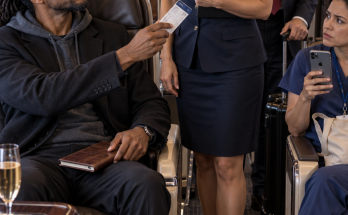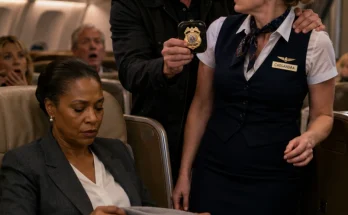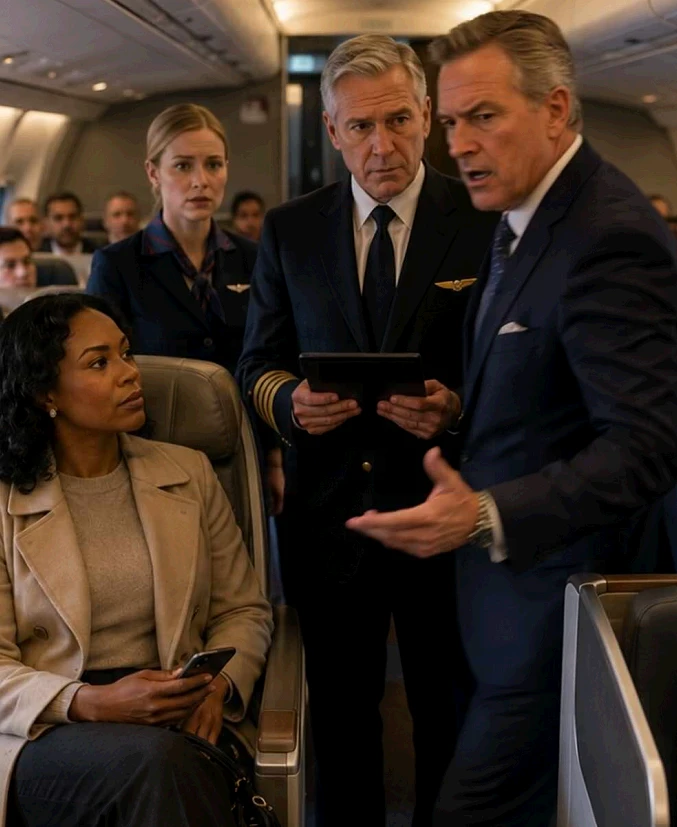
PART ONE — SEAT 2A
The first insult arrived before Flight 227 had even left the ground.
Naomi Carter sat beside the rain-streaked window in seat 2A, watching baggage carts move like dim yellow insects across the gray Chicago tarmac. Beyond the glass, runway lights dissolved into long ribbons of blue and amber. Inside the cabin, everything smelled of polished leather, bitter coffee, and the faint chemical cleanliness of an aircraft prepared for departure.
She had chosen the window seat because she wanted silence.
For fourteen months, silence had been nearly impossible to find.
Fourteen months of negotiations. Fourteen months of men twice her age telling her she did not understand the aviation industry. Fourteen months of lenders withdrawing at the last moment, board members leaking private discussions, and competitors planting stories about her judgment.
Forty-eight hours earlier, she had signed the final documents.
Her investment firm now controlled Meridian Atlantic Airlines.
The public announcement would come Monday morning, before the opening bell. Until then, fewer than twelve people knew Naomi Carter was the company’s new chief executive officer.
She had decided to fly anonymously.
No assistants. No private car waiting beside the aircraft. No special welcome from management.
She wore charcoal slacks, a beige cashmere sweater, and the tailored trench coat she had bought in Paris after closing the largest deal of her career. Her diamond earrings were small. Her leather handbag carried no visible designer emblem.
She wanted to see the airline as ordinary passengers saw it.
More importantly, she wanted to see how the company behaved when no one important appeared to be watching.
“Excuse me.”
The voice above her was not a request.
Naomi turned slowly.
Three men stood in the aisle. All wore dark suits. All appeared to be in their fifties. Their faces had the flushed impatience of travelers who considered delay a personal offense.
The man in front was tall and broad, with carefully combed silver hair and a heavy watch pressing into his wrist. A monogrammed briefcase hung from one hand.
H.M.H.
Naomi recognized him.
Harrison Mercer Hale, senior partner at Hale, Dunning and Cross.
His firm advised several major transportation companies. During the acquisition, he had represented a group of investors who had attempted to purchase Meridian Atlantic and break it into separate regional carriers.
He did not recognize her.
That fact almost made her smile.
“I believe you’re in the wrong cabin,” Harrison said.
Naomi looked at the seat number beside her shoulder.
“Two A,” she said. “That is the seat printed on my boarding pass.”
Harrison gave a small laugh and looked at the men behind him.
The younger one, Clark Dunning, had slicked-back hair and the pale, tight expression of someone who slept badly and drank too much coffee. Beside him stood Peter Rowe, a quieter man with rimless glasses and a wedding ring he kept twisting around his finger.
“We need these seats,” Harrison said. “The three of us are preparing for an important meeting in New York.”
“There are three of you,” Naomi replied. “There are only two seats in this row.”
His mouth tightened.
“We have colleagues nearby. We need the section.”
“You may ask the flight attendant whether other seats are available.”
“I am asking you to move.”
“No,” Naomi said.
She did not raise her voice. She had learned long ago that powerful men often became most unsettled when a woman refused them without appearing angry.
Harrison leaned closer.
“Perhaps you don’t understand.”
Naomi held his gaze.
“I understand perfectly.”
“This cabin is full of people conducting serious business.”
“So am I.”
His eyes traveled over her sweater, her handbag, and the coat folded across her lap.
The judgment came quickly.
“I don’t know how you obtained this seat,” he said, “but my firm spends more with this airline in one month than most people earn in a year.”
The cabin had begun to grow quiet.
Naomi noticed the subtle movements around her. A newspaper lifted higher. A laptop screen became suddenly fascinating. A woman across the aisle lowered her champagne glass but did not speak.
Harrison continued.
“We are Platinum Executive members. We have a board presentation immediately after landing. You can move to the rear, and the airline will compensate you.”
“I will remain here.”
His face changed.
The corporate smile vanished. Beneath it was something older and less disciplined.
“You don’t belong up here,” he said.
The words were quiet, but everyone nearby heard them.
Naomi felt the familiar pressure behind her ribs.
She remembered being twenty-six and staying late at an investment bank, only to have security summoned because a partner assumed she was part of the cleaning crew. She remembered her first luxury car purchase, when a salesman asked whether her husband would be joining her. She remembered walking into negotiation rooms where men handed documents to her male associates and asked when the decision-maker would arrive.
The insults had changed their clothing over the years, but never their shape.
Before Naomi could respond, a young flight attendant approached.
Her name tag read EMILY WARD.
She appeared no older than twenty-three. Her blonde hair was pinned into a careful bun, but a loose strand trembled near her cheek.
“Is there a problem?” Emily asked.
Harrison turned toward her with the relaxed authority of a man addressing an employee he expected to obey.
“Yes. This passenger is refusing to leave a seat my colleagues and I require.”
Emily glanced at Naomi.
“Sir, if this is her assigned seat—”
“Check her boarding pass.”
The young woman hesitated.
Harrison lowered his voice.
“My firm manages significant corporate travel through Meridian Atlantic. I would hate for a simple service failure to become a formal complaint.”
Naomi saw the fear pass across Emily’s face.
The girl’s hands folded tightly at her waist.
“Ma’am,” Emily said, “may I please see your boarding pass?”
The question was professionally phrased. The injustice of it remained.
Naomi had passed security. Her ticket had been scanned. She was seated in the correct place.
Still, she was the person asked to prove herself.
“My identification and ticket were verified at the gate,” Naomi said. “Seat 2A belongs to me.”
Emily’s cheeks reddened.
“I understand. I’m only trying to resolve the situation.”
“You can resolve it by asking these gentlemen to take their assigned seats.”
Harrison laughed sharply.
“This is absurd.”
Then he turned to Clark.
“Get her bag.”
Clark looked uncertain.
“Harrison—”
“Remove it from the overhead compartment. Once her things are in the aisle, perhaps she’ll understand that we are not debating.”
Clark reached upward.
Naomi’s voice stopped him.
“Do not touch my property.”
Something in her tone made his hand freeze beside the latch.
It was not loud. It was not emotional.
It was the voice she had used during hostile negotiations when a room full of bankers realized they had underestimated the only person who had read every page of the contract.
Clark lowered his arm.
Harrison’s face darkened.
“She’s becoming belligerent,” he said.
Naomi almost admired the speed with which he rewrote reality.
She remained seated. He stood over her.
She spoke calmly. He issued threats.
Yet he had found the word that could turn her from passenger into danger.
“Call security,” Harrison ordered Emily. “Tell them we have an uncooperative passenger threatening the flight crew.”
“I have threatened no one,” Naomi said.
“You’re delaying departure.”
“You approached me.”
“You refused a reasonable request.”
“You ordered me out of my seat.”
Peter Rowe finally spoke.
“Harrison, perhaps we should sit down.”
Harrison turned on him.
“We have spent six months preparing for today.”
The words caught Naomi’s attention.
Six months.
Their board presentation was not ordinary client work.
She reached into her coat and removed her phone.
Harrison stepped back.
The movement was small but revealing.
Naomi unlocked the screen.
“You are making a mistake,” she said.
He recovered quickly.
“The only mistake is believing you can intimidate us with a telephone.”
“I am not trying to intimidate you.”
“What, then?”
“I am preserving evidence.”
PART TWO — THE CAPTAIN’S DECISION
The cockpit door opened with a metallic click.
Captain Daniel Miller stepped into the forward galley.
He was fifty-eight, broad through the shoulders, with short gray hair and the weathered face of a man who had spent half his life watching storms form at thirty thousand feet. Four gold stripes marked each sleeve of his uniform.
Naomi had read his personnel file the night before.
Twenty-two years with Meridian Atlantic. Former Air Force transport pilot. Impeccable safety record. Two commendations for emergency leadership.
There was also a disciplinary note from nine years earlier.
Captain Miller had once delayed a departure after a gate supervisor demanded that a deaf passenger travel without her service dog. He had refused to close the aircraft door until the problem was corrected.
The delay cost the airline nineteen thousand dollars.
Miller had accepted the reprimand without apology.
Now his eyes moved from Emily’s frightened face to the three men blocking the aisle.
“What is happening in my cabin?” he asked.
Harrison stepped forward.
“Captain, thank goodness. This passenger is creating a disturbance. She is occupying space required by our corporate group, refusing crew instructions, and threatening to record other passengers.”
Captain Miller looked at Naomi.
“Were you instructed by a crew member to leave your assigned seat?”
“No.”
Emily swallowed.
“I asked to verify her boarding pass, Captain. Her seat is valid.”
Miller turned back to Harrison.
“Then the matter appears settled.”
“It is not settled.”
“It is on my aircraft.”
Harrison’s eyes narrowed.
“Do you understand who I am?”
“No,” Miller said, “but I understand where you are standing. You are blocking the aisle during boarding.”
Harrison reached into his jacket and produced a black membership card.
“My firm has top-tier status. We advise the Meridian Atlantic board. We are expected in New York for a meeting that could determine the future of this company.”
Captain Miller did not look at the card.
Instead, he lifted the company tablet in his hand and opened the passenger manifest.
He scrolled.
His gaze paused.
Then he looked at Naomi again.
The change in his face was slight. A tightening around the eyes. A deeper stillness.
Harrison noticed it and smiled.
“There,” he said. “Now you understand.”
Captain Miller did understand.
The secure manifest contained more than names and seat assignments. Certain passengers carried internal codes visible only to the captain and senior operations staff.
Beside Naomi Carter’s name appeared a red-bordered directive:
EXECUTIVE CONTROL TRANSITION — CONFIDENTIAL.
DO NOT DISCLOSE IDENTITY WITHOUT AUTHORIZATION.
REPORT MATERIAL SERVICE OR SAFETY INCIDENTS DIRECTLY TO GENERAL COUNSEL.
Miller looked at Emily.
“Close the forward door.”
Harrison smiled more broadly.
“Finally.”
Captain Miller raised a hand.
“We are not departing.”
The smile disappeared.
“What?”
“I will not move this aircraft until airport operations and corporate security review the incident.”
Harrison stared at him.
“You are delaying a full flight because she refuses to change seats?”
“No. I am delaying departure because three passengers attempted to remove another passenger’s property and made a false security allegation.”
“That is not what happened.”
Naomi lifted her phone.
“I recorded what happened.”
Clark’s face lost color.
Peter stopped twisting his wedding ring.
Harrison pointed at Naomi.
“She recorded us without consent.”
“This is an aircraft cabin,” Miller said. “You had no reasonable expectation that your public behavior would remain private.”
Harrison moved closer.
“You are placing your career at risk.”
Captain Miller’s expression remained calm.
“At my age, Mr. Hale, a career becomes less important than the kind of man one has been during it.”
The words settled over the cabin.
For the first time, another passenger spoke.
A woman in row 3 leaned into the aisle.
“Captain, I saw the entire thing. The men approached her. She never threatened anyone.”
A gray-haired man across from her removed his headphones.
“So did I.”
Then another voice.
“They tried to touch her luggage.”
Harrison turned, astonished by the sudden rebellion of the people who had been silent minutes earlier.
Naomi watched them with mixed feelings.
Their support mattered.
So did the fact that it had required a captain’s intervention before they found their courage.
Emily stepped closer to Naomi.
“I’m sorry,” she whispered.
Naomi looked at the young woman’s trembling hands.
“Why did you ask for my boarding pass?”
Emily’s eyes filled.
“Because I was afraid of him.”
The honesty surprised Naomi.
“Are passengers often allowed to frighten the crew?”
Emily looked toward the rear galley.
“Some passengers know exactly which words to use. They mention status. Complaints. Jobs. Management tells us to de-escalate.”
“Does de-escalate mean appease?”
“Sometimes.”
Captain Miller’s jaw tightened.
A radio message sounded from the galley. Ground operations had been notified. A security supervisor was on the way.
Harrison opened his briefcase.
“You want facts?” he said. “Here are facts.”
He removed a folder stamped CONFIDENTIAL.
“My firm is presenting a restructuring plan to Meridian Atlantic’s board this afternoon. The airline is overleveraged. Its regional routes are failing. Its labor costs are unsustainable. Without our proposal, thousands of employees could lose their jobs.”
Captain Miller said nothing.
Harrison looked at Naomi as though explaining economics to a child.
“Our meeting is more important than your pride.”
Naomi’s expression did not change.
“What does your proposal involve?”
He hesitated.
“That is confidential.”
“Closing regional hubs?”
Harrison stared.
“Selling maintenance operations?”
Clark looked sharply at him.
Naomi continued.
“Terminating pension obligations through bankruptcy restructuring? Selling landing rights to three competitors? Awarding Hale, Dunning and Cross a success fee of eighty-four million dollars?”
Peter Rowe’s lips parted.
Captain Miller watched Harrison’s confidence fracture.
“How do you know that?” Harrison asked.
Naomi placed her phone on the armrest.
“Because I rejected your proposal two weeks ago.”
PART THREE — THE NAME ON THE MANIFEST
The cabin seemed to contract around them.
Harrison looked from Naomi to Captain Miller, then back again.
“No,” he said.
Naomi unfolded her trench coat and stood.
She was not tall, but when she faced him, the imbalance of power shifted so completely that Harrison took half a step backward.
“My name is Naomi Carter.”
Clark closed his eyes.
Peter whispered something that sounded like a prayer.
Harrison remained motionless.
Naomi continued.
“Two days ago, Carter Strategic Holdings completed its purchase of a controlling stake in Meridian Atlantic Airlines. Effective immediately, I serve as chief executive officer.”
The silence that followed was different from the silence before.
Earlier, it had been the silence of avoidance.
Now it was the silence of recognition.
Harrison’s face drained of color.
“That announcement was not supposed to occur until Monday.”
“It still is not.”
“You are violating securities protocol.”
“No. I am identifying myself during a material internal incident involving the airline’s incoming executive officer.”
He tried to recover.
“Then you understand the stakes. Our proposal—”
“Was designed to enrich your firm while dismantling the company.”
“That is a grotesque simplification.”
“I read every schedule, every fee arrangement, and every projected layoff.”
“You are not an aviation expert.”
“No,” Naomi said. “I am an expert in recognizing theft when it has been organized into a presentation.”
A murmur moved through the cabin.
Harrison glanced at the watching passengers.
“This conversation should take place privately.”
“You did not want privacy when you ordered my removal.”
His shoulders stiffened.
“I did not know who you were.”
Naomi’s eyes hardened.
“That is the point.”
Harrison opened his mouth, but she continued.
“You believed I was a woman without influence. You assumed the rules could be bent because you thought I lacked the power to punish you.”
“That is not fair.”
“Fair?”
For the first time, emotion entered her voice.
Not rage. Something older.
“You looked at me and decided I could not possibly belong in First Class. You threatened a young employee’s job. You instructed another man to touch my belongings. Then you called me belligerent when I refused to obey you.”
Harrison glanced at Clark.
Clark looked away.
“It was a misunderstanding.”
“No. A misunderstanding is confusing two similar seat numbers. This was a decision. Then another decision. Then another.”
The airport security supervisor boarded with two officers, followed by Meridian Atlantic’s station manager.
The manager, Ronald Pierce, hurried forward with the anxious expression of a man who already understood that his morning had become historic.
“Captain Miller,” he said. “What is the nature of the delay?”
Miller handed him the tablet.
“Attempted passenger displacement. Interference with boarding. False allegation of a security threat. Possible attempted handling of another passenger’s property.”
Ronald read Naomi’s internal designation.
His face changed.
“Ms. Carter.”
Harrison turned sharply.
“You know her?”
Ronald lowered his voice.
“Yes.”
Naomi faced the security supervisor.
“I do not want anyone physically removed unless required for safety. I want statements taken from the crew and witnesses. I want all cabin video preserved. I want the gate audio secured. And I want these gentlemen separated during questioning.”
Harrison’s voice rose.
“You cannot detain us.”
The security supervisor answered.
“We can ask you to leave the aircraft. Refusal may become a separate matter.”
Peter Rowe stepped forward.
“I’ll cooperate.”
Harrison stared at him.
“Peter.”
“I said I’ll cooperate.”
Clark remained pale.
Naomi noticed the sweat near his hairline.
He was frightened by more than public embarrassment.
“Mr. Dunning,” she said, “is there something you wish to tell me?”
Harrison spoke before Clark could answer.
“No.”
Naomi looked directly at Clark.
“I did not ask him.”
Clark’s lips moved, but no words came.
Harrison seized his arm.
“Say nothing.”
Captain Miller stepped between them.
“Do not touch another passenger.”
Harrison released him.
Clark looked at Naomi.
“We were not supposed to be on this flight.”
Harrison’s face became rigid.
“Clark.”
“Our reservations were changed last night,” Clark continued. “Harrison insisted.”
“Be quiet.”
“He knew she would be here.”
The words landed like a dropped glass.
Naomi felt the cabin tilt beneath her, though the aircraft had not moved.
“What did you say?”
Clark looked sick.
“Harrison knew you were flying to New York.”
PART FOUR — THE PLAN BEHIND THE INCIDENT
The officers escorted the three men into the jet bridge, where they were placed in separate interview rooms near the gate. Passengers remained aboard while operations evaluated the delay.
Naomi moved to the forward galley with Captain Miller, Emily, and Ronald Pierce.
Rain struck the fuselage in steady waves.
“How could they have known?” Miller asked.
“Only a few people had my itinerary,” Naomi said.
Ronald shifted uneasily.
“Executive travel appears in the internal reservation system.”
“Under restricted access.”
“Yes.”
“Who accessed my record?”
“I’ll have information security check.”
Emily stood near the coffee station, her face pale.
Naomi turned to her.
“You should sit down.”
“I’m fine.”
“You are shaking.”
Emily lowered herself onto the crew seat.
“I thought I was going to lose my job.”
Naomi sat across from her.
“Has someone threatened you before?”
Emily looked at Ronald.
He avoided her eyes.
“Answer honestly,” Naomi said.
“Yes.”
“Passengers?”
“And managers.”
Ronald sighed.
“Ms. Carter, customer complaints have become a major performance metric. Crew members are evaluated partly on escalation rates.”
“Who approved that policy?”
“It came from an outside consulting review.”
“What firm?”
No one needed to answer.
Hale, Dunning and Cross.
Naomi felt anger rise with a clarity that was almost cold.
Harrison’s influence was not limited to the restructuring plan. His firm had already embedded policies inside the airline—policies that trained employees to fear wealthy passengers more than they trusted their own judgment.
Her phone rang.
The caller was Elena Ruiz, Meridian Atlantic’s general counsel.
“Naomi,” Elena said, “we have a serious problem.”
“Only one?”
“We reviewed the cabin video remotely. Clark Dunning has requested whistleblower protection.”
Naomi stood.
“What does he have?”
“Documents. Emails. Internal access logs. He claims Harrison paid a Meridian Atlantic technology administrator to monitor your travel and executive communications.”
Captain Miller’s expression darkened.
“Why?”
Elena paused.
“According to Clark, this morning’s confrontation was not accidental.”
Naomi looked through the open aircraft door toward the jet bridge.
“What was the objective?”
“To provoke you.”
The words were so unexpected that Naomi did not immediately understand them.
“Explain.”
“Harrison believed you would react publicly if challenged. He wanted a recording of you appearing aggressive toward passengers or crew before Monday’s announcement.”
Naomi remembered Harrison’s repeated use of the word belligerent.
She remembered how quickly he had demanded security.
“He planned to create a scandal.”
“Yes. Clark says a communications team was prepared to release edited footage showing you refusing crew instructions. The narrative would have been that Meridian Atlantic’s incoming CEO abused airline employees on her first anonymous inspection.”
Emily covered her mouth.
Ronald whispered, “My God.”
Elena continued.
“The goal was to trigger a leadership crisis. Harrison’s investor group would then argue that the acquisition was unstable and pressure the board to reconsider the restructuring plan.”
Naomi closed her eyes.
The confrontation had felt familiar because it was built from familiar prejudice. Harrison understood exactly which assumptions other people would make. He had chosen a weapon that society had already sharpened for him.
He had expected her anger to become evidence against her.
“He needed me to lose control,” Naomi said.
“He expected it.”
“And when I did not?”
“Clark says Harrison planned to escalate until security physically removed you.”
Captain Miller’s face hardened.
“That could have caused serious injury.”
“He considered that useful.”
Naomi looked at Emily.
The young attendant was crying silently.
“I helped him,” she said.
“No,” Naomi replied.
“I asked for your boarding pass.”
“You followed a policy designed to make you afraid.”
“I should have known better.”
“So should everyone who watched.”
Naomi returned to seat 2A and faced the cabin.
The passengers looked at her with expressions ranging from shame to curiosity.
She spoke without a microphone.
“This flight will depart,” she said. “But before it does, I need to ask something of you.”
No one moved.
“When those men approached me, many of you heard what was said. Most of you remained silent.”
The woman in row 3 lowered her head.
Naomi continued.
“I understand fear. I understand uncertainty. But institutions do not become unjust only because cruel people hold power. They become unjust because decent people decide that speaking is someone else’s responsibility.”
An older man near the aisle removed his glasses.
“I’m sorry,” he said.
Naomi nodded.
“So am I.”
Her phone rang again.
Elena’s voice was sharper this time.
“We found the technology administrator. He is cooperating.”
“And?”
“The breach goes beyond your itinerary.”
“How far?”
“Passenger complaint records. Employee disciplinary files. Corporate travel data. Harrison’s firm used the information to identify vulnerable employees and high-value customers.”
“For what purpose?”
“To manufacture service failures, then offer consulting solutions. They created the problems they were paid to solve.”
Naomi stared at the rain beyond the window.
The airline had paid Hale, Dunning and Cross more than eight million dollars over three years for customer-service and operational advice.
“How much?” she asked.
Elena already understood the question.
“Eight point four million dollars.”
The number struck Naomi with almost comic precision.
Eight point four million dollars paid to a firm that had quietly corrupted the company’s culture, frightened employees, and exploited passengers.
“Freeze every payment,” Naomi said.
“Already done.”
“Notify federal authorities.”
“Already in progress.”
“And Elena?”
“Yes?”
“Prepare a civil action for recovery of the full amount.”
PART FIVE — THE LAST PASSENGER TO LEAVE
Flight 227 departed three hours late.
Harrison Hale did not board.
Neither did Clark Dunning or Peter Rowe.
Clark entered formal cooperation with investigators. Peter provided financial records showing that Harrison’s scheme extended across four transportation companies. Within weeks, federal prosecutors opened cases involving wire fraud, commercial bribery, data theft, and obstruction.
Meridian Atlantic terminated every contract connected to Hale, Dunning and Cross.
The airline later recovered 8.4 million dollars in fees, penalties, and settlement payments.
News outlets called the story extraordinary.
They focused on the dramatic details: the anonymous CEO in seat 2A, the entitled consultant, the captain who refused takeoff.
But the public did not know everything.
Naomi kept one fact private.
During Clark’s first interview, he had handed investigators a sealed envelope.
Inside was a photograph taken twenty-six years earlier.
It showed a much younger Harrison Hale standing beside Naomi’s father.
Thomas Carter had been a financial auditor for a regional airline that later merged into Meridian Atlantic. He died when Naomi was seventeen, after his car left an icy road outside Pittsburgh.
The death had been ruled accidental.
Alongside the photograph was a copy of a report Thomas had written shortly before his death. It described a hidden kickback arrangement involving aircraft maintenance contracts.
One of the junior attorneys who helped suppress the report was Harrison Hale.
Naomi read the file alone in her New York office.
Her hands remained steady until she reached the final page.
There, in her father’s handwriting, was a note:
If anything happens to me, the records are hidden where Naomi learned to fly.
Naomi had never learned to fly an aircraft.
But when she was a child, her father often took her to a hill overlooking the small municipal airport near their home. They would lie in the grass and watch planes rise into the evening sky.
“People think flying is about escaping gravity,” he once told her. “It isn’t. It’s about understanding gravity well enough that it cannot hold you down.”
At the bottom of the hill stood an abandoned wooden observation shed.
Naomi returned there three days later with Elena and two federal agents.
Beneath a loose floorboard, they found a metal box wrapped in deteriorating plastic.
Inside were maintenance invoices, bank transfers, recorded conversations, and photographs.
The evidence showed that Harrison Hale had not caused Thomas Carter’s death.
The truth was more complicated.
Thomas had discovered that senior airline executives were accepting bribes to approve defective replacement parts. Harrison, then a young attorney, had helped conceal the scheme.
But another name appeared repeatedly in the documents.
Daniel Miller.
Naomi felt the blood leave her face.
At that time, Miller had been a junior pilot and union safety representative. He had secretly helped Thomas collect evidence.
The final recording in the box contained her father’s voice.
“If they stop me,” Thomas said, “Miller will know what to do.”
Then came Miller’s younger voice.
“I’ll protect the records. And if your daughter ever comes looking, I’ll tell her the truth.”
Naomi returned to Chicago and found Captain Miller in an empty training room.
He looked at the metal box on the table and closed his eyes.
“You found it.”
“You knew.”
“I knew your father hid evidence. I did not know where.”
“You recognized my name on the manifest.”
“Yes.”
“Not because I was the new CEO.”
Miller’s voice softened.
“Because you were Thomas Carter’s daughter.”
Naomi sat across from him.
“Why didn’t you contact me?”
“I tried after his death. Your mother refused to let me near you.”
“Why?”
“Because she believed the investigation had already taken her husband. She would not let it take her child.”
Naomi looked at the old captain.
“And today?”
“When I saw your name, I thought fate had placed you on my aircraft.”
“No,” Naomi said. “Harrison placed me there.”
Miller nodded.
“And perhaps fate decided what happened next.”
The final surprise came Monday morning.
Naomi stood before Meridian Atlantic’s employees in a broadcast transmitted to every hub, gate, maintenance facility, and office.
She announced new passenger-protection standards, whistleblower safeguards, and the removal of complaint quotas that punished employees for resisting abuse.
Then she introduced the Thomas Carter Integrity Fund, financed by the recovered 8.4 million dollars.
The fund would provide legal protection, counseling, and emergency financial support to airline employees who reported misconduct.
Emily Ward became its first employee representative.
Captain Miller was offered a senior safety position after retirement.
He declined.
“I belong in the cockpit,” he told Naomi. “At least for a little longer.”
Months later, Naomi boarded another Meridian Atlantic flight.
This time, her identity was known.
Executives waited near the gate. Cameras gathered beyond the security line. A flight attendant offered to escort her onto the aircraft before everyone else.
Naomi declined.
She waited with the other passengers.
When boarding began, she entered with Group One and took seat 2A.
A woman in her seventies sat across the aisle. She studied Naomi for several moments before speaking.
“I saw you on television.”
Naomi smiled.
“I hope they used a flattering picture.”
The woman laughed.
“My husband worked for this airline for thirty-one years. Maintenance division. He lost his pension during the old merger.”
“I’m sorry.”
“He would have liked what you did.”
Naomi looked toward the window.
Outside, sunlight broke through the clouds, turning the wet runway into a field of gold.
The woman leaned closer.
“May I ask you something?”
“Of course.”
“When those men stood over you, were you afraid?”
Naomi considered the question.
“Yes.”
The woman seemed surprised.
“You didn’t look afraid.”
“I have learned that courage and fear often occupy the same seat.”
The aircraft door closed.
The engines began their low, gathering roar.
As the plane moved toward the runway, Naomi rested one hand against the window and thought of her father on the grassy hill, teaching her that flight was not the absence of gravity.
It was the decision to rise despite it.
Flight 227 had begun as a test of an airline she had purchased.
It ended by revealing the truth about the father she had lost, the company she had inherited, and the system Harrison Hale believed he could control.
He had arranged the confrontation because he expected Naomi Carter to become angry.
He had never imagined that his plan would uncover a secret buried for twenty-six years.
And he had certainly never imagined that the woman he tried to remove from First Class would use his own scheme to return 8.4 million dollars to the people he had exploited.
The aircraft lifted into the morning sky.
For the first time in many years, Naomi did not feel tired.
She felt weightless.