PART ONE
THE QUIET WOMAN BY THE WINDOW
The insult that would destroy Oceanic Airlines began with a blanket.
Hours before it landed on the cabin floor, however, Eleanor Vance had entered John F. Kennedy International Airport carrying nothing that suggested power.
No security escort surrounded her. No assistant hurried beside her with a tablet. No black government vehicle waited at the curb with its engine running. She wore a charcoal-gray suit, sensible leather flats, and a pair of pearl earrings that had belonged to her mother.
At fifty-two, Eleanor had learned that real authority often moved most effectively when it did not announce itself.
She passed through security without complaint, removed her shoes, placed her briefcase in a plastic bin, and endured the bored scrutiny of a young officer who had no idea that the woman standing before him had ruled on constitutional questions discussed in law schools across the country.
To everyone else, she was simply another tired traveler on a late flight from New York to Los Angeles.
That was exactly what she wanted.
Oceanic Airlines Flight 815 was scheduled to depart at 11:40 p.m. The terminal glowed beneath unforgiving white lights. Businessmen loosened their ties. Families negotiated with sleepy children. Elderly travelers sat protectively beside their luggage while departure announcements dissolved into the mechanical hum of the building.
Eleanor sat near the gate with her briefcase resting against her ankle.
Inside it were six months of notes concerning Williams et al. v. Oceanic Airlines, the largest civil rights class-action lawsuit the company had faced in its seventy-year history.
The allegations extended far beyond rude employees or isolated misunderstandings.
Minority passengers had allegedly been removed from flights at nearly four times the rate of white passengers under similar circumstances. Black employees described being passed over for promotion, assigned undesirable routes, and disciplined for behavior tolerated in others. Internal complaints had disappeared. Surveillance footage had been overwritten. Managers who questioned the pattern had been transferred or terminated.
Oceanic insisted there was no pattern.
Only unfortunate incidents.
Only misunderstandings.
Only difficult passengers.
Eleanor had heard those phrases in one form or another throughout her life.
They were the language institutions used when they wanted injustice to appear accidental.
“Judge Vance?”
The voice came softly through the phone in her hand.
It belonged to Thomas Keene, her senior law clerk.
“Your security detail is in position,” he said. “They’ll remain out of sight unless necessary.”
“I understand.”
“You could still cancel.”
Eleanor looked through the glass wall at the aircraft waiting beyond the gate.
“I could,” she said.
There was a pause.
Thomas had worked for her for three years. He knew that tone.
“The airline’s attorneys will accuse you of conducting an improper investigation if they learn about this.”
“They’ve accused the plaintiffs of inventing discrimination,” Eleanor replied. “I can survive their disapproval.”
“This is different.”
“Yes,” she said quietly. “It is.”
The decision to fly anonymously had not been made lightly. Judges were not investigators. They did not secretly gather evidence for cases before them. Eleanor understood that boundary better than anyone.
But she was not traveling to manufacture evidence.
She was traveling because Oceanic’s attorneys had made an extraordinary request. They wanted the court to dismiss hundreds of passenger declarations as unreliable, exaggerated, or emotionally motivated.
Their argument rested on one central claim:
The experiences described by the plaintiffs were inconsistent with the airline’s ordinary practices.
Eleanor wanted to understand what “ordinary” felt like.
She had informed the chief judge of the district. She had arranged for an independent ethics adviser to review the trip. Any direct evidence of misconduct would be turned over to counsel and evaluated by another judge.
Everything had been carefully structured.
Still, she felt uneasy.
Not because she feared the airline.
Because she feared what she might discover about herself.
Would she remain impartial if she experienced what the plaintiffs had described? Would the law remain an intellectual framework once humiliation became personal?
The boarding announcement interrupted her thoughts.
First Class was invited first.
Eleanor stood, lifted her briefcase, and entered the priority lane.
A man behind her gave a small, impatient sigh.
She did not turn around.
The boarding process revealed the American hierarchy with remarkable efficiency. Passengers turning right at the aircraft door entered a crowded tunnel of narrow seats and limited space. Those turning left entered a cabin of soft light, wide leather chairs, and voices lowered almost instinctively in respect for wealth.
Eleanor turned left.
Her seat was 2A.
She placed her briefcase in the overhead compartment and felt the familiar sensation of being watched.
It was never dramatic.
No one pointed. No one openly objected.
Instead, there were glances that lingered half a second too long. Eyebrows lifted. Eyes moved from her face to her clothes and back again, searching for an explanation.
Perhaps she was an entertainer.
Perhaps she had received an upgrade.
Perhaps she worked for someone important.
The possibility that she simply belonged there seemed to occur last.
Eleanor settled by the window.
A flight attendant approached before she had fastened her seat belt.
Her uniform was immaculate. Her ash-blonde hair had been sprayed into a flawless knot. A gold name tag identified her as CASSANDRA VALE, SENIOR PURSER.
“May I see your boarding pass?”
The words were polite.
The tone was not.
Eleanor handed it over.
Cassandra examined it carefully.
“Seat 2A,” she said.
“Yes.”
Cassandra looked at the empty overhead compartment.
“Please make certain your belongings are pushed all the way back. We need space for our other First Class passengers.”
“My briefcase is the only item inside.”
“It’s simply a reminder.”
“Thank you.”
Cassandra handed the boarding pass back without smiling.
As she walked away, Eleanor saw her expression change immediately.
“Mr. Sterling,” Cassandra said warmly to the man entering the cabin. “How wonderful to see you again.”
The passenger was tall, silver-haired, and broad through the shoulders. He wore a navy suit and carried himself with the ease of someone who expected recognition wherever he went.
Eleanor knew his face.
Graham Sterling.
Chairman of Oceanic Airlines.
He was not listed as a trial witness. He had claimed limited involvement in daily operations and denied knowledge of the discriminatory practices described in the lawsuit.
Sterling paused when he noticed Eleanor.
Only for an instant.
Then he smiled at Cassandra.
“Good evening, Cassie.”
Eleanor turned toward the window.
Sterling’s presence on the flight was unexpected.
Perhaps it was coincidence.
Perhaps not.
Across the aisle, Cassandra helped him with his coat.
“Your usual champagne after boarding?”
“Please.”
The warmth in her voice was almost intimate.
A few minutes later, she began serving the cabin.
She offered champagne to Sterling. She offered it to the businessman seated beside him. She served the elderly white couple in row three and a technology executive behind them.
She walked past Eleanor without stopping.
Eleanor looked at the empty glass holder beside her seat.
A small omission.
An easily deniable omission.
She opened her notebook and wrote one sentence.
Pre-flight beverage offered to all visible First Class passengers except 2A.
Then she closed the notebook.
The aircraft door sealed.
The engines awakened.
As Flight 815 rose into the dark sky, Eleanor watched New York become a field of scattered lights beneath the wing.
She did not yet know that before sunrise, the chairman of Oceanic Airlines would beg her not to open her briefcase.
PART TWO
THE THOUSAND SMALL CUTS
For the first hour of the flight, Eleanor tried to work.
She reviewed passenger declarations beneath the soft reading light above her seat.
A seventy-one-year-old retired schoolteacher from Ohio had been questioned three times about whether she belonged in the priority boarding lane.
A Black surgeon traveling to perform an emergency operation had been removed after a white passenger complained that he appeared “agitated.”
A Latino father had been ordered to surrender his child’s paid seat even though the airline had oversold the flight.
Each account sounded familiar because institutions rarely invented new ways to diminish people. They relied on repetition, confident that each victim would believe the insult belonged only to them.
Eleanor made notes in the margin.
Across the aisle, Graham Sterling drank his second glass of champagne.
He spoke quietly with a man beside him, but Eleanor caught fragments.
“Tomorrow morning…”
“Board approval…”
“California office…”
Once, Sterling looked directly toward her.
Their eyes met.
He nodded politely.
Eleanor returned the gesture.
If he recognized her, he gave no sign.
The cabin lights dimmed to a cool blue. Dinner trays were cleared. Passengers reclined their seats.
The temperature dropped.
Cold settled first around Eleanor’s ankles, then moved upward through her body. She had slept only four hours in the previous two days. Exhaustion made the chill sharper.
She pressed the call button.
A gentle chime sounded.
Cassandra did not appear.
Five minutes passed.
Then seven.
A younger flight attendant named Jared finally stepped from the galley, but Cassandra stopped him with a hand on his arm. They exchanged words Eleanor could not hear. Cassandra then came down the aisle herself.
“Yes?”
“Could I please have a blanket?” Eleanor asked. “It’s quite cold by the window.”
Cassandra glanced at the empty seat beside her.
“The premium blankets are reserved for our top-tier loyalty members.”
Eleanor thought she had misheard.
“I purchased a First Class ticket.”
“That doesn’t automatically include every premium amenity.”
“The service description on Oceanic’s website specifically lists bedding.”
Cassandra’s smile tightened.
“We have limited inventory. I can see whether an economy blanket is available.”
Eleanor felt every eye within hearing distance shift subtly toward them.
This was another familiar part of the experience. Discrimination did not merely deny a service. It required the targeted person to decide whether dignity was worth a public confrontation.
Accept the insult, and preserve the peace.
Challenge it, and risk becoming the problem.
“I would prefer the blanket provided for this cabin,” Eleanor said.
Cassandra exhaled slowly.
“I’ll see what I can do.”
She walked away.
The businessman across the aisle leaned toward Eleanor.
“You can have mine,” he whispered. “I’m not using it.”
“That’s kind of you,” she said. “But no. The airline should provide one.”
He seemed embarrassed, though he had done nothing wrong.
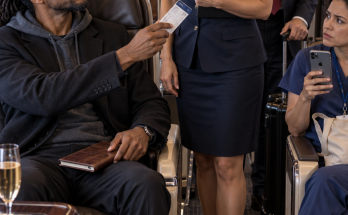
Ten minutes later, Cassandra returned carrying a sealed gray blanket.
She dropped it onto the empty seat beside Eleanor.
“We had exactly one left.”
“Thank you.”
“Consider yourself fortunate.”
Eleanor looked up.
“Fortunate to receive an item included in the price of my ticket?”
For the first time, Cassandra’s professional mask slipped completely.
“You received the blanket, ma’am.”
She turned and walked back to the galley.
Eleanor opened her notebook.
Blanket initially denied. Loyalty status invoked despite First Class fare. Delivered with hostile remark.
She stared at the words.
On paper, the incident looked trivial.
That was the genius of it.
The injury lived between the lines.
After wrapping herself in the blanket, Eleanor tried to continue reading, but the words blurred. The engines produced a deep, steady vibration. Her body surrendered to fatigue.
Within minutes, she was asleep.
In the rear galley, Cassandra closed the curtain.
Jared was preparing coffee.
“What was that about?” he asked.
“What was what about?”
“Seat 2A.”
Cassandra opened a cabinet with unnecessary force.
“She demanded the last premium blanket.”
“She asked for it.”
“You weren’t there.”
“I saw most of it.”
Cassandra turned.
At twenty-six, Jared still possessed the dangerous habit of believing truth should influence authority.
“She’s been difficult since boarding,” Cassandra said. “People like her come up here on points or upgrades and think First Class rules no longer apply.”
Jared stared at her.
“People like her?”
Cassandra’s eyes hardened.
“You know what I mean.”
“No,” he said. “I don’t.”
She stepped closer.
“You’re new, Jared. Let me give you advice. There are passengers who test boundaries because they assume the airline is afraid of complaints. Once they sense weakness, they take advantage.”
“She asked for a blanket.”
“It’s not about the blanket.”
“What is it about?”
Cassandra looked toward the curtain, lowering her voice.
“Standards.”
Jared’s expression changed.
Not dramatically. Just enough.
He reached for his phone lying beside the coffee machine and turned it facedown.
Cassandra did not notice the small red recording symbol glowing on the screen.
“She didn’t even say please,” Cassandra added.
“She did.”
“You’re mistaken.”
“I was standing three feet away.”
Cassandra leaned close enough for Jared to smell the coffee on her breath.
“I am the senior purser. My report becomes the official account. Remember that.”
Then she pulled open the curtain and returned to the cabin.
Jared remained motionless.
Months earlier, his sister had been fired from Oceanic after reporting that supervisors used coded language to exclude minority applicants from international routes. She had been called disruptive, unstable, and insufficiently professional.
Jared had taken the job partly because he needed the salary.
He had stayed because he wanted proof.
Now, inside the pocket of his uniform, his phone contained Cassandra’s voice saying what the company’s attorneys claimed no employee ever believed.
People like her.
Standards.
My report becomes the official account.
He saved the recording to a secure cloud account.
Then he sent a brief message to a contact saved under the name DAVID R.
Something is happening in First Class.
Three rows ahead, a man wearing a black jacket felt his phone vibrate.
Federal Air Marshal David Reynolds read the message without changing his expression.
He looked toward Eleanor.
She was sleeping.
He looked toward Cassandra.
She stood in the aisle staring at the gray blanket wrapped around Eleanor’s shoulders.
There was something frightening in Cassandra’s stillness.
Not anger alone.
Permission.
As though she believed the cabin belonged to her and no consequence could reach her at thirty-eight thousand feet.
Reynolds unfastened the top button of his jacket.
He had spent eighteen years studying the moments before people crossed irreversible lines.
Cassandra’s hands began to shake.
Then she reached for the blanket.
PART THREE
THE MOMENT THE CABIN WOKE UP
Eleanor awoke believing, for one disoriented instant, that she was falling.
The blanket scraped across her neck as Cassandra tore it away with both hands.
Cold air struck Eleanor’s body.
Her eyes opened to a face twisted by anger.
“I told you!” Cassandra shouted. “Servants don’t get luxury perks!”
The words cracked through the cabin.
The blanket landed in the aisle.
A woman gasped.
Someone behind Eleanor said, “My God.”
Cassandra pointed toward the floor.
“You want a blanket? Use your coat. These are for paying customers.”
For several seconds, Eleanor could not speak.
She had spent years listening to witnesses describe humiliation. Many cried in her courtroom. Some became angry. Others struggled to remember details because shame had blurred the edges of memory.
Eleanor had always treated them with patience.
But until that moment, she had not fully understood the physical sensation of public degradation.
It was heat rising through the chest.
A tightening in the throat.
A strange separation between mind and body, as though one part of the self stepped away to avoid witnessing what was happening to the other.
She looked at the blanket on the floor.
Then she looked at Cassandra.
“Pick that up.”
Her voice was quiet.
Cassandra laughed.
“Excuse me?”
“Pick up the blanket.”
“You do not give orders to the crew.”
“I am not giving you an order. I am giving you an opportunity.”
“To do what?”
“To correct yourself.”
Cassandra leaned closer.
“I can have you restrained for interfering with a flight attendant.”
“You woke a sleeping passenger by forcibly removing airline property from her body.”
“You were noncompliant.”
“With what instruction?”
“Lower your voice.”
Eleanor had not raised it.
That accusation, too, was familiar.
The older woman seated behind her spoke up.
“She hasn’t raised her voice at all.”
Cassandra spun around.
“Please remain out of this.”
“I saw what you did.”
“Ma’am, return to your seat.”
“I am in my seat.”
A nervous ripple moved through the cabin.
Cassandra’s authority was slipping, and everyone could see it.
She reached for the intercom panel.
“I’m calling the captain.”
A seat belt clicked behind Eleanor.
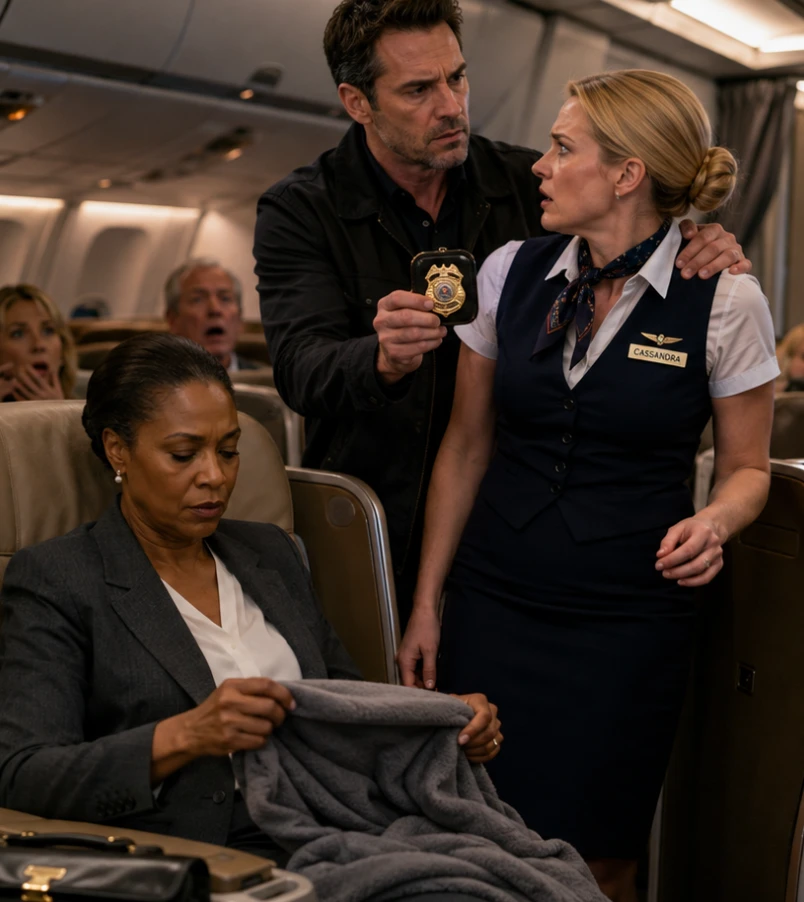
David Reynolds stood.
He was tall enough that his shoulders nearly filled the aisle. His expression contained no drama, only the disciplined certainty of a man who had already decided what would happen next.
“Step away from the passenger.”
Cassandra turned.
“Sit down.”
“Step away.”
“You are interfering with a crew member.”
Reynolds moved closer.
Cassandra lifted one hand as though to push him back.
He caught her wrist, turned her gently but firmly, and placed his other hand on her shoulder.
She cried out.
“Jared! Call the cockpit! We have an assault!”
Reynolds released her wrist and opened his jacket.
Several passengers recoiled.
He removed a black leather credential case and displayed the gold shield.
“Federal Air Marshal David Reynolds.”
The cabin became silent.
Cassandra’s face emptied of color.
“I was following procedure.”
“No,” Reynolds said. “You were committing an assault.”
“She refused instructions.”
“What instruction?”
Cassandra opened her mouth.
No answer came.
Reynolds looked toward Jared, who had entered the cabin.
“Did the passenger refuse a lawful crew instruction?”
Jared hesitated.
Cassandra stared at him.
The threat in her eyes was unmistakable.
Jared swallowed.
“No.”
“Did she threaten anyone?”
“No.”
“Did she raise her voice?”
“No.”
“Did she request a blanket politely?”
“Yes.”
Cassandra’s expression turned vicious.
“You have no idea what you’re doing.”
“For the first time since I joined this airline,” Jared said, “I think I do.”
Reynolds faced Cassandra again.
“You will remain in the rear jump seat until landing. Another crew member will perform your duties.”
“You can’t remove me from my own cabin.”
“This is not your cabin.”
The words landed harder than a shout.
Reynolds gestured for Jared to escort her away.
Cassandra looked at Eleanor.
“You planned this.”
Eleanor bent down and picked up the blanket.
She folded it once, then again, smoothing the fabric across her lap.
“I asked for warmth,” she said. “You supplied evidence.”
Cassandra’s eyes narrowed.
“Who are you?”
Before Eleanor could answer, Graham Sterling rose from Seat 1C.
“That’s enough.”
His voice carried the practiced authority of a boardroom chairman.
Cassandra looked toward him with visible relief.
“Mr. Sterling—”
“Go to the galley,” he said.
Reynolds turned.
“And you are?”
Sterling gave a thin smile.
“Graham Sterling. Chairman of Oceanic Airlines.”
Murmurs spread through the cabin.
Sterling adjusted his jacket.
“I’m certain this has been a deeply regrettable misunderstanding. There is no need to inflame the situation.”
Eleanor watched him carefully.
He still had not acknowledged knowing her.
Sterling addressed the cabin.
“On behalf of Oceanic Airlines, I apologize for the disruption. Ms. Vale’s conduct will be reviewed.”
“Reviewed?” the older woman behind Eleanor said. “She attacked that passenger.”
“We should avoid conclusions before all facts are known.”
“The facts happened in front of us,” the businessman across the aisle said.
Sterling’s smile vanished.
“I appreciate everyone’s concern. But employee discipline is an internal matter.”
Eleanor finally spoke.
“Mr. Sterling.”
He looked at her.
Recognition entered his face.
Not surprise.
Recognition.
“Judge Vance,” he said.
The cabin reacted again.
Cassandra, standing near the galley curtain, froze.
Eleanor rose slowly.
“Yes,” she said. “The Honorable Eleanor Vance, United States District Court.”
Sterling closed his eyes for half a second.
Eleanor continued.
“I am currently assigned to the civil rights action filed against Oceanic Airlines.”
Cassandra gripped the edge of a seat.
“No,” she whispered.
Sterling stepped into the aisle.
“Judge, I strongly advise that we discuss this privately.”
“You advised the court last month that allegations of discriminatory service were exaggerated.”
“This incident cannot be interpreted without context.”
“What context makes the word ‘servant’ appropriate?”
Cassandra began to cry.
“I didn’t know who she was.”
The sentence produced a reaction more damaging than any confession.
Eleanor looked at her.
“That is precisely the point.”
Cassandra covered her mouth.
Sterling moved closer to Eleanor.
“Judge Vance, your presence on this flight creates serious ethical questions. Any personal involvement may require your immediate recusal.”
“I am aware of my obligations.”
“Then you understand that this incident cannot become part of the pending case.”
“That decision will not be yours.”
Sterling lowered his voice.
“You have compromised yourself.”
Eleanor studied him.
Despite the situation, he appeared almost relieved.
That troubled her.
Then she noticed his hand resting against his jacket pocket.
His phone was inside.
The screen glowed through the fabric.
A message had arrived.
Sterling looked at it briefly.
His expression changed.
Not fear.
Satisfaction.
Reynolds saw it too.
“Mr. Sterling,” he said, “place your phone on the seat.”
Sterling laughed softly.
“You have no authority to seize my property.”
“Not yet.”
“Then I suggest you stop performing for the cabin.”
Reynolds did not move.
Eleanor felt the atmosphere shift.
Sterling had expected something like this.
Perhaps not Cassandra’s explosion, but a confrontation.
A judge emotionally involved.
A public incident.
A basis for recusal.
She looked toward Cassandra.
“Who told you I had been upgraded?”
Cassandra blinked.
“What?”
“In the galley, you said I had probably entered First Class through points or an upgrade. Who told you that?”
“I assumed.”
“Why?”
Cassandra glanced at Sterling.
It lasted less than a second.
But Eleanor saw it.
So did Reynolds.
Sterling stepped forward.
“This conversation is over.”
Eleanor turned toward him.
“No,” she said. “I believe it has just begun.”
PART FOUR
THE MAN BEHIND THE CURTAIN
The aircraft was still three hours from Los Angeles.
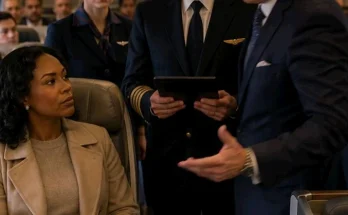
The captain had been informed that the senior purser had been removed from duty following an incident involving a federal air marshal. He ordered Cassandra to remain seated and advised the cabin that law enforcement would meet the flight upon arrival.
Sterling returned to Seat 1C, but his confidence had begun to fracture.
Eleanor could see it in the movement of his hands.
He kept touching his phone.
Reynolds sat across the aisle from him.
Jared served water to the passengers, though few accepted it.
The cabin no longer resembled a place of luxury. It felt like a sealed courtroom suspended above the continent.
Every face had become part of the jury.
Eleanor remained in Seat 2A.
She should have felt triumphant.
Instead, she felt sick.
Cassandra’s words replayed in her mind.
Servants don’t get luxury perks.
Her mother had spent thirty-eight years working as a housekeeper in Richmond, Virginia. She had cleaned homes belonging to families who praised her reliability but never invited her through the front door when guests were present.
When Eleanor was twelve, she accompanied her mother to work during school holidays. She remembered folding towels in rooms larger than their entire apartment.
Once, a homeowner’s daughter had handed Eleanor an empty glass and said, “You people know where the kitchen is.”
Eleanor had never told her mother.
Some humiliations were too sharp to share.
She closed her eyes.
“Judge Vance?”
Jared stood beside her.
“Yes?”
He glanced toward Sterling.
“I need to show you something.”
Reynolds approached.
Jared removed his phone and opened the recording from the galley.
Cassandra’s voice emerged quietly through the speaker.
People like her come up here on points or upgrades…
This is First Class. It’s about standards…
My report becomes the official account.
Eleanor listened without expression.
Then another voice appeared on the recording.
Not Jared’s.
A man’s voice coming through Cassandra’s earpiece.
“Has she reacted yet?”
Cassandra answered softly, “Not enough.”
The man replied, “Keep pressure on her. We need something usable before landing.”
Eleanor looked up.
“Play that again.”
Jared did.
The voice was muffled, but recognizable.
Graham Sterling.
Reynolds turned toward Seat 1C.
Sterling had gone completely still.
Cassandra began sobbing near the galley.
“He said it was a service assessment.”
Everyone looked at her.
She pressed both hands against her face.
“He told me the passenger in 2A was suspected of using fraudulent credentials. He said she had a history of threatening lawsuits. He told me to document aggressive behavior.”
Sterling rose.
“Do not say another word.”
Cassandra stared at him.
“You said the company would protect me.”
“You are confused.”
“You told me to provoke her.”
“I said no such thing.”
Jared lifted the phone.
“We have your voice.”
Sterling’s face hardened.
“That recording is illegal.”
Reynolds stepped closer.
“Under federal law, the admissibility question can be resolved later. Tonight, it establishes enough concern for an investigation.”
Sterling looked at Eleanor.
“You see what this is, don’t you? A manufactured spectacle. A disgruntled employee and an incompetent junior attendant trying to save themselves.”
Cassandra stood.
“You knew she was the judge.”
Sterling said nothing.
“You knew,” Cassandra repeated. “You told me she was an activist attorney traveling under a false reservation.”
Sterling’s voice became cold.
“Sit down.”
“You wanted her to lose control.”
“Sit down.”
“You wanted video of her threatening the crew so your lawyers could remove her from the case.”
Sterling lunged toward her.
Reynolds intercepted him and forced him back against the seat.
Passengers cried out.
Sterling struggled.
“Get your hands off me!”
“Stop resisting.”
“I am the chairman of this airline!”
Reynolds tightened his grip.
“And at this moment, you are a passenger interfering with a federal investigation.”
Sterling stopped moving.
His breathing came fast and shallow.
Eleanor watched him.
The pattern was now clear.
Oceanic’s legal team had discovered her travel plans.
Sterling had boarded the flight personally.
Cassandra had been instructed to create a record of hostile behavior.
If Eleanor complained, the airline would characterize her as biased.
If she became angry, they would seek her recusal.
If she remained silent, the treatment would continue without consequence.
It was an elegant trap.
But something did not fit.
Sterling had taken an extraordinary risk.
Why?
Recusing one judge would delay the case, not destroy it. Another judge would eventually review the evidence.
Unless Sterling needed only a few days.
Eleanor looked at his briefcase under the seat.
“What happens tomorrow morning?”
He stared at her.
“You mentioned board approval,” she said. “What is the California office approving?”
“I have no obligation to answer.”
“Then perhaps your phone will.”
Sterling smiled again.
It was the smile of a man who believed he had found solid ground.
“You have no warrant.”
Reynolds looked toward Eleanor.
“He’s right.”
Sterling relaxed.
Then Jared spoke.
“His phone is connected to the aircraft Wi-Fi system.”
No one understood immediately.
Jared continued.
“Crew devices and executive accounts route through the onboard business network. Messages are mirrored temporarily for system diagnostics.”
Sterling’s face changed.
Jared turned toward the galley.
“The onboard server keeps a cache until the aircraft lands.”
Sterling moved before anyone expected it.
He shoved Reynolds aside and ran toward the galley.
Passengers screamed.
Jared blocked the aisle.
Sterling struck him across the face.
Reynolds seized Sterling from behind and drove him against the bulkhead.
The chairman fought with desperate strength.
“Erase it!” he shouted toward Cassandra. “Erase the server now!”
Cassandra stared at him.
Something inside her broke.
Perhaps it was loyalty.
Perhaps fear.
Perhaps the realization that she had been used.
She stepped away from the galley controls.
“No.”
Sterling stopped struggling.
The word had defeated him more completely than force.
Reynolds restrained his wrists with plastic cuffs.
Eleanor remained seated.
“What happens tomorrow morning?” she asked again.
Sterling looked at her with hatred.
Then he laughed.
“You think this is about your lawsuit?”
No one spoke.
He leaned back against the bulkhead.
“By nine o’clock Pacific time, there won’t be an Oceanic Airlines for your plaintiffs to sue.”
PART FIVE
THE LAST FLIGHT OF OCEANIC AIRLINES
The truth emerged piece by piece.
Sterling had arranged an emergency sale of Oceanic’s most valuable assets to a private aviation consortium registered in the Cayman Islands. Aircraft leases, airport gates, maintenance contracts, and intellectual property were scheduled to transfer at nine o’clock the following morning.
The remaining corporation would enter bankruptcy carrying billions in liabilities, including any judgment from the civil rights case.
Passengers and employees might win in court.
But there would be nothing left to collect.
The buyer was controlled through shell companies.
The ultimate beneficiary was Graham Sterling.
He intended to sell Oceanic to himself, abandon its debts, and relaunch the profitable routes under a different name.
The discrimination lawsuit was not the only reason.
Pension obligations were due.
Employee healthcare costs were rising.
Several aircraft required expensive repairs.
Sterling had decided that destroying the company was more profitable than leading it.
His messages, contracts, and board communications were stored in encrypted files on his phone and laptop.
He had planned to finalize the transfer immediately after landing.
Eleanor’s recusal would have created enough confusion to prevent the plaintiffs from seeking an emergency injunction before the sale.
“You were willing to provoke a federal judge to buy twelve hours,” Eleanor said.
Sterling sat cuffed in Seat 1C.
“Twelve hours is an eternity in business.”
“You used Cassandra.”
He looked toward the rear galley.
“She used herself.”
Cassandra flinched.
Sterling continued.
“I gave her an assignment. She revealed her nature.”
Eleanor could not disagree.
The plan had created the circumstances.
Cassandra’s prejudice had supplied the cruelty.
Both truths mattered.
Reynolds contacted federal authorities through the secure air marshal communication system. Agents in Los Angeles prepared to board the aircraft. A magistrate judge was awakened to review an emergency request concerning the onboard server and Sterling’s devices.
But there was a problem.
The planned asset transfer was legally structured to occur automatically.
Even Sterling’s arrest might not stop it.
Someone with authority had to obtain a temporary restraining order before nine o’clock.
Eleanor looked at the time.
4:18 a.m. Pacific.
She could not issue the order herself. She was personally involved in the triggering incident.
Sterling knew it.
That was why some of his confidence returned.
“You have evidence,” he said. “But you cannot touch the transaction.”
Eleanor opened her briefcase.
Sterling leaned forward.
“What are you doing?”
She removed a sealed envelope.
The chief judge’s signature appeared across the back.
Sterling’s expression tightened.
“What is that?”
Eleanor broke the seal.
Inside was an administrative order signed two days earlier.
She read it once, though she already knew every word.
Then she handed it to Reynolds.
Sterling stared at her.
“You planned for this?”
“I planned for the possibility that personal experience might compromise my neutrality.”
The order temporarily reassigned all emergency matters in Williams v. Oceanic Airlines to Judge Marianne Bell, Eleanor’s longtime colleague in the Central District of California.
Bell had been informed that she might receive a request during the night.
Sterling’s smile disappeared.
Eleanor took out a satellite phone approved for judicial emergencies.
“You wanted me removed from the case,” she said. “So I removed myself from tonight’s decision before I ever boarded.”
She called Judge Bell.
At 5:02 a.m., attorneys for the plaintiffs joined an emergency telephone hearing.
At 5:19, Oceanic’s outside counsel appeared.
At 5:31, Jared authenticated the recording.
At 5:44, Reynolds described Sterling’s attempt to reach the onboard server.
At 6:03, Judge Bell issued a temporary restraining order blocking the transfer of every Oceanic asset worldwide.
The order also prohibited destruction of records and froze accounts linked to Sterling’s shell companies.
For the first time that night, Graham Sterling looked afraid.
But the final revelation had not yet arrived.
As dawn spread across the horizon, the aircraft began its descent toward Los Angeles.
The cabin lights brightened.
Passengers raised their window shades.
Cassandra sat alone in the rear jump seat, her face gray with exhaustion.
Eleanor walked toward her.
Reynolds started to follow, but she shook her head.
Cassandra looked up.
“Are you here to tell me I’m finished?”
“No.”
“You should.”
“I am here to ask why.”
Cassandra laughed bitterly.
“You already know why.”
“I know what you did. I want to know when you decided I was beneath you.”
Cassandra looked away.
“I don’t know.”
“That is not true.”
Silence stretched between them.
Finally, Cassandra spoke.
“My father worked for Oceanic for thirty-one years. Baggage operations. He died believing the company was the finest institution in America.”
Eleanor waited.
“He used to bring me to the airport when I was little. He would point at the First Class passengers and tell me they were important people. He said if I worked hard, maybe one day I would serve people like that.”
“Serve them?”
Cassandra’s mouth trembled.
“He thought it was an honor.”
“And you?”
“I thought proximity to important people made me important.”
She looked toward the cabin.
“Then passengers like you started appearing.”
“Passengers like me.”
“People who didn’t match what I had been taught wealth looked like.”
Eleanor felt sadness, not sympathy.
Those were different things.
“So you guarded the door,” she said.
Cassandra nodded.
“I told myself I was protecting standards. I told myself I could recognize who belonged.”
“You protected a hierarchy that never included you.”
Cassandra began to cry.
“I know.”
“No,” Eleanor said. “You are beginning to know.”
The landing gear lowered with a mechanical roar.
Cassandra wiped her face.
“Will you destroy me?”
“I do not have that power.”
“You have more power than anyone I’ve ever met.”
“That does not make revenge justice.”
Cassandra looked up hopefully.
Eleanor’s expression remained firm.
“You assaulted me. You humiliated me. You used a word designed to reduce generations of people to a position of obedience. You will face consequences.”
Hope disappeared.
“But,” Eleanor continued, “you will face them according to law. Not according to my anger.”
The aircraft touched down at 6:42 a.m.
Federal agents entered as soon as the door opened.
Sterling was taken into custody.
His phone, laptop, and briefcase were seized pursuant to the magistrate’s warrant.
Cassandra was escorted away for questioning.
Jared received medical treatment for the bruise forming along his jaw.
Passengers provided statements.
News crews gathered outside the terminal before sunrise had fully broken.
Someone had transmitted a description of the incident to the press.
By eight o’clock, every major network carried the same headline:
OCEANIC CHAIRMAN ARRESTED AFTER MID-AIR CONFRONTATION WITH FEDERAL JUDGE.
The company’s stock collapsed.
Board members resigned.
The asset transfer failed.
Sterling was charged with obstruction, wire fraud, conspiracy, and attempted destruction of evidence. Additional investigations uncovered years of hidden complaints, manipulated passenger reports, and secret settlement agreements.
Cassandra lost her job and later pleaded guilty to a misdemeanor assault charge.
At sentencing, she apologized publicly.
Not elegantly.
Not perfectly.
But without excuses.
Jared became the central whistleblower in the federal investigation. Oceanic’s employees called him a hero, though he rejected the word.
“I waited too long,” he said. “Heroes don’t wait.”
Months passed.
The civil rights case continued under a new judge after Eleanor permanently recused herself.
That decision surprised many people.
Some believed Sterling had succeeded in removing her after all.
But Eleanor knew otherwise.
Impartiality was not weakness. Sometimes stepping away protected the integrity of the result more powerfully than remaining.
Oceanic entered court-supervised restructuring rather than fraudulent bankruptcy. Its assets were preserved. A compensation fund was established for affected passengers and employees.
The company was required to release internal records publicly.
The evidence was worse than anyone expected.
Discrimination had not merely been tolerated.
It had been measured, categorized, and quietly monetized.
Executives had calculated that mistreated minority passengers were less likely to pursue expensive litigation. Complaints from certain ZIP codes received lower settlement authority. Employees who used phrases such as “racial bias” or “unequal service” were flagged as potential risks.
The case settled for an amount large enough to change corporate behavior across the airline industry.
Graham Sterling was convicted on all major counts.
On the day of sentencing, Eleanor sat in the back of the courtroom.
Sterling saw her.
For the first time, there was no First Class cabin, no boardroom, no employee waiting to obey him.
Only a defendant standing before the law.
He received eighteen years in federal prison.
Afterward, Eleanor returned to her chambers.
A package was waiting on her desk.
There was no return address.
Inside lay the gray blanket from Flight 815, carefully cleaned and folded.
Beneath it was a letter.
Judge Vance,
You asked me when I decided you were beneath me.
The truth is that I never decided.
I inherited the decision.
I accepted it from my family, my workplace, my friends, and every institution that rewarded me for enforcing it.
That does not excuse what I did.
It makes it worse.
You told me I was beginning to know.
I am still beginning.
Cassandra Vale
Eleanor read the letter twice.
Then she noticed something stitched into the corner of the blanket.
A small cloth label had been added by hand.
It contained no company logo.
Only a name.
LILLIAN VANCE.
Eleanor stopped breathing.
Lillian had been her mother’s name.
She turned the label over.
On the reverse was a handwritten inventory number.
Eleanor recognized the format from childhood.
It belonged to the Richmond textile factory where her mother had worked nights before becoming a housekeeper.
The factory had manufactured luxury airline blankets during the 1970s.
Eleanor called the number included at the bottom of Cassandra’s letter.
Cassandra answered from a residential rehabilitation program in Virginia.
“How did you get this blanket?”
There was a long pause.
“My father kept it,” Cassandra said.
“Why?”
“He supervised shipping at the textile factory before joining Oceanic.”
Eleanor sat down.
Cassandra continued.
“He found your mother’s name in the stitching records. After the flight, I searched the company archives because I wanted to understand why you reacted to the word ‘servant’ the way you did.”
“My mother never spoke about that factory.”
“She filed a complaint in 1976.”
Eleanor closed her eyes.
“For what?”
“Black women were assigned to inspect and repair defective blankets. White women were promoted to quality control. Your mother organized the workers.”
Eleanor felt the room shift around her.
“She was fired,” Cassandra said. “The complaint disappeared. My father signed the disciplinary report.”
The silence between them contained half a century.
“Why send this to me?”
“Because I thought the story began on Flight 815.”
Cassandra’s voice broke.
“It didn’t.”
Eleanor looked at the gray blanket across her desk.
Her mother had touched it.
Perhaps she had repaired it.
Perhaps she had stitched her name into the corner as proof that her hands had existed inside an industry determined to erase them.
The airline had carried that blanket for decades.
Through thousands of flights.
Across millions of miles.
Until it reached Seat 2A.
Eleanor understood then that the most powerful evidence had never been inside her briefcase.
It had been wrapped around her body.
The object Cassandra had torn away as a symbol of exclusion had been made by the woman whose sacrifice allowed Eleanor to enter that cabin with the authority to challenge an empire.
Months later, Eleanor donated the blanket to the National Museum of African American History and Culture.
Its display carried a simple description:
Luxury airline blanket manufactured in 1976 by Lillian Vance, a textile worker dismissed after protesting racial discrimination. Returned to her daughter, Federal Judge Eleanor Vance, following the civil rights case that transformed Oceanic Airlines.
Visitors often stood before it longer than expected.
Some saw fabric.
Some saw history.
Eleanor saw her mother’s hands.
On the first anniversary of Flight 815, she returned to Los Angeles.
Oceanic had renamed the First Class service program after Lillian Vance—not as a marketing gesture, but as part of a legally binding reform agreement requiring scholarships, employee protections, and independent civil rights oversight.
Eleanor refused the invitation to attend the ceremony in First Class.
She purchased an economy ticket.
When the flight attendant offered her a blanket, Eleanor accepted it.
“Thank you,” she said.
The young woman smiled.
“You’re welcome, Judge Vance.”
Eleanor unfolded the blanket across her knees.
Outside the window, the aircraft rose through a layer of clouds into brilliant morning light.
For most of her life, she had believed justice traveled forward, carried by laws, rulings, and people courageous enough to challenge the present.
Now she understood that justice also traveled backward.
It returned names to the forgotten.
It restored dignity to the dead.
It reached into the past and said:
You were seen.
You mattered.
And the door you were forbidden to enter did not remain closed forever.
“`