PART ONE — THE SEAT BESIDE ME
The first sign that trouble had chosen me was not the phone pointed at my face.
It was the silence that came before it.
There is a particular kind of silence that enters a room—or an airplane cabin—when people have already decided who is dangerous. It is not empty. It is crowded with assumptions. It watches. It waits. It dares you to move the wrong way.
I felt that silence the moment Chloe stopped beside seat 2A.
I had boarded the Delta flight from Atlanta to Seattle twenty minutes earlier, stored my overnight bag in the overhead bin, and settled beside the window with the private gratitude of a man who had paid too much money for a little peace. At thirty-four, I had learned not to romanticize travel. Airports were fluorescent purgatories. Airplanes were metal tubes full of strangers, recycled breath, and unspoken negotiations over armrests.
But that morning, I had allowed myself one luxury.
First Class.
I had earned it.
For six years, I had worked as Director of Threat Intelligence at Blackstone Meridian, a cybersecurity firm that advised banks, hospitals, federal contractors, and companies wealthy enough to fear enemies they could not see. My workdays began before sunrise and often ended after midnight. I had spent the previous week helping contain a coordinated ransomware attack against a regional power grid.
I was exhausted enough to feel hollow.
All I wanted was John Coltrane in my headphones, a glass of water, and four uninterrupted hours where no one needed me to stop a disaster.
Then Chloe arrived.
She stood in the aisle wearing an oversized beige cashmere sweater, fitted cream trousers, and white leather sneakers so spotless they seemed protected by a legal agreement. A pink Samsonite suitcase rolled behind her. A large Prada tote hung from one shoulder. Her phone was attached to a small glowing ring light, and she held it at an angle that placed her face in perfect illumination.
She looked at me.
Then at the row number.
Then at me again.
“Excuse me,” she said.
Her smile was pleasant in the same way a locked door is polite.
“Yes?”
“Are you sure you’re in the right seat?”
I glanced at the number above us.
“Two A.”
“This is First Class.”
“I’m aware.”
The smile remained, but something behind it hardened.
“Oh. Right.”
She looked toward the flight attendant station as if expecting someone to correct an administrative mistake.
When no one came, she squeezed past me, pressing her Prada tote to her chest.
As she sat down, her perfume surrounded us—sandalwood, smoke, and something expensive enough to announce itself.
She turned her phone toward the window and smiled brightly.
“Hey, loves,” she said to the screen. “We finally made it onto the flight. You would not believe the morning I’ve had.”
Her voice was airy, animated, practiced.
I put on my headphones.
In the row ahead, an older white man glanced over his newspaper. He wore a navy blazer, a pale blue shirt, and a Rolex Daytona that caught the cabin lights whenever he moved. He had silver hair and the grave, self-contained expression of a man accustomed to being listened to.
Later, I would learn his name was Arthur Bell.
At that moment, he was only another passenger who had noticed the tension and chosen not to involve himself.
The lead flight attendant came down the aisle carrying preflight drinks. Her name tag read BRENDA. She was probably in her late fifties, with carefully arranged blond-gray hair and the tired eyes of someone who had spent decades calming people who believed a boarding pass granted them temporary royalty.
She leaned toward Chloe.
“Champagne, honey?”
“Oh, thank God,” Chloe said, laughing toward her livestream. “My anxiety is insane today.”
Brenda poured the champagne and smiled.
Then she turned to me.
The smile vanished.
“Sir, I’ll need to see your boarding pass.”
I looked at her.
For half a second, I considered asking why.
Why mine?
Why not Chloe’s?
Why not the man in front of us?
But I already knew the answer, and I was too tired to force her to lie.
“You scanned it at the gate,” I said.
“It’s just protocol. We need to verify everyone is seated correctly.”
I looked past her.
She had not checked anyone else.
The familiar ache spread beneath my ribs.
It was not anger exactly. Anger was too simple. It was something older, heavier—the exhaustion of being asked to provide evidence of your right to occupy a space while everyone else was granted innocence by default.
My father used to call it the tax.
“You pay it in patience,” he had told me when I was sixteen. “You pay it in swallowed words. You pay it because the world charges some men more just to stand still.”
My father, Leon Carter, had been a mechanic on the South Side of Chicago. He could rebuild an engine with his eyes half closed, but he never trusted banks, police officers, or smiling strangers who called him “sir” too many times.
He died when I was twenty-eight.
I still heard his voice when I needed it most.
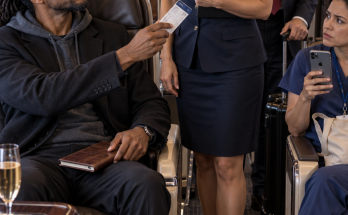
I opened the Delta app and held up my phone.
Brenda examined the boarding pass longer than necessary.
Finally, she nodded.
“Water or juice?”
“Water, please.”
She moved on.
Chloe took a slow sip of champagne and watched me over the rim of the glass.
“You travel for work?” she asked.
Her camera remained angled toward us.
“Yes.”
“What do you do?”
“Cybersecurity.”
Her eyebrows rose.
“Like hacking?”
“Mostly preventing it.”
“That sounds intense.”
“It can be.”
She looked at my dark gray hoodie, my headphones, and the laptop case under the seat.
Then she smiled toward her phone.
“I swear, you meet the most interesting people when you travel.”
I turned toward the window.
Outside, baggage carts moved beneath a washed-out Georgia sky.
I had no idea that before we landed, fifty thousand people would know my face.
Or that one of them had been waiting years to see it again.
PART TWO — THE STORY SHE NEEDED
Once we were airborne, the cabin settled into the restless peace of long-distance travel.
The engines became a steady roar. Seat belts clicked open. Drinks appeared. Laptops unfolded.
I opened my MacBook and connected to the onboard Wi-Fi.
The ransomware attack from the previous week was technically contained, but I had promised one of our clients a final review of the intrusion logs. A terminal window filled the screen. White and green lines of code moved across a black background.
The work calmed me.
Machines were not unbiased, despite what people liked to claim. People built them, and people carried their prejudices into everything they touched. But systems had rules. Signals could be traced. Patterns could be tested. Evidence did not become offended when questioned.
Beside me, Chloe had been livestreaming for nearly forty-five minutes.
I learned more about her life than I wanted to know.
She had missed a brand partnership deadline.
A cosmetics company had reduced her fee.
Her engagement was down.
Her former assistant was “obsessed” with ruining her.
The social media algorithm was “basically emotional abuse.”
Every complaint was delivered with a wounded smile and a little laugh designed to make outrage seem charming.
At one point, she held up her champagne glass.
“To surviving,” she told her viewers.
Her audience counter hovered around twelve thousand.
Then it began to fall.
Eleven thousand eight hundred.
Eleven thousand four hundred.
Eleven thousand one hundred.
Chloe noticed.
Her tone changed.
She lowered her voice and leaned closer to the camera.
“Okay, guys,” she whispered. “I don’t want to be dramatic, but my energy is really off right now.”
I kept typing.
“I’m sitting next to this man, and he’s been acting… weird.”
My hands slowed.
“He’s typing all this hacker code. He keeps watching me.”
I had not looked at her in twenty minutes.
“I don’t know. You girls know what I mean. Sometimes your intuition tells you something before your brain catches up.”
The viewer count stabilized.
Then rose.
Twelve thousand.
Twelve thousand five hundred.
The comments accelerated.
Chloe leaned farther away from me.
“He has his hood up.”
My hood was folded behind my neck.
“He keeps glancing at my bag.”
I had forgotten she had a bag.
I removed my hands from the keyboard and placed them flat on the edge of the laptop.
A pulse beat hard in my jaw.
I could have turned toward her camera and corrected the lies. I could have said she was manufacturing fear because fear performed well online.
But I knew what would happen.
If I spoke firmly, I would be aggressive.
If I laughed, I would be mocking her fear.
If I objected to being filmed, I would have something to hide.
My father’s voice returned.
Your anger is a weapon they will use against you. Your silence is armor.
So I stayed silent.
Across the aisle, a woman in her sixties watched Chloe with a troubled expression. She had short auburn hair, reading glasses hanging from a chain, and a paperback open in her lap. Our eyes met briefly.
She looked away.
Arthur, in the row ahead, lowered his newspaper.
“Miss,” he said.
Chloe turned.
“Are you speaking to me?”
“You’re filming other passengers.”
“I’m filming myself.”
“Your camera is pointed at half the cabin.”
“This is a public space.”
“No,” Arthur said calmly. “It’s a commercial aircraft.”
Chloe smiled.
“Thanks for your concern.”
Arthur returned to his paper.
For several minutes, nothing happened.
Then Chloe stood and opened the overhead bin.
I barely noticed. People moved in and out of the aisle constantly.
She took down her pink suitcase, set it upright beside her seat, and unzipped it just enough to reach inside. Her body blocked my view. After a few seconds, she zipped it again, returned it to the bin, and sat down.
When she glanced at me, her expression was different.
Focused.
Almost eager.
Twenty minutes later, she gasped.
It was loud enough to cut through the engine noise.
“Oh my God.”
The woman across the aisle looked up.
Arthur turned around.
Chloe grabbed at her lap.
“My bag.”
She checked beside her seat, beneath the blanket, and under the armrest.
“My Chanel bag is gone.”
Brenda hurried toward us.
“What happened?”
“My clutch,” Chloe said. “My vintage Chanel clutch. It was right here.”
“Could it have slid under the seat?”
“No.”
Brenda crouched and checked.
Nothing.
“Maybe you put it overhead.”
“I didn’t.”
Her breathing became rapid and shallow, but her phone remained perfectly positioned.
“I fell asleep for ten minutes,” she said. “Someone took it.”
“You weren’t asleep,” I said before I could stop myself.
The cabin seemed to tighten.
Chloe turned slowly.
“What?”
“You’ve been livestreaming.”
Her face changed.
Not much.
Just enough.
Then she stood.
The ring light swung toward me.
“He took it.”
For one second, no one moved.
Then the viewer count on her screen surged.
Twenty thousand.
Twenty-eight thousand.
Thirty-six thousand.
Chloe pointed at me.
“He stole my bag.”
“That’s not true.”
“You’ve been watching me since we boarded.”
“No.”
“You were typing hacker code.”
“I was working.”
“And now my bag is missing.”
Brenda stood between us, but her body faced me.
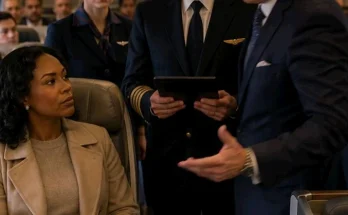
“Sir, I need you to step into the aisle.”
“I haven’t touched her property.”
“We need to inspect the seating area.”
“You can inspect it without treating me like a criminal.”
Chloe’s phone moved closer.
“Look at him,” she told her viewers. “He won’t cooperate.”
The comments flew by.
Search him.
Call the police.
He looks guilty.
Typical.
I saw the word thug more than once.
My face grew hot.
The plane suddenly felt too small.
I thought of every story I had read about a misunderstanding escalating because a Black man moved too quickly, spoke too loudly, or refused to become smaller when ordered.
Brenda crossed her arms.
“If you don’t cooperate, the captain will have law enforcement meet us in Seattle.”
“On what evidence?”
“Her property is missing.”
“That is not evidence against me.”
“Why are you being defensive?” Chloe asked.
I looked at her.
Behind the trembling lips and widened eyes, I saw satisfaction.
She had found the story she needed.
Her audience climbed past fifty thousand.
“You planned this,” I said.
She recoiled theatrically.
“Oh my God. He’s threatening me now.”
“I did not threaten you.”
Brenda reached toward the intercom.
That was the moment something inside me became very still.
Fear did not disappear.
It changed shape.
I looked at my laptop.
Then at Chloe.
“You said the clutch has an AirTag?”
She blinked.
“What?”
“Does it?”
“Yes, but my phone can’t connect.”
“What is the device name?”
“Why?”
“Because I can find it.”
PART THREE — THE SIGNAL
Brenda hesitated with one hand near the intercom.
Chloe stared at me as if I had stepped out of the role she had written.
“You can track it?” Brenda asked.
“Possibly.”
“AirTags don’t work like that,” Chloe said.
“Usually, they rely on nearby Apple devices to relay a Bluetooth signal,” I replied. “But Bluetooth Low Energy beacons still transmit identifiable patterns. I have a diagnostic receiver built into my security kit.”
Arthur turned fully around.
“What kind of security kit?”
“The kind used to locate unauthorized wireless devices in restricted facilities.”
The woman across the aisle leaned forward.
Chloe’s phone remained trained on me.
She could not stop filming now.
Ending the livestream would look suspicious.
Continuing it might destroy her.
I opened a custom utility called Lantern.
The program had been developed during an internal investigation two years earlier, when a defense contractor discovered tracking devices hidden in employee vehicles. It mapped nearby Bluetooth signals based on strength, movement, and transmission behavior.
Dozens of devices appeared.
Headphones.
Phones.
Watches.
Tablets.
A glucose monitor.
A wireless keyboard somewhere in the rear cabin.
“What is the AirTag called?” I asked again.
Chloe swallowed.
“Chloe’s Chanel.”
I entered the identifier.
A signal appeared.
Weak.
Then stronger.
I adjusted the receiver and turned slightly toward the aisle.
The indicator dipped.
I moved the laptop upward.
The indicator jumped.
I looked toward the overhead bin.
“Found it.”
Brenda stepped closer.
“Where?”
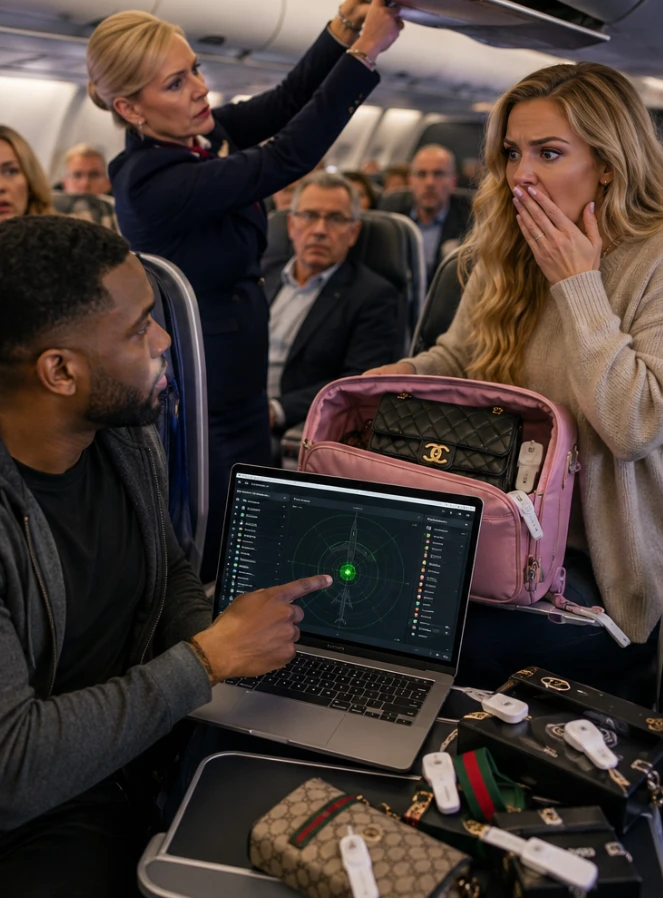
I rotated the laptop.
A red marker pulsed on a rough cabin diagram.
“The signal is above us.”
Chloe shook her head.
“No.”
“Approximately three feet from the receiver.”
“That doesn’t make sense.”
“It’s inside the overhead compartment.”
“No.”
“In your pink suitcase.”
Her face lost its color.
The woman across the aisle covered her mouth.
Arthur’s eyes narrowed.
Brenda looked at Chloe.
“Ma’am, did you put the clutch in your luggage?”
“No. Absolutely not.”
“Then we need to check.”
“You can’t open my suitcase.”
“You accused another passenger of theft,” Arthur said. “In front of fifty thousand people.”
Chloe glared at him.
“Stay out of this.”
Arthur folded his newspaper carefully.
“I believe we passed that point some time ago.”
Brenda reached up and opened the bin.
The pink suitcase was wedged behind a black garment bag.
She pulled it down and set it across the empty aisle seat.
“Please open it,” she told Chloe.
Chloe did not move.
Brenda’s voice softened.
“If the bag is not inside, we continue searching.”
“And if it is?” I asked.
Brenda looked at me but did not answer.
Chloe’s hand trembled as she unzipped the suitcase.
The lid opened.
The black Chanel clutch sat directly on top of a folded white blouse.
No one spoke.
The truth had arrived without drama.
It did not scream.
It simply existed.
Chloe stared down.
“That’s impossible.”
Brenda touched the clutch.
“Is this your bag?”
“Yes, but I didn’t put it there.”
“You took the suitcase down earlier,” I said.
Her head snapped toward me.
“I saw you.”
“You’re lying.”
“The man behind us may have seen it too.”
A middle-aged passenger in row three raised his hand slightly.
“She did take the case down,” he said. “I thought she was getting something.”
Chloe’s comments were now moving too fast to read.
Her audience had turned.
Did she plant it?
She framed him.
Call the police on her.
This is disgusting.
Chloe looked at the screen, and for the first time since the confrontation began, her fear was real.
“It was a mistake,” she said. “I must have put it there without thinking.”
“You accused me of a felony.”
“I panicked.”
“You pointed fifty thousand people at me.”
“I said I was scared.”
“You said I stole it.”
Brenda’s face had changed. Shame, worry, and self-protection moved across it in quick succession.
“Mr.—”
“Carter.”
“Mr. Carter, I’m sorry this happened.”
“You threatened to have me arrested.”
“I was following procedure.”
“No,” Arthur said quietly. “You were following an accusation.”
Brenda flinched.
Chloe began closing the suitcase.
“Wait,” I said.
She froze.
My screen showed other signals near the AirTag.
Several retail security tags were transmitting low-frequency identification pings. Most anti-theft tags were passive and required a scanner, but newer inventory devices sometimes included active tracking components for stock monitoring.
I enlarged the data.
Four identifiers.
All registered to the same merchant profile.
Gucci Duty Free, Terminal E.
“Brenda,” I said, “don’t let her close that case.”
Chloe pulled the lid down.
Arthur stood.
He was taller than I expected.
“Leave it open.”
“You have no right,” Chloe snapped.
“Perhaps not,” he said. “But I suspect the authorities will.”
I pointed to the lower section of the suitcase.
“Those items beneath the clutch have active retail tags.”
Brenda lifted a folded sweater.
Underneath were four silk scarves, a leather wallet, and a heavy gold necklace. White security blocks remained attached to each item.
Chloe’s mouth opened.
No words came.
“My scanner identifies the tags as inventory from the Gucci boutique in Terminal E,” I said. “They were never deactivated.”
Chloe’s phone slipped slightly.
The ring light tilted toward the ceiling.
“I bought those.”
“Then you have a receipt.”
“It’s digital.”
“Show us.”
“My phone is livestreaming.”
“End the livestream.”
She looked at the viewer count.
Seventy-three thousand.
The number seemed to hold her hostage.
“If you bought them,” I said, “show the receipt.”
“I don’t have to prove anything to you.”
The irony was so complete that a few passengers laughed.
Chloe’s face twisted.
“You think this is funny?”
“No,” I said. “I think it’s familiar.”
Brenda contacted the captain.
The captain contacted ground security.
The cabin filled with whispers.
Chloe finally ended the livestream, but the damage had already escaped her control. Clips were being recorded, reposted, and shared while we were still in the air.
I closed Lantern.
My hands were shaking.
Not from fear now.
From the force of everything I had held inside.
Arthur studied me.
“You handled that well.”
“I shouldn’t have had to.”
“No,” he said. “You shouldn’t.”
For the first time, his certainty seemed to leave him.
He looked suddenly older.
PART FOUR — THE NAME I KNEW
The remaining three hours of the flight passed beneath a strange cloud of tension.
Chloe sat rigidly beside me until Brenda moved her to an empty seat in the rear of First Class. Her suitcase was secured in the galley at the captain’s instruction. Two flight attendants documented the items inside.
I stayed in 2A.
I could not work.
The terminal window on my laptop had become meaningless.
My phone, however, would not stop vibrating.
Messages from colleagues.
A text from my younger sister, Dana.
MARCUS, ARE YOU ON A PLANE RIGHT NOW?
Another.
YOUR FACE IS EVERYWHERE.
I turned the phone off.
The woman across the aisle introduced herself as Evelyn Brooks, a retired school principal from Tacoma.
“I’m sorry,” she said.
“For what?”
“For watching so long before I said anything.”
“You didn’t accuse me.”
“No. I just sat there while someone else did.”
Her honesty surprised me.
She folded her hands over the paperback.
“When I was a principal, I used to tell teachers that silence could become agreement if you let it sit too long. Apparently, I needed to hear my own advice.”
I nodded.
“Thank you for saying that.”
Arthur remained quiet until Brenda dimmed the cabin lights.
Then he turned around.
“Mr. Carter.”
“Marcus is fine.”
“Arthur Bell.”
We shook hands.
His grip was firm but hesitant.
“I know your firm,” he said.
“Many people do.”
“I know your name.”
That made me look at him.
“From where?”
He studied my face.
“Your father was Leon Carter.”
The engine noise seemed to deepen.
“How do you know my father?”
Arthur glanced toward the darkened window.
“Because I knew the man he worked for.”
“My father worked at a repair shop.”
“He did. Before that, he worked for Bell Automotive Systems.”
The name struck something buried in my memory.
Bell Automotive had been a major Chicago parts manufacturer. It closed nearly twenty years earlier after a pension scandal and a factory fire. Hundreds of workers lost their jobs and retirement savings.
My father had rarely spoken about it.
When I was a child, I remembered him coming home with soot on his jacket and blood on one knuckle. I remembered my mother crying at the kitchen table over a stack of bills. I remembered a newspaper headline he had folded and hidden in a drawer.
“You own Bell Automotive?” I asked.
“My family did.”
“Your name was on the company.”
“Yes.”
I looked at the Rolex on his wrist.
“My father lost his pension because of that company.”
Arthur did not deny it.
“He did.”
Anger returned, but this time it was clean and sharp.
“You sat in front of me for four hours and said nothing.”
“I did not know who you were when we boarded.”
“But you knew once you heard my name.”
“Yes.”
“What happened to the pension money?”
Arthur’s jaw tightened.
“The official explanation was that the fund collapsed after the factory fire exposed years of financial mismanagement.”
“That is what my father was told.”
“It was not the truth.”
Evelyn had gone still across the aisle.
I lowered my voice.
“What was the truth?”
Arthur looked toward Chloe, seated several rows back.
“My brother diverted the pension fund.”
The words landed slowly.
“Your brother stole it.”
“Yes.”
“And your family covered it up.”
“My father did. The board did. I did.”
I felt the pulse in my neck.
“How much?”
“Forty-two million dollars.”
My father had worked until his hands became swollen and stiff because forty-two million dollars had disappeared into other people’s lives.
“Why are you telling me this?”
Arthur reached into his leather briefcase.
Brenda moved quickly toward us.
“Sir, please keep the aisle clear.”
Arthur removed a thin encrypted drive and placed it on my tray table.
“Because your father tried to expose it.”
I stared at the device.
“He found internal records proving the theft,” Arthur continued. “He copied them. Two weeks later, the factory burned.”
My mouth went dry.
“The fire was ruled electrical.”
“It was not.”
For several seconds, I could not breathe.
“My father was inside that night.”
“I know.”
“He survived.”
“Barely.”
“He told us a compressor exploded.”
“He was protecting you.”
I looked at the drive.
“What is this?”
“The original accounting archive. Board correspondence. Insurance records. Security logs. Everything.”
“Why do you have it?”
“Because I have spent eighteen years deciding whether cowardice becomes less shameful if a man regrets it long enough.”
“And?”
“It doesn’t.”
I wanted to throw the drive in his face.
I wanted to demand why he had kept it while my father died believing the truth had been buried.
Instead, I asked, “Why today?”
Arthur looked toward the rear cabin.
“Because Chloe Bell is my granddaughter.”
I turned.
Chloe sat beneath a reading light, her face hidden in her hands.
For a moment, the entire flight rearranged itself in my mind.
Her surname had never been mentioned.
“She’s your granddaughter?”
“Yes.”
“Did she know who I was?”
“I don’t know.”
“You expect me to believe that?”
“No. I expect you to verify everything.”
That answer sounded like guilt.
Or fear.
Perhaps both.
Arthur leaned closer.
“Chloe has been in financial trouble for months. She stole from the boutique. She created this spectacle to distract from what she had done. But I don’t believe choosing you was random.”
“Why?”
“Because three days ago, someone accessed sealed Bell Automotive records using credentials linked to her former assistant.”
“What records?”
“Your father’s personnel file.”
My skin went cold.
The accusation had not been spontaneous.
Chloe had selected me.
She had known my name before she took seat 2B.
PART FIVE — THE WITNESSES
When we landed in Seattle, airport police boarded before passengers were allowed to leave.
Two officers questioned Chloe. Another spoke with Brenda and the captain. Security representatives from the Gucci boutique confirmed that four items matching the tagged inventory had disappeared shortly before boarding.
Chloe began crying.
This time, there was no camera.
“I made a mistake,” she said.
One officer asked, “Which mistake?”
She looked at me.
The theft.
The false accusation.
The livestream.
Or whatever had happened before she boarded.
Her silence answered more than she intended.
I gave my statement.
Arthur gave his.
Evelyn gave hers.
So did six other passengers.
For once, the witnesses did not look away.
When the officers led Chloe toward the jet bridge, she stopped beside me.
“You ruined my life,” she whispered.
I almost laughed.
“You pointed a camera at me and told the world I was a criminal.”
“You don’t understand.”
“Then explain.”
Her eyes moved toward Arthur.
“He was going to cut me off.”
“For stealing?”
“For asking questions.”
“What questions?”
“About your father.”
Arthur’s face tightened.
Chloe lowered her voice.
“My mother died when I was twelve. Grandfather said it was an overdose. It wasn’t.”
“Chloe,” Arthur warned.
“She found the same records Leon found,” Chloe said. “She tried to expose the company. Two days later, she drove off a bridge.”
Arthur closed his eyes.
The officer took Chloe’s arm.
She pulled away.
“I knew who you were,” she told me. “I found your photo in Leon Carter’s personnel file.”
“Why frame me?”
“I needed your laptop searched.”
The words stunned me.
“What?”
“I knew you worked in cybersecurity. I knew you traveled with company equipment. If the police searched your devices, they would find the files I sent.”
Arthur went pale.
“What files?”
Chloe smiled through tears.
“The ones proving you ordered both deaths.”
The terminal noise seemed to disappear.
Arthur stepped forward.
“That is a lie.”
“Is it?”
He reached toward her.
The officers stopped him.
Chloe looked at me.
“Check your laptop.”
I remembered the inflight Wi-Fi.
The strange handshake request Lantern had blocked shortly before her accusation.
At the time, I had assumed it was a routine network scan.
I opened my MacBook.
A hidden encrypted partition had been mounted inside a temporary system directory. The files were professionally concealed, but not professionally enough.
There were photographs.
Emails.
Payment records.
A recorded call.
I played the audio.
Arthur’s younger voice filled the terminal.
“The mechanic copied the ledgers. Handle the factory tonight.”
Another voice asked, “And Margaret?”
A pause.
Then Arthur said, “She made her choice.”
Chloe’s mother.
Arthur did not move.
The airport police officers looked at him.
The old man who had spent the flight judging a crisis from behind the Wall Street Journal suddenly appeared smaller than everyone around him.
“You said your brother stole the pension money,” I said.
“He did.”
“But you ordered the fire.”
Arthur’s silence confessed.
“You gave me the drive because you knew Chloe had already planted the evidence,” I continued. “You wanted to control the story before I found it.”
“I was trying to make amends.”
“No. You were trying to choose which truth survived.”
His face collapsed.
For the first time, I saw not a powerful man or a remorseful witness, but someone who had lived so long inside privilege that he believed confession itself was a form of generosity.
Chloe laughed bitterly.
“There he is,” she said. “The man everyone trusts.”
I turned toward her.
“And you accused me of theft to expose him?”
“I needed the police involved before we landed. I needed your computer taken into evidence where he couldn’t reach it.”
“You could have come to me.”
“Would you have believed me?”
“You never gave me the chance.”
Her expression faltered.
“No,” she admitted.
“You used racism because you knew it would work.”
Tears filled her eyes.
“Yes.”
The honesty was more terrible than denial.
“You knew the flight attendant would suspect me. You knew your viewers would attack me. You knew the cabin would accept your fear as proof.”
“Yes.”
“And you did it anyway.”
“I was desperate.”
“My father was desperate when your family stole his pension. He didn’t frame an innocent person.”
She lowered her head.
There was no triumph in the moment.
Only damage spreading outward through generations.
Arthur was arrested in the terminal.
Chloe was also taken into custody for theft, false reporting, and evidence tampering. Her plan had exposed a killer, but it had not made her innocent. She had chosen me as collateral because she believed the world would help destroy me before anyone asked questions.
She had been right.
That was the part I could not forget.
Months later, federal prosecutors reopened the Bell Automotive case.
The recovered files proved that Arthur had authorized the factory fire to destroy pension records. My father had survived because a night custodian pulled him from the building moments before the roof collapsed. Margaret Bell—Chloe’s mother—had discovered the scheme years later and threatened to testify. Her death had been staged to look like an accident.
Arthur accepted a plea agreement only after prosecutors found one final piece of evidence.
A handwritten statement from my father.
It had been hidden inside the archived personnel file Chloe accessed.
The statement ended with a sentence I read so many times the paper nearly softened beneath my fingers:
If anything happens to me, tell my son Marcus that silence is not always armor. Sometimes it is the cage they hope you will build around yourself.
My father had changed his mind.
Or perhaps he had always understood more than he told me.
The passengers from Flight 428 became witnesses in more ways than one.
Evelyn testified before a federal grand jury.
Brenda resigned from the airline and later spoke publicly about racial bias in passenger complaints. I did not forgive her immediately. Forgiveness is not a switch. It is a road, and some roads take years.
Gucci recovered its merchandise.
Chloe’s online empire collapsed within forty-eight hours.
The final clip from her livestream had been viewed more than sixty million times. Not the accusation. Not the stolen bag.
The moment I turned my laptop and showed the signal pointing into her own suitcase.
People called it justice.
They called it karma.
They called it the perfect reversal.
But strangers on the internet like clean endings because they do not have to live inside them.
The truth was less satisfying.
Arthur had destroyed lives.
Chloe had exposed him by trying to destroy mine.
Brenda had nearly handed me to the police because accusation felt easier than doubt.
And I had survived because I happened to possess the right skills, the right software, and the discipline not to give them the reaction they expected.
What would have happened if I had been a teacher?
A mechanic?
A tired father traveling home?
What if I had not been able to prove my innocence before landing?
That question stayed with me.
One year after the flight, the Bell Automotive pension fund was restored through seized assets, insurance settlements, and a federal restitution order. Hundreds of former workers received payments they had stopped believing would ever come.
My mother received a check in my father’s name.
She held it at the kitchen table where they had once sorted overdue bills.
For a long time, she said nothing.
Then she touched the signature line.
“Your father used to say the truth was like an old engine,” she whispered. “You could neglect it. You could bury it under rust. But if one good mechanic got his hands on it, it might run again.”
I smiled.
“That sounds like him.”
She looked at me.
“Did you know the girl wrote to me?”
“Chloe?”
My mother nodded.
“What did she say?”
“She apologized.”
“Do you believe her?”
“I believe she is sorry now.”
“That isn’t the same thing.”
“No,” my mother said. “It isn’t.”
Chloe was sentenced to eighteen months in federal custody after cooperating in Arthur’s prosecution. Before sentencing, she sent me a letter.
I did not open it for six weeks.
When I finally did, there were no excuses.
She wrote that she had spent years learning how to turn emotion into currency. Fear brought attention. Outrage brought followers. Victimhood brought loyalty. She had believed the only way to defeat her grandfather was to create a story louder than his power.
She admitted she had chosen me because I was Black.
Because the accusation would be believed.
Because suspicion already existed in the minds of strangers, and she only needed to point it in my direction.
Her final paragraph read:
I told myself you would be cleared once they searched your computer. I told myself a few minutes of fear were worth exposing what he had done. I understand now that this is how people like my grandfather think. They decide someone else’s suffering is an acceptable price for their goal. I became him before I defeated him.
I folded the letter and placed it beside my father’s statement.
I never wrote back.
Some apologies deserve to be heard.
Not all of them deserve an answer.
Today, when people recognize me from the video, they usually say the same thing.
“You stayed so calm.”
They mean it as praise.
I understand that.
But calm should not be the price of innocence.
A man should not have to perform perfect restraint while someone builds a lie around him. He should not have to be exceptional to be believed. He should not need specialized software, professional authority, or fifty thousand witnesses to prove he belongs in the seat he paid for.
The world remembers the moment my laptop found four stolen items.
I remember something else.
I remember the woman across the aisle finally speaking.
I remember Arthur’s newspaper folding shut.
I remember passengers raising their hands to say what they had seen.
I remember the precise instant silence stopped serving the lie.
That was the real turning point.
Not the technology.
Not the AirTag.
Not the security tags.
The witnesses.
The people who decided, one by one, that watching was no longer enough.
At thirty thousand feet, Chloe tried to turn me into a villain because she believed the audience already knew how the story should end.
She was wrong.
The ending belonged to the evidence.
And for once, the truth did not whisper.
“`