PART ONE
The Man Who Never Looked Back
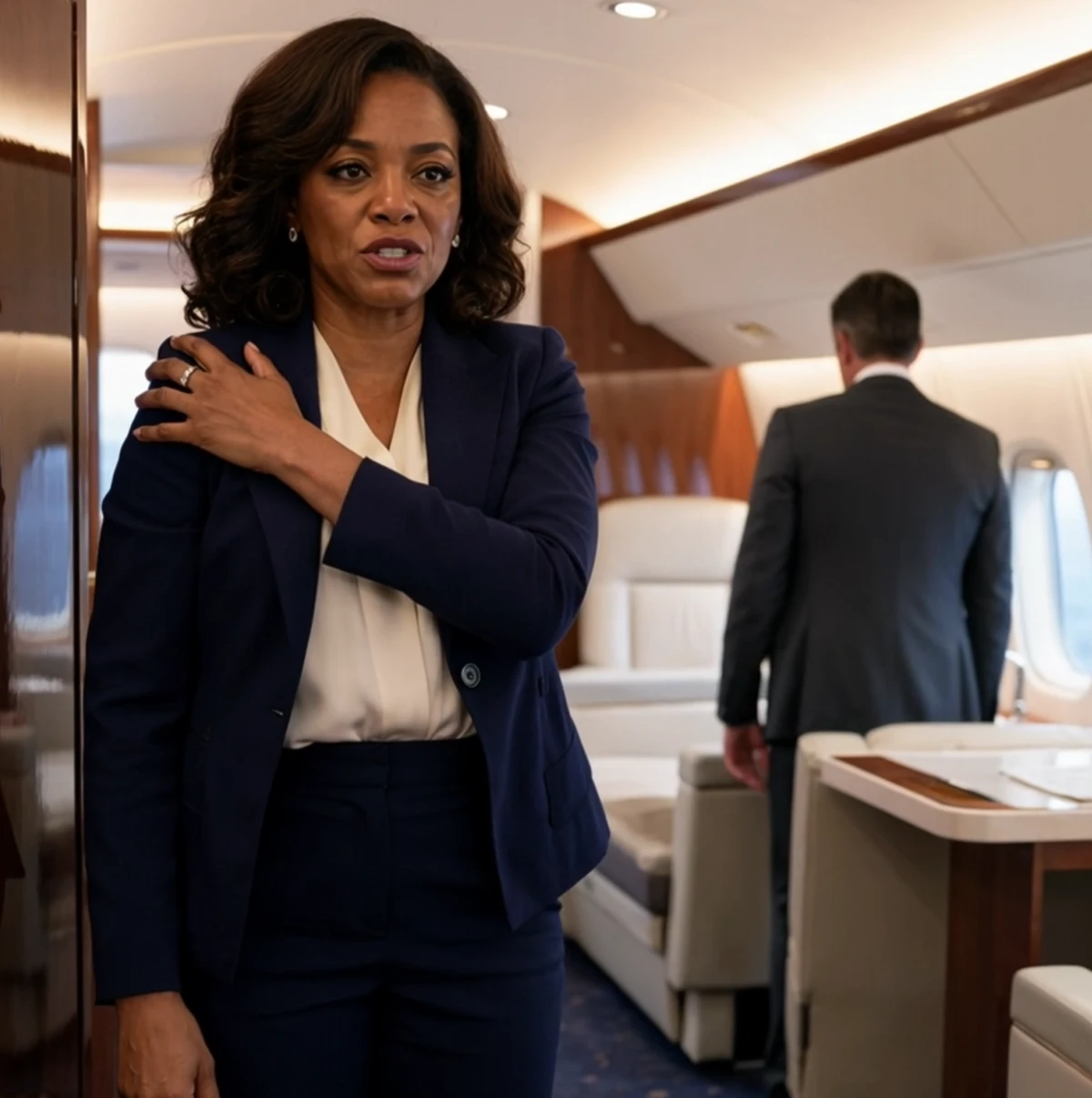
The first thing I heard after my shoulder struck the galley wall was not an apology.
It was the sound of Richard Vance snapping his fingers.
“Someone clean that up.”
For several seconds, I could not breathe.
Pain spread from my shoulder down my left arm, hot and electrical, while confidential documents lay scattered across the carpet of Flight 408’s First Class cabin. One page had landed beneath a passenger’s polished shoe. Another rested beside a half-empty champagne glass. A third had slid almost to the reinforced cockpit door.
Richard did not bend to help.
He stepped over the papers as if they were litter and continued toward seat 1C, still speaking into his phone.
“I don’t care what the board thinks,” he said. “By the time they understand what happened, the acquisition will already be complete.”
His voice carried through the cabin with the practiced authority of a man accustomed to being overheard.
I remained against the wall, one hand gripping the edge of the galley counter.
Thirty years earlier, I had begun my career beneath fluorescent lights in the baggage-claims office at LaGuardia Airport. I had spent eight-hour shifts listening to exhausted passengers describe missing suitcases, ruined weddings, lost medications, and family heirlooms that had vanished somewhere between terminals.
I had learned to remain calm while people shouted.
I had learned to listen when powerful men interrupted.
I had learned how often cruelty disguised itself as urgency.
But I had never learned how to stop humiliation from turning me into that twenty-three-year-old woman again.
The woman whose supervisor once told her she was “surprisingly articulate.”
The woman who brought ideas to meetings only to hear them repeated by someone else ten minutes later.
The woman who had been advised to smile more, speak less, and avoid appearing “too ambitious.”
Now, at fifty-two, I was the newly appointed chief executive officer of Vanguard Aviation, the parent company of Skyward Airlines.
Yet as passengers lowered their eyes and pretended not to notice me, none of that seemed to matter.
All they saw was a Black woman kneeling in the aisle, gathering papers after an important man had pushed her aside.
A shadow fell across the carpet.
Chloe Bennett, the lead flight attendant, crouched beside me. Her blond hair was drawn into a perfect bun, but a strand had loosened near her cheek.
“Ma’am,” she whispered, “please let me help.”
Her hands trembled as she collected the route reports.
“Did you see what happened?” I asked.
Her eyes flicked toward Richard.
“Yes.”
“He deliberately shoved me.”
“I know.”
“Then why are you asking me to sit down?”
Her face tightened.
“Because he’s Richard Vance.”
The name was supposed to explain everything.
In certain circles, it did.
Richard was the founder of Vance Meridian, an investment firm that had swallowed regional manufacturers, hotel chains, and transportation companies throughout the Midwest. Business magazines described him as ruthless, visionary, and uncompromising.
Employees used different words when they believed no one was listening.
Vindictive.
Explosive.
Dangerous.
Chloe lowered her voice further.
“He’s Diamond Elite,” she said. “He flies with us almost every week. Last year, he complained about a flight attendant who refused to serve him after landing. She was suspended before she got home.”
“And what happened after the investigation?”
“There wasn’t one.”
I looked at Chloe carefully.
“How long have you worked for Skyward?”
“Eleven years.”
“And you believe doing your job could cost you that career?”
Her lips parted, but no answer came.
Richard snapped his fingers again.
“Macallan,” he barked. “Double. No ice.”
Chloe flinched.
Something inside me became very still.
I reached toward the inside pocket of my blazer, where the titanium Vanguard Aviation Master Identification badge rested against the lining.
The badge was not ornamental.
It granted immediate access to corporate facilities, operational centers, secured aircraft areas, and executive systems. Fewer than twenty people in the entire company possessed one.
Mine had been issued three days earlier.
I was about to remove it when the cockpit door opened.
Captain Samuel Miller stepped into the cabin.
He was a broad-shouldered man in his early sixties, with silver hair at his temples and four gold stripes on each sleeve. I recognized him from personnel records. He had flown for Skyward for thirty-four years and had served as chief pilot of the western division before returning to regular routes.
His gaze moved across the scattered papers.
Then he saw me.
The color drained from his face.
“Ms. Carter?”
Richard stopped speaking into his phone.
Chloe froze beside me.
Every head in First Class turned.
Captain Miller stared at me as though he had discovered the president of the United States sitting beside the lavatory.
I rose slowly.
“My name is Naomi Carter,” I said.
Richard gave an irritated laugh.
“We know your name now. Congratulations.”
Captain Miller’s expression hardened.
He stepped forward.
“Sir, I suggest you be quiet.”
Richard lowered his phone.
“Excuse me?”
The captain did not look at him.
“Ms. Carter,” he said, “are you injured?”
“My shoulder took most of the impact.”
“Impact from what?”
The cabin became so silent that I could hear the soft hum of the ventilation system.
I looked at Chloe.
She stared down at the documents in her hands.
Then I looked at Richard.
He smiled.
It was not a nervous smile. It was the smile of a man who believed consequences were a language spoken only to other people.
“She stumbled,” he said. “I was boarding. She blocked the aisle.”
Captain Miller’s jaw tightened.
“Did you make physical contact with her?”
“People bump into each other on airplanes.”
“He drove his shoulder into her,” a voice said behind me.
Everyone turned.
The speaker was an elderly woman seated in 3A. She was perhaps seventy-five, with neatly curled gray hair and a soft green cardigan buttoned over a cream blouse. Beside her sat a thin man wearing wire-framed glasses and a brown sport coat.
The woman held Richard’s gaze.
“I watched him do it,” she said. “He saw her and shoved her anyway.”
Richard scoffed.
“You should mind your own business.”
The elderly man folded his newspaper.
“My wife made it her business when she witnessed an assault.”
Richard looked around the cabin.
“Is this really happening? I have a meeting in Los Angeles worth more than this entire plane.”
Captain Miller’s voice dropped.
“This aircraft is valued at eighty-seven million dollars.”
Richard smiled thinly.
“Then perhaps you should remember who pays for it.”
That sentence changed the atmosphere.
It revealed what Richard believed—not merely about the captain, or Chloe, or me, but about the world.
He believed money did not purchase services.
He believed it purchased people.
I removed the titanium badge from my blazer.
The metal caught the cabin light.
Chloe stared at the Vanguard crest engraved above my photograph. Her eyes widened as she read the title beneath my name.
Chief Executive Officer.
Her lips moved soundlessly.
Richard’s smile disappeared.
Captain Miller straightened.
“Ms. Carter,” he said formally, “how would you like me to proceed?”
I could have ordered Richard removed immediately.
The aircraft door was still open. Airport police were less than two minutes away. With one instruction, Richard Vance could have been escorted through the terminal in handcuffs while every passenger recorded the scene.
A younger version of me might have wanted that.
The wounded young woman from the mailroom certainly did.
But I had not boarded Flight 408 to avenge old humiliations.
I had boarded to understand why fear had become stronger than policy.
“Close the aircraft door on schedule,” I said.
Richard blinked.
Captain Miller looked uncertain.
“Ma’am?”
“We will depart.”
“You’re letting him remain aboard?” Chloe asked.
“For now.”
Richard regained some of his composure.
“Finally. Someone with common sense.”
I turned toward him.
“Do not mistake restraint for weakness, Mr. Vance.”
He stared at my badge.
“You’re the new CEO?”
“That information is not yet public.”
A flicker of calculation appeared in his eyes.
He looked down at the documents Chloe had gathered, then back at me.
His shock lasted only a moment.
Then he smiled again.
This smile was different.
Smaller.
Colder.
“I know exactly who you are,” he said.
The words unsettled me more than the assault.
The board had approved my appointment inside a secure Chicago conference room. Only seven directors, the general counsel, and two senior officers had attended.
The public announcement was not scheduled until Monday morning.
No passenger should have known.
Richard slipped his phone into his pocket.
“And you,” he continued softly, “have no idea what you just walked into.”
PART TWO
Thirty Thousand Feet Above the Truth
Flight 408 departed twenty-two minutes later.
Airport security had taken brief statements at the gate, but I had declined to press charges until we landed. Richard remained in seat 1C under the condition that he consume no alcohol and make no contact with me.
He laughed when Captain Miller delivered the warning.
“You’ll regret humiliating me,” Richard said.
Captain Miller leaned closer.
“No, sir. I believe you have confused humiliation with accountability.”
The aircraft climbed through a layer of gray clouds, and Manhattan disappeared beneath us.
My shoulder throbbed beneath a cold compress Chloe had brought. I sat in 2A, watching the country flatten into patterns of roads, fields, and rivers far below.
Richard sat one row ahead.
He had stopped making calls, but he typed continuously on his phone.
Every few minutes, he glanced back at me.
Chloe approached after the seat belt sign was turned off.
“May I speak with you privately?” she asked.
We moved into the forward galley.
Her face had lost its professional brightness.
“I need to apologize,” she said.
“You already did.”
“No. I apologized because I was frightened. I need to apologize because I asked you to accept something no passenger should ever be asked to accept.”
I studied her.
“What were you afraid would happen?”
She looked toward the cabin.
“Two years ago, Mr. Vance threw a glass at one of our attendants. It missed her face and shattered against the bulkhead. He claimed turbulence caused it.”
“Was there turbulence?”
“No.”
“Did anyone report him?”
“Three of us did.”
“And?”
“Customer Relations rewrote the incident as an accidental spill. The station manager told us Mr. Vance generated more than four hundred thousand dollars in annual premium revenue.”
I felt my anger sharpen.
“Who was the station manager?”
“Daniel Rourke.”
I knew the name.
Rourke was now vice president of guest loyalty and executive services, promoted six months earlier by outgoing CEO Preston Caldwell.
“Were the original reports preserved?”
Chloe hesitated.
“I kept a copy of mine.”
“Why?”
“Because the attendant he nearly hit was my younger sister.”
I looked at her again.
“She worked for Skyward?”
“For six months. After she complained, every trip became unbearable. Supervisors scrutinized her uniform, delayed her reimbursements, and scheduled her on reserve without explanation. She resigned.”
“What is her name?”
“Emma Bennett.”
The name stirred a memory.
I had reviewed a list of wrongful-termination settlements during my appointment process. Emma Bennett’s complaint had been classified as a voluntary separation involving “performance concerns.”
“Did she receive a settlement?”
Chloe gave a bitter laugh.
“She received a warning that fighting the airline would make it difficult to work anywhere else.”
I leaned against the galley counter.
My shadow audit had been intended to examine ordinary service failures—delayed assistance, inaccessible procedures, inconsistent policies.
This was not inconsistency.
It was corruption.
“Chloe,” I said, “why did you stay?”
Her eyes filled.
“My husband died four years ago. Pancreatic cancer. We had two daughters in college and medical bills that seemed to reproduce overnight. I needed the health insurance. I needed the flight benefits. I told myself I could survive anything if it kept my family safe.”
“There is no shame in surviving.”
“There is when survival turns you into someone who watches another woman get hurt and asks her to be quiet.”
I reached for her hand.
“You were trained by fear. That is not the same as choosing cruelty.”
Before she could respond, Richard appeared at the galley entrance.
“Touching,” he said.
Chloe stepped back.
“You are not permitted in this area, Mr. Vance.”
“I need to speak to Ms. Carter.”
“She doesn’t wish to speak with you.”
He ignored her.
“Naomi, we should discuss this privately.”
“You may address me as Ms. Carter.”
His mouth tightened.
“Very well. Ms. Carter, you need to understand the situation before you create a spectacle.”
“You assaulted me.”
“I brushed past you.”
“You threatened to have me removed.”
“I didn’t know who you were.”
“That is precisely the problem.”
He sighed as though I were exhausting him.
“Do you believe wealthy customers are treated differently? Of course they are. Every airline does it. Every hotel does it. Every bank does it. The world runs on value.”
“You are confusing value with wealth.”
“I’m explaining reality.”
“No, Mr. Vance. You are explaining the system that protected you.”
His eyes moved to Chloe.
“She will deny everything once she understands what is at stake.”
Chloe’s face paled.
I stepped between them.
“Return to your seat.”
“You’re making an enemy you cannot afford.”
“I have survived enemies with better manners.”
He leaned closer.
“Have you survived betrayal from your own board?”
The question landed with quiet force.
I said nothing.
Richard smiled.
“There it is. You don’t know.”
“Know what?”
“Why Caldwell chose you.”
“Preston Caldwell did not choose me. The board did.”
“He controlled the selection committee.”
“His preferred candidate was Martin Weller.”
“That is what you were told.”
The aircraft gave a slight shudder as it passed through uneven air.
Richard lowered his voice.
“You were not appointed to lead Vanguard. You were appointed to take the blame when it collapses.”
Chloe looked between us.
I kept my expression neutral.
“What collapse?”
“Ask your chief financial officer about the Pacific expansion. Ask why lease obligations were moved through shell companies. Ask why maintenance reserves are lower than the figures presented to regulators.”
“You expect me to believe you are concerned about corporate misconduct?”
“I expect you to understand that your appointment was announced to certain people before you entered that boardroom.”
“How did you learn about it?”
“Because Caldwell called me.”
I felt the floor beneath me change, though the aircraft remained level.
Preston Caldwell had served as chief executive of Vanguard Aviation for fourteen years. Publicly, he was retiring for health reasons. Privately, several directors believed he had become too closely aligned with creditors and institutional investors.
Richard Vance was one of those investors.
“How much of Vanguard’s debt does your firm control?” I asked.
“Enough.”
“To do what?”
“To decide who survives.”
He took a folded document from inside his jacket.
“Read this.”
I did not reach for it.
“What is it?”
“A term sheet. Vanguard defaults on a series of private covenants at midnight Sunday. Vance Meridian acquires the debt at a discount. By Tuesday, we control the restructuring.”
“That is impossible.”
“Is it?”
“The board would have been notified.”
“The board was notified.”
His gaze remained fixed on mine.
“Not every director believes you should succeed.”
I took the document.
The first page appeared legitimate. It referenced loan facilities, aircraft leases, and debt covenants tied to Vanguard’s liquidity ratio.
At the bottom was a signature.
Preston Caldwell.
My predecessor.
I read the figure twice.
Four hundred and eighty million dollars.
If authentic, the agreement gave Richard’s firm the ability to trigger a default, seize pledged assets, and force Vanguard into emergency restructuring.
Thousands of jobs would be at risk.
Routes serving small communities could disappear overnight.
Richard watched me absorb it.
“You see?” he said. “You thought this flight was an inspection. It is your final quiet afternoon before they place a burning company in your hands.”
“Why show me?”
“Because I’m willing to offer you a way out.”
There it was.
“What do you want?”
“On Monday, announce that unforeseen health concerns prevent you from accepting the position. Caldwell remains interim executive. The restructuring proceeds without resistance.”
“And in return?”
“Your reputation remains intact. You receive a generous consulting arrangement. Five million over three years.”
Chloe inhaled sharply.
I folded the term sheet.
“You shoved me into a wall and then tried to buy me.”
“I’m giving you a choice.”
“No. You are revealing how frightened you are.”
His eyebrows lifted.
“Of you?”
“Of anyone who cannot be purchased.”
He stared at me for a long moment.
Then he leaned near my ear.
“By the time this airplane lands, every major financial reporter in America will know Vanguard appointed an unqualified diversity candidate while hiding catastrophic debt.”
My fingers tightened around the paper.
Richard stepped back.
“You have five hours to reconsider.”
He returned to his seat.
Chloe whispered, “Is the company really in danger?”
I looked at Preston Caldwell’s signature.
“I don’t know.”
That was the first honest answer I had given since boarding.
And it terrified me.
PART THREE
The Passenger in 3A
I spent the next hour reviewing the documents Richard had given me.
They were detailed enough to be convincing.
Aircraft identification numbers matched Vanguard’s fleet. Subsidiary names were accurate. The debt facilities existed. Some pages contained internal accounting codes known only to senior finance personnel.
Yet something felt wrong.
Not obviously wrong.
Intentionally wrong.
The figures had the polished quality of a lie built from mostly true pieces.
I opened my laptop and attempted to connect to the aircraft’s secured executive network. The connection failed.
A message appeared:
ACCESS TEMPORARILY RESTRICTED.
I tried again.
The same message returned.
Someone had disabled my credentials after takeoff.
I looked toward Richard.
He was drinking sparkling water and reading a financial newspaper as if nothing unusual had happened.
The elderly woman from 3A rose and walked toward me.
“May I sit?” she asked, indicating the empty seat beside mine.
“Of course.”
She lowered herself carefully into 2B.
Up close, I noticed that her green cardigan had been mended at one cuff. Her hands were delicate but strong, the hands of someone who had spent a lifetime doing more than signing checks.
“My name is Eleanor,” she said.
“Naomi.”
“I know.”
She nodded toward the cold compress on my shoulder.
“How badly are you hurt?”
“I’ll be sore tomorrow.”
“Pain often waits until the crisis is over before demanding attention.”
Something about her voice comforted me.
“You spoke up when no one else did,” I said. “Thank you.”
“I am old enough to have learned that silence is rarely neutral.”
Her husband remained in 3B, apparently asleep behind his glasses.
Eleanor glanced at the documents on my tray table.
“That man is trying to frighten you.”
“He may have a legitimate reason.”
“Frightening people and telling the truth are not the same thing.”
“You heard our conversation?”
“Only pieces. My hearing is better than people assume.”
Despite myself, I smiled.
She studied my face.
“Do you believe the documents?”
“I believe some of the information is real.”
“That was not my question.”
I leaned back.
“My father repaired city buses in Cleveland. When I was a child, he taught me to listen to machinery. He said a bad engine did not always make the loudest noise. Sometimes the most dangerous problem was the quiet vibration beneath your feet.”
“And what do you feel now?”
“A vibration.”
“From the documents?”
“From the timing.”
I explained the hidden announcement, Caldwell’s signature, and the restricted network access. Eleanor listened without interrupting.
When I finished, she said, “What would you do if the company truly were collapsing?”
“Tell the truth.”
“To whom?”
“Employees first. Then regulators, passengers, and investors.”
“Even if the truth destroyed your career?”
“If the company is failing, protecting my title would be the least important concern.”
“And what if telling the truth destroyed the company?”
“Then we would distinguish between the company and the people who corrupted it.”
A small expression passed across her face.
Approval, perhaps.
“Why aviation?” she asked.
The question seemed unrelated, but I answered.
“When I was eleven, my mother took me to visit my aunt in California. It was my first flight. I remember looking through the window and realizing the country was larger than my fear. For six hours, every limitation I understood disappeared beneath the clouds.”
Eleanor smiled.
“That is a beautiful answer.”
“It is also impractical.”
“The best reasons usually are.”
She looked toward Chloe, who was serving lunch.
“Would you fire her?”
“No.”
“Even though she asked you to remain silent?”
“I would remove the people who taught her that silence was part of her job.”
Eleanor’s eyes glistened briefly.
Before I could ask why, Captain Miller emerged from the cockpit and motioned discreetly toward me.
I followed him into the galley.
“We have a problem,” he said.
“What kind?”
“Our dispatch center received an anonymous report that you stole confidential corporate documents and are attempting to transport them to a competitor.”
I stared at him.
“That is absurd.”
“I know.”
“Who made the report?”
“It was submitted through the ethics hotline using executive authentication.”
“Whose authentication?”
“Yours.”
A chill spread through me.
Richard was not merely threatening to discredit me.
He was constructing evidence.
Captain Miller continued.
“Corporate Security has instructed us to surrender your laptop, phone, and documents upon landing. They claim federal officers may meet the aircraft.”
“Who signed the instruction?”
“Daniel Rourke.”
The same executive who had buried Chloe’s assault complaint.
I looked toward the cabin.
Richard was watching us.
This time, he did not hide his smile.
Captain Miller lowered his voice.
“I can divert to Denver. We could request independent law enforcement.”
“No. That gives them control of the story before I understand the evidence.”
“What do you want me to do?”
“Maintain course.”
“Ms. Carter, if the company’s security officers board in Los Angeles—”
“They may discover that issuing false federal allegations against a corporate officer carries consequences.”
He hesitated.
“There’s something else.”
“What?”
“The report includes photographs of documents spread across the First Class aisle. The images were uploaded nine minutes after boarding.”
I remembered the passengers lowering their heads.
Someone had not looked away.
Someone had taken photographs.
“Can you identify the device?”
“No.”
I returned to my seat.
Eleanor was gone.
The term sheet remained on my tray table.
Beside it lay a small card I had not seen before.
There was no name.
Only a handwritten sentence:
Look at page seventeen. Then ask why an airline debt agreement mentions a maritime salvage company.
I opened the document.
Page seventeen listed collateral assigned through a subsidiary named Blue Meridian Recovery.
It sounded like an aviation asset firm.
It was not.
Years earlier, while overseeing international logistics, I had encountered Blue Meridian Recovery during an investigation involving decommissioned cargo vessels.
The company did not lease aircraft.
It salvaged ships.
The agreement was fraudulent.
Not entirely fraudulent—but altered.
Someone had inserted authentic Vanguard data into a contract belonging to another industry.
Richard had given me a forgery.
I looked toward seat 3A.
Eleanor was quietly reading a paperback novel.
Her husband remained beside her.
Who was she?
I opened the route report that had landed near the cockpit door. At the top right corner was a tiny black mark I had placed there before leaving Chicago.
The mark identified the documents as controlled audit copies.
They contained fictional route projections and altered asset numbers designed to reveal unauthorized access.
Only the board’s audit committee knew they were decoys.
Richard’s forged agreement used the altered numbers.
That meant someone had copied my shadow-audit documents before I boarded.
Someone with access to the boardroom.
I stood and approached Richard.
He looked up lazily.
“Changed your mind?”
“Where did you obtain the asset schedules used in this agreement?”
“From people who understand the company better than you.”
“Blue Meridian Recovery.”
For the first time, his confidence cracked.
Only slightly.
But I saw it.
“What about it?”
“It salvages ships.”
Richard said nothing.
“The aircraft values in your agreement came from decoy reports prepared for an internal security test. Anyone using those numbers has identified himself as part of the breach.”
His expression hardened.
“You’re bluffing.”
“Your problem, Mr. Vance, is that you have spent too many years surrounded by people who were afraid to tell you when you were wrong.”
I leaned closer.
“Your second problem is that the cabin has been recording audio since Captain Miller opened the cockpit door.”
Richard’s face changed.
The claim was only partly true. Cockpit-area security systems recorded sound near the door, but not every conversation in the cabin.
He did not know that.
He stood abruptly.
“You cannot record private business discussions.”
Captain Miller’s voice came over the intercom.
“Mr. Vance, return to your seat immediately.”
Richard looked around.
Passengers were watching now.
Not looking down.
Watching.
The elderly man in 3B folded his newspaper again.
Chloe stood at the far end of the aisle, no longer trembling.
Richard sat.
But his right hand disappeared briefly inside his jacket.
When it emerged, it was empty.
A moment later, a faint smell reached me.
Burning plastic.
Smoke curled from beneath his seat.
“Chloe!” I shouted.
She rushed forward.
Richard had placed his phone inside an airsickness bag and poured water over it after apparently damaging the battery with a metal object. The device hissed and smoked.
He was trying to destroy evidence.
Chloe reached for the containment bag used for overheated electronic devices.
Richard grabbed her wrist.
“Leave it!”
She froze.
Then something extraordinary happened.
Chloe looked at his hand.
She looked at me.
And the frightened woman who had asked me to sit down disappeared.
“Take your hand off me,” she said.
Richard tightened his grip.
“You work for me.”
“No,” Chloe replied. “That was the lie.”
She twisted free, secured the smoking phone, and handed it to another attendant.
Passengers began applauding.
Not loudly.
Not theatrically.
It started with the elderly woman in 3A.
Then her husband.
Then the man in row four.
Within seconds, the entire First Class cabin was applauding Chloe Bennett for performing the simplest act of dignity imaginable.
She had said no.
Richard looked around at the passengers.
For the first time in his life, perhaps, he understood that the room no longer belonged to him.
But the final battle was still waiting in Los Angeles.
PART FOUR
The Arrest That Was Meant for Me
Flight 408 landed at Los Angeles International Airport shortly after four in the afternoon.
As we taxied toward the gate, Captain Miller instructed passengers to remain seated.
Through the window, I saw three black vehicles parked beside the jet bridge. Uniformed airport police stood near the terminal entrance. Four men in dark suits waited with Daniel Rourke.
Rourke was younger than I expected, perhaps forty-five, with carefully styled hair and the smooth expression of a man who had built a career by making unpleasant decisions sound procedural.
Beside him stood Preston Caldwell.
My predecessor.
He had not mentioned traveling to Los Angeles.
The jet bridge connected.
The cabin door opened.
Rourke boarded first.
His eyes moved directly to me.
“Naomi Carter,” he announced, “you are required to surrender all Vanguard property and accompany Corporate Security for questioning.”
Passengers began murmuring.
Richard leaned back in his seat, his confidence returning.
Preston Caldwell boarded behind Rourke.
He looked tired. His famous silver hair was thinner than it appeared in photographs, and the skin beneath his eyes sagged.
“Naomi,” he said solemnly, “I’m deeply disappointed.”
I stood.
“Are you?”
“You were entrusted with sensitive information.”
“And someone copied it from the Chicago boardroom.”
“That accusation is beneath you.”
Richard rose.
“I witnessed Ms. Carter behaving erratically,” he said. “She threatened passengers and attempted to coerce airline employees.”
Chloe stepped into the aisle.
“That is false.”
Rourke glared at her.
“Ms. Bennett, return to your station.”
“No.”
He seemed almost amused.
“You are jeopardizing your employment.”
“Then my employment was never worth what I thought it was.”
The elderly woman in 3A smiled.
Rourke turned back to me.
“Your devices.”
“No.”
One of the security officers stepped forward.
Captain Miller blocked him.
“This is my aircraft until every passenger has deplaned.”
Rourke’s expression sharpened.
“You are interfering with a corporate investigation.”
“I am protecting a passenger from an unauthorized seizure.”
Preston sighed.
“Samuel, don’t make this difficult.”
Captain Miller looked at him with open contempt.
“You made it difficult years ago.”
Something passed between them.
A history I did not understand.
Rourke produced a printed document.
“We have authorization from the acting chief executive.”
“Mr. Caldwell is no longer acting chief executive,” I said.
“My appointment takes effect Monday.”
Preston smiled faintly.
“Unless the board withdraws it before then.”
There it was.
The trap.
They intended to accuse me publicly, force an emergency board vote, and remove me before my authority became official.
Richard stepped into the aisle.
“Take the offer, Naomi. Resign quietly.”
I looked at Preston.
“Did you give him the audit reports?”
“Be careful.”
“Did you?”
Preston’s expression cooled.
“You were selected because the board needed reassurance. A fresh face. A symbolic transition. But Vanguard requires experienced leadership during restructuring.”
“A fresh face.”
“You know what I mean.”
“Yes,” I said. “I have heard it in many forms.”
Rourke motioned to the officers.
“Detain her.”
The elderly woman stood.
“No.”
She did not raise her voice.
She did not need to.
Everyone turned toward her.
Rourke frowned.
“Ma’am, remain seated.”
The elderly man beside her rose as well.
Eleanor removed her green cardigan and handed it to him. Beneath it, she wore a simple cream blouse and a small gold pin shaped like a pair of wings.
Preston Caldwell went completely still.
“Eleanor,” he whispered.
Richard looked confused.
I stared at her.
She stepped into the aisle.
“My full name,” she said, “is Eleanor Vanguard Hale.”
The name struck the cabin like thunder.
Vanguard Aviation had been founded sixty-eight years earlier by aviator Thomas Vanguard and his business partner, James Hale.
Eleanor was Thomas Vanguard’s only surviving child.
Her family trust owned a relatively small percentage of public shares, but the company’s original charter granted that trust a special voting right over any sale, merger, or forced restructuring.
A golden share.
One vote capable of stopping Richard’s entire plan.
Richard’s face drained.
“You’re Eleanor Hale?”
“I was when you told me to mind my own business.”
Her husband stepped beside her.
“And I am Judge Franklin Hale,” he said. “Retired, though not yet incapable of recognizing attempted evidence destruction.”
Rourke lowered his document.
Preston looked as if he had aged ten years in ten seconds.
Eleanor turned to me.
“The board did not finalize your permanent appointment three days ago.”
I felt the ground shift again.
“What?”
“You were appointed provisional chief executive pending one final review.”
Richard began to smile.
Eleanor continued.
“The review was this flight.”
His smile vanished.
I could only stare at her.
She explained calmly.
“For years, I received polished reports claiming Vanguard’s culture remained healthy. Yet employee complaints disappeared. Passenger incidents were rewritten. Executives protected profitable abusers. My trust demanded an independent leadership test before approving the new CEO.”
“You knew I would be aboard?”
“Yes.”
“Did you know Richard would be aboard?”
“No. That was either providence or the devil’s sense of humor.”
Franklin Hale almost smiled.
Eleanor looked toward Preston.
“We suspected someone was attempting to force a fraudulent restructuring. The altered audit documents were distributed through separate channels. Each copy contained different fictional numbers.”
I understood.
“The numbers in Richard’s agreement identify the source.”
“Precisely.”
She turned to Preston.
“Your copy, Preston.”
The former CEO’s face collapsed.
Rourke took a step backward.
Airport police moved closer.
Richard pointed at Preston.
“He told me the documents were legitimate!”
Preston spun toward him.
“You commissioned the forged agreement.”
“You promised the trust would approve the sale!”
“You said you controlled Eleanor!”
Eleanor’s eyes hardened.
“Men like you always assume an old woman can be controlled.”
Richard began speaking rapidly.
“This is a misunderstanding. Negotiations became aggressive, perhaps, but no crime occurred.”
Franklin Hale nodded toward the smoking-device containment bag.
“You attempted to destroy your phone in an aircraft cabin after offering a corporate officer five million dollars to resign.”
Richard looked at me.
“You recorded that?”
I did not answer.
He turned toward Chloe.
“You have no proof of anything.”
Chloe reached into her uniform pocket.
“I do.”
She removed a small digital recorder.
“My sister gave it to me after the airline erased her complaint,” she said. “I began carrying it on every flight you booked.”
Richard stared at the device.
Chloe’s voice shook, but she continued.
“I recorded you threatening Ms. Carter. I recorded your offer. I recorded you saying Mr. Caldwell informed you of her appointment.”
For eleven years, Chloe had survived by remaining quiet.
Yet she had also been collecting the truth.
Rourke moved toward the aircraft door.
Two airport police officers blocked him.
Preston gripped a seat back.
“Eleanor, think about what this will do to the company.”
She looked at him sadly.
“No, Preston. You think about what you already did.”
Richard lunged toward Chloe.
Captain Miller intercepted him before he took two steps.
The captain pushed Richard against the bulkhead—not violently, but firmly enough to end the threat.
“Careful,” Captain Miller said. “Important people are deplaning.”
No one laughed.
The words were too close to the cruelty that had begun the day.
Airport police placed Richard Vance in handcuffs.
Rourke followed.
Preston Caldwell was escorted from the aircraft for questioning.
Passengers remained seated in stunned silence.
I should have felt victorious.
Instead, I felt hollow.
I turned to Eleanor.
“You tested me without telling me.”
“Yes.”
“You allowed me to believe the company might collapse.”
“Yes.”
“You watched me get assaulted.”
Pain entered her face.
“I did not anticipate that. The moment it happened, I wanted to reveal myself.”
“Why didn’t you?”
“Because you asked the captain to continue the flight.”
“That does not justify—”
“No,” she said. “It does not.”
Her answer stopped me.
No excuses.
No claim that the outcome made the method acceptable.
“I am sorry,” she continued. “Powerful institutions often excuse cruelty by calling it necessary. I will not do that to you.”
I looked at the woman who possessed the vote that could decide my future.
“What happens now?”
“That depends.”
“On what?”
“On whether you still want the job.”
PART FIVE
The Name on the Other Side of the Badge
The public announcement was postponed for forty-eight hours.
Richard Vance was charged with assault, evidence tampering, and conspiracy related to the fraudulent restructuring documents. Investigators searching his phone and financial records uncovered payments to Daniel Rourke, hidden communications with Preston Caldwell, and a plan to close seventeen regional routes after acquiring Vanguard’s debt.
Those routes served communities that larger airlines had abandoned decades earlier.
Preston Caldwell resigned from every corporate board on which he served.
Rourke was terminated before sunset.
But those were not the consequences that mattered most to me.
On Sunday morning, I returned to Chicago and entered Vanguard’s boardroom alone.
The room looked different from three days earlier.
Then, it had seemed like the destination of my entire life—a polished table, city skyline, leather chairs, and the silent recognition that I had finally reached a place from which women like me had once been excluded.
Now it looked like what it truly was.
A room.
Nothing more.
Rooms did not create leadership.
Choices did.
The directors entered gradually. Eleanor and Franklin Hale arrived last.
A folder waited at my seat.
Across the cover were the words:
FINAL APPOINTMENT — CHIEF EXECUTIVE OFFICER
I did not open it.
Eleanor sat across from me.
“The trust has approved your appointment,” she said. “Unanimously.”
The directors applauded.
I remained seated.
When the room quieted, I pushed the folder away.
“I have conditions.”
A director named Martin Weller frowned.
“The contract has already been negotiated.”
“I am not discussing compensation.”
I placed a document of my own on the table.
“First, every employee complaint involving passenger misconduct will be reviewed by an independent office reporting directly to the board’s ethics committee.”
No one objected.
“Second, customer revenue status will no longer influence safety or misconduct investigations.”
Weller shifted in his chair.
“That could cost us premium accounts.”
“Then we will lose customers who believe a ticket includes permission to abuse employees.”
Eleanor nodded.
“Continue.”
“Third, every employee retaliated against for reporting Richard Vance or similar passengers will be contacted, compensated where appropriate, and offered reinstatement.”
I thought of Emma Bennett.
“Fourth, executive travel will include unannounced observation of actual passenger and employee conditions. No staged visits. No prepared stations.”
A few directors looked uncomfortable.
“Fifth, the Hale Trust’s leadership test ends with me.”
Eleanor’s expression changed.
I continued.
“No future candidate should be unknowingly placed in danger to prove character. Transparency cannot be built through deception.”
Silence filled the room.
Franklin Hale looked at his wife.
Eleanor lowered her eyes.
“You are right,” she said.
I opened the appointment folder.
Beneath the contract lay the titanium badge.
The same badge I had nearly used as a weapon of authority aboard Flight 408.
I picked it up.
“Titles reveal very little about character,” I said. “The question is not how someone treats a CEO when the badge is visible. The question is how they treat a woman kneeling on the floor when they believe she has no power.”
I signed the contract.
Three weeks later, I returned to Los Angeles.
Chloe and Emma Bennett were waiting in a small conference room near Skyward’s crew center.
Emma resembled her sister, though her hair was darker and her expression more guarded.
She had not worn a flight attendant uniform in nearly two years.
“I don’t want my job back,” she told me.
“You are not required to accept it.”
“I loved flying.”
“Then why not return?”
“Because every time I think about an aircraft cabin, I remember that glass breaking behind my head.”
Chloe reached for her hand.
Emma continued.
“They made me believe I was weak because I couldn’t forget.”
“You are not weak,” I said. “Your mind remembered danger after the company pretended there was none.”
She looked at me.
“What happens to the people who covered it up?”
“Some have been dismissed. Others are under investigation.”
“And the system?”
“That will take longer.”
She gave a sad smile.
“At least you’re honest.”
I offered her a different position: employee safety adviser within the new independent reporting office.
She stared at the description.
“You want me to investigate complaints?”
“I want you to help design a system that would have protected you.”
Tears filled her eyes.
“Why?”
“Because survivors often see failures that executives cannot.”
She accepted.
Chloe returned to flying but was promoted six months later to director of cabin safety and employee advocacy.
Captain Miller retired the following spring.
At his final ceremony, he refused a grand speech.
He simply looked across the crowded hangar and said, “An aircraft can survive bad weather. It cannot survive a crew too frightened to speak.”
Eleanor attended quietly in her green cardigan.
Richard Vance’s empire did not collapse overnight.
Real life rarely provides such clean endings.
His company fought the charges, blamed rogue employees, and hired public-relations experts to reshape the story. But creditors withdrew. Partners reconsidered. Former employees began speaking.
A single act of cruelty had not destroyed him.
It had merely opened the door.
Everything he had hidden walked through afterward.
Nearly one year after Flight 408, I was reviewing passenger-service reports when my assistant told me an unexpected visitor had arrived.
It was Eleanor.
She entered my office carrying the worn leather briefcase that had fallen open during the assault.
“I believe this belongs to you,” she said.
“I thought it was damaged.”
“It was.”
She placed it on my desk.
The torn stitching had been repaired. The leather had been cleaned but not replaced. Every scratch remained.
“My father repaired it,” I said softly.
Eleanor sat across from me.
“I know.”
I looked up.
She reached inside the briefcase and removed a yellowed envelope that I had never seen.
My name was written across the front.
Not in my father’s handwriting.
In my mother’s.
My hands began to tremble.
“Where did you find this?”
“Inside the lining. The impact on the aircraft tore an old seam. The repairman discovered a hidden pocket.”
My mother had died eleven years earlier.
I opened the envelope.
Inside was a letter dated thirty-two years ago, when I had just begun working at LaGuardia.
My mother wrote that she had hidden the letter because she lacked the courage to give it to me.
She described a summer in Cleveland before she married my father. She had worked briefly as a secretary for a small regional airline. During that time, she became involved with a young executive who promised to leave his fiancée.
He never did.
My breath caught as I reached the final paragraph.
The young executive’s name was Preston Caldwell.
I read it again.
Then a third time.
The room seemed to tilt.
Eleanor watched me quietly.
“Preston was my father?”
“Biologically,” she said. “Yes.”
I stood and walked toward the window.
Chicago spread beneath me, bright and indifferent.
All my life, I had believed my father was the patient man who repaired buses, packed my lunches, attended every school performance, and taught me to hear the quiet vibration beneath a failing machine.
And he was my father.
A letter could not erase that.
But Preston Caldwell—the man who had tried to make me the scapegoat for his corruption—had known who I was.
The appointment had not merely been a corporate trap.
It had been personal.
“He knew,” I whispered.
“We believe he discovered the truth when your background investigation began. Your mother had once listed him as an emergency contact on an employment form. He recognized her name.”
“He pushed for my appointment because he thought he could control me.”
“Or destroy you before you discovered the connection.”
I turned toward Eleanor.
“Did the board know?”
“No.”
“Did you?”
“Not until yesterday.”
I looked at the letter.
The final twist was not that Preston Caldwell had denied me an inheritance or hidden some grand family fortune.
It was far more painful.
He had looked across a boardroom table at his own daughter and seen only a convenient shield.
He had spent his life measuring human beings by usefulness.
Even blood had no value unless it served him.
“What will you do?” Eleanor asked.
I folded the letter carefully.
“Nothing publicly.”
She seemed surprised.
“He is facing criminal charges. This could—”
“I will not let him turn my mother’s shame into a spectacle. And I will not give him the honor of being called my father.”
I placed the letter inside the repaired briefcase.
“My father’s name was Isaiah Carter. He fixed buses. He sang badly in church. He worked overtime to pay for my college applications. He taught me that a machine tells the truth if you are willing to listen.”
Eleanor smiled through tears.
“Then you know who you are.”
“Yes.”
For the first time since Flight 408, I felt the last piece of the story settle into place.
Richard Vance had shoved me because he believed I was unimportant.
Preston Caldwell had promoted me because he believed I was disposable.
Both men made the same mistake.
They believed power came from standing above other people.
They never understood that real power is revealed when someone has every opportunity to become cruel—and chooses not to.
I kept the worn briefcase.
I carried it to every board meeting, every labor negotiation, and every airport inspection.
The scratches remained visible.
So did the repaired seam.
Years later, young employees sometimes asked why the chief executive of a global aviation company carried something so old.
I always gave them the same answer.
“It reminds me to look down.”
They usually appeared confused.
Then I explained.
“Because when everyone in the room is staring at the most powerful person, someone else may be on the floor gathering the papers.”
And that person, ignored and underestimated, may be the one who changes everything.